

If I set up an FSA the right way, I can cut payroll tax costs, lower taxable wages, offer tax-free reimbursements, deduct employer contributions, and use the plan as a simple tax-planning tool.
Here’s the short version: these tax results usually depend on a written Section 125 cafeteria plan, correct payroll coding, valid employee elections, and proper claim records. For Illinois employers, most of the tax treatment comes from federal law, and it often flows through to Illinois wage reporting too.
At a glance, the article covers these 5 tax benefits:
- Payroll tax savings on employee pre-tax FSA contributions, often at 7.65% for employer FICA
- Lower taxable wages, which can also affect FUTA and Illinois unemployment wage exposure
- Tax-free reimbursements for qualified medical and dependent care expenses
- Business tax deductions for employer-funded FSA amounts
- Better tax planning for small businesses that want to balance pay and benefits
A quick example: if one employee puts $2,400 into a health FSA through salary reduction, the employer may save about $184 in FICA taxes. If 12 employees each elect $2,500, the employer FICA savings can reach about $2,295, before wage-base limits and other payroll factors.
Quick comparison
| Tax benefit | How it helps the employer | What it depends on |
|---|---|---|
| Payroll tax savings | Cuts employer FICA on pre-tax salary reductions | Section 125 setup and correct payroll treatment |
| Lower taxable wages | Shrinks wage-based tax calculations | Valid employee elections and plan compliance |
| Tax-free reimbursements | Keeps qualified payouts out of taxable wages | Eligible expenses and claim substantiation |
| Deductible employer contributions | Lets employer-funded amounts count as business deductions | Proper plan terms and tax treatment |
| Small-business tax planning | Gives more control over benefits and payroll costs | Annual limits, testing, and clean administration |
In plain English, the article shows that an FSA is not just a perk for employees. When I handle the paperwork and payroll correctly, it can also trim employer tax costs in a few clear ways.
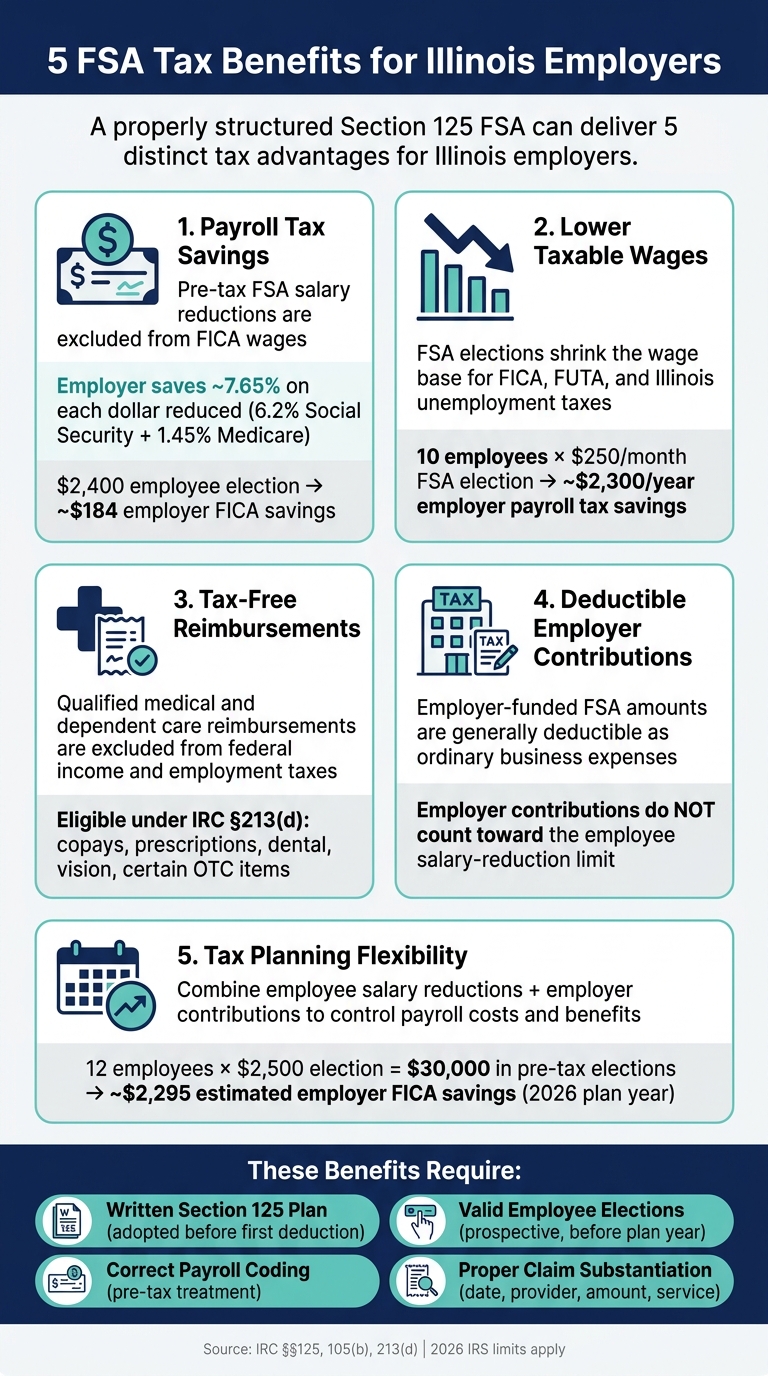
5 FSA Tax Benefits for Illinois Employers: At-a-Glance Guide
How Does An FSA Work For Small Business Health Insurance? - Health Insurance Experts Guide
Compare group health plans for your Illinois business. Our local, licensed agents shop the top carriers and send you side by side quotes at no cost.
Get Group Quotes
How FSA Tax Treatment Works for Illinois Employers
FSA tax savings mostly come from federal Section 125 rules, not from an Illinois-only program. In Illinois, those federal exclusions usually flow through to Illinois wage reporting. That can lower state income tax wages and trim Illinois unemployment taxes tied to IDES wage exposure. With that setup, the tax effects break into five clear categories.
Employee Salary Reduction vs. Employer Contributions
FSAs can be funded in two ways, and the tax result is not the same.
With employee salary reductions, the employee chooses to redirect part of future compensation into the FSA before it becomes cash pay. Since that money is redirected before the employee receives it as wages, it is generally excluded from federal gross income. It is also usually not subject to Social Security and Medicare taxes, or FICA, and federal unemployment tax, or FUTA. That exclusion is what creates the payroll tax savings discussed in the next section.
Direct employer contributions work differently. They are funded without cutting employee wages, so they do not produce the same payroll tax savings as salary reductions. Employers should track each funding source on its own in both the plan document and the payroll system.
Federal Rules Drive Most FSA Tax Treatment
Illinois does not offer a separate FSA tax incentive. For Illinois employers, the day-to-day result is simpler than it sounds: if compensation is excluded at the federal level, it will generally reduce wages reported for Illinois income tax and IDES unemployment purposes too. Employers should check how their payroll system handles state reporting with their payroll provider or tax adviser. That federal structure is why the first tax savings usually show up in payroll taxes and taxable wages.
Plan Documents and Payroll Compliance
This tax treatment does not apply by default. A written Section 125 cafeteria plan must be in place before the first deduction is taken, and the IRS does not permit retroactive adoption. In plain English, you can’t set up the paperwork after the fact and expect the tax result to stick.
Elections must be collected before the plan year starts or before an employee becomes eligible. Reimbursements also need records that show:
- the date
- the service
- the patient
- the amount
Once the plan is set up the right way, the tax savings depend on how payroll and reimbursements are processed.
1. Payroll Tax Savings From Pre-Tax Contributions
Once the plan is set up, the first dollars you save usually show up in payroll taxes. When employees make pre-tax FSA salary reductions through a Section 125 plan, those amounts are left out of FICA wages. That means the employer pays less in payroll tax at the standard 7.65% rate. For Illinois employers, this comes from federal tax rules, but it still hits the business in a very practical way: lower FICA starts with lower taxable payroll. This is a direct payroll tax savings, not a credit or deduction.
Here’s what that looks like in plain English. The standard employer FICA rate is generally 7.65%:
- 6.2% for Social Security
- 1.45% for Medicare
So if an employee earning $50,000 per year elects $2,400 for a health FSA, payroll will generally treat $47,600 - not $50,000 - as wages for FICA purposes. The estimated employer savings on that one election comes to about $184 ($2,400 × 7.65%).
There is one key limit. You get the full savings only while the employee’s wages are below the Social Security wage base. Once wages go past that line, the Social Security piece no longer applies to added earnings, though the Medicare portion will usually still apply.
It also helps to be clear about where the savings comes from. This tax break is tied to employee salary reductions, not separate employer contributions.
To make this work, payroll has to code FSA deductions the right way, and the business needs a written Section 125 plan in place before the first deduction. That’s the step that turns an FSA from a simple payroll withholding into a tax-saving setup.
2. Lower Taxable Wages and Related Payroll Costs
The FICA savings are only part of the story. When employees make pre-tax FSA elections through a proper Section 125 plan, those elections also cut the taxable wage base used for other payroll calculations. Put simply: payroll taxes are figured on the lower wage amount.
Here’s what that looks like in practice. If an employee earning $60,000 elects $2,000 into a health FSA, their taxable wages drop to $58,000. For Illinois small businesses, that change can add up fast across a team. If 10 employees each defer $250 per month through a qualifying Section 125 plan, the employer may save about $2,300 per year in payroll taxes. It may also change Illinois unemployment tax exposure through payroll reporting.
That said, the exact savings will vary. It depends on employee election amounts, wage caps, and whether the plan stays in line with Section 125 rules.
Lower taxable wages also reduce federal income tax withholding. But from the employer’s side, the main tax savings come from FICA and FUTA. And this only works if the plan is handled the right way. The plan document must be in place before the first payroll deduction. Employee elections must be valid. Payroll also has to be coded the right way for Section 125 pre-tax treatment.
Miss one of those steps, and the tax treatment can fall apart. If the plan document is missing or the timing is off, the deductions become taxable wages.
That lower wage base sets up the next tax break: tax-free reimbursements.
3. Tax-Free Reimbursements for Qualified Expenses
Once pre-tax contributions reduce taxable wages, reimbursements for qualified expenses can also stay tax-free if the plan is handled the right way. In most cases, a valid health FSA reimbursement is tax-free under Sections 125 and 105(b). That means it doesn’t add to federal income tax or employment taxes, and it doesn’t show up as extra taxable wages.
Eligible expenses usually follow IRC Section 213(d) and IRS Publication 502. In plain English, that often includes:
- Deductibles and copays
- Prescription drugs
- Dental and vision care
- Certain medical devices
- Some over-the-counter medicines and menstrual-care products
On the flip side, ordinary vitamins, general wellness costs, and expenses that were already reimbursed don’t qualify.
There’s also a timing and paperwork piece. The expense must be incurred during the coverage period, and it needs independent documentation that shows the provider or merchant, the date, the item or service, and the amount. A credit card receipt by itself usually isn’t enough.
Employees also can’t use the same expense twice. If an expense is reimbursed through the FSA, it can’t also be claimed as an itemized medical deduction. That’s why employers should spell this out clearly in enrollment materials.
4. Deductible Employer Contributions and Plan Funding
Employer-funded FSA contributions are often deductible as ordinary business expenses when the plan is set up and run under Section 125. This is a different tax angle from the payroll tax savings tied to employee elections. Here, the tax break comes from employer funding itself. For Illinois employers, federal rules set the basic treatment, but it’s still smart to check the deduction’s category and timing with a tax adviser.
One detail trips people up: a deduction lowers taxable income. It does not cut your tax bill dollar for dollar. The actual tax effect depends on your tax rate, how much the employer puts in, and whether the plan follows the rules.
A lot of Illinois employers use a mixed setup. They give a fixed employer contribution and also let employees make salary reductions, up to plan limits. That approach can work well because employer-funded amounts do not count toward the employee’s salary-reduction limit. In plain English, the company piece and the employee piece are treated differently for limit purposes.
That said, the details matter. The plan needs to stay nondiscriminatory and match the written terms. If it doesn’t, the intended tax treatment can be questioned. Illinois employers should also have their payroll provider or tax professional confirm how Illinois wage reporting and withholding apply to the exact plan design being used.
For many Illinois small businesses, that setup gives them more room to shape benefits and taxes at the same time.
5. Section 125 FSAs as a Tax Planning Tool for Illinois Small Businesses
A Section 125 cafeteria plan gives Illinois small businesses a federal tax setup that can trim payroll costs while helping employers keep pay and benefits competitive. For small businesses in Illinois, that makes FSA elections more than a benefit. It turns them into a payroll planning tool.
Here’s a simple example for the 2026 plan year. Say 12 employees each choose $2,500 in health FSA salary reductions. That adds up to $30,000 in total elections, which stays well below the 2026 individual limit of $3,400 per employee. With the employer FICA rate at 7.65%, the estimated employer FICA savings would be about $2,295 for the year before wage-base limits and other payroll taxes come into play.
Illinois employers can also lower wages subject to IDES unemployment insurance taxes when those salary reductions are handled through Section 125.
Small businesses can also combine employee salary reductions with a fixed employer contribution. That gives employers room to line up plan design with budget and benefit goals without making the setup overly complicated. The next table shows employee funding and employer funding side by side.
The tax result depends on doing the basics right:
- Adopt the plan before the first pre-tax payroll run
- Complete annual nondiscrimination testing
- Code payroll correctly
If any of that slips, the tax treatment can change fast. The next section compares employee and employer funding side by side.
FSA Funding Methods and Tax Treatment: Side-by-Side Comparison
Those five tax perks hinge on how the FSA is funded. In Illinois, employers can fund an FSA through employee salary reductions, employer contributions, or a mix of both. The tax outcome turns on the funding source and how payroll codes the amounts. For Illinois employers, federal tax treatment usually carries over into state wage reporting as well.
Employers can use both methods at the same time, as long as total employee salary reductions stay within the annual health FSA limit. Here’s how each method changes the tax picture and the compliance rules tied to it.
Employee Funding vs. Employer Funding Table
| Funding Method | Reduces FICA Wages? | Taxable Wage Effect | Qualified Reimbursements Generally Tax-Free to Employees? | Key Compliance Conditions |
|---|---|---|---|---|
| Employee salary-reduction funding | Generally yes. The elected amount generally reduces FICA wages under a compliant Section 125 plan. | Generally lowers federal income-tax wages and FICA wages, which cuts the employer’s FICA liability on the elected amount. | Generally yes, when reimbursements cover eligible expenses under the plan. | Written Section 125 plan; valid prospective election; 2026 health FSA salary-reduction limit of $3,400; eligible-expense substantiation; nondiscrimination compliance. |
| Direct employer funding | No salary reduction. The contribution is generally not employee wage income under a compliant plan. | Generally does not reduce the employee’s salary. The contribution is generally excluded from taxable wages if the plan permits it. | Generally yes, provided reimbursements meet eligibility and substantiation rules. | Written plan must authorize the contribution and spell out eligibility, amounts, and reimbursement procedures; nondiscrimination rules apply; employer-funded amounts must not be misclassified as employee salary reductions. |
Track employee and employer funding separately in payroll to avoid reporting mistakes. These tax results only hold if the plan stays within annual limits and follows the plan rules, which matter next.
Limits and Compliance Notes to Keep in Mind
Once you pick a funding method, the next job is staying within the annual caps and compliance rules. These tax perks don’t run on autopilot. They depend on annual limits and Section 125 rules being followed, which is what protects the payroll tax savings and tax-free treatment noted above.
Annual Limits and Eligible Expense Rules
For the 2026 plan year, the health FSA salary-reduction limit is $3,400 per employee, up from $3,300 in 2025. If an employee elects more than the allowed amount, that excess can miss Section 125 treatment and become taxable.
That’s why employers should update payroll settings and open enrollment materials before each new plan year. A small setup miss can turn into a tax problem later.
Reimbursements also need proper substantiation before any money goes out. If documentation is missing, the tax exclusion can be lost.
Nondiscrimination Testing, Carryovers, and Reporting
Section 125 plans have to pass annual nondiscrimination testing. The point is simple: the plan can’t lean too heavily toward highly compensated or key employees. If the plan fails, those affected employees lose the tax exclusion. For Illinois small businesses, this matters even more when owners or family members are on payroll, so it makes sense to run the test before year-end.
Carryover rules need care too. Employers must pick one design:
- A carryover of up to $680 for unused 2026 health FSA funds
- Or a grace period of up to 2½ months after the plan year ends
A health FSA can use either a carryover or a grace period, not both. Put the choice in the plan document and in employee materials so there’s no confusion.
On the payroll side, salary reductions need to be coded the right way. It also helps to reconcile payroll with the FSA administrator’s election and reimbursement reports on a regular basis. Keep Illinois withholding in line with the federal tax code.
Conclusion
Put simply, these five tax benefits can make FSAs a solid fit for many Illinois employers. They can help cut payroll taxes, reduce taxable wages, allow tax-free reimbursements, support deductible employer contributions, and give employers another way to plan under Section 125.
That said, the tax savings only apply when the plan is set up and handled the right way. The plan needs a written cafeteria plan document, and elections, reimbursements, and amendments need to be handled the same way every time.
Before making changes to an FSA, Illinois employers should check current limits, plan terms, and payroll treatment with a qualified adviser. Plan design, payroll setup, and tax treatment all need to line up.
If you’re weighing benefit options, Illinois Health Agents can help Illinois businesses review FSA-friendly coverage choices. For Illinois employers, the goal is simple: line up the FSA design with payroll rules, tax rules, and the written plan.
FAQs
Do I need a Section 125 plan first?
Yes. To offer an FSA, you need a written Section 125 cafeteria plan in place before you take any pre-tax deductions.
If that plan isn’t in place, the IRS may treat those deductions as taxable wages during an audit. That can lead to tax liability for both the employer and employees.
One more thing: a cafeteria plan can’t be adopted retroactively.
How much could my business save in payroll taxes?
With an FSA offered through a Section 125 cafeteria plan, your business can save 7.65% in employer FICA taxes on every pre-tax employee contribution.
Here’s what that looks like in plain English: if 10 employees each contribute $250 per month, your business could save about $2,300 per year in payroll taxes. That’s money you get to keep just by setting up the plan the right way.
Pre-tax contributions may also reduce your Illinois unemployment wage base, which can lower payroll costs even more.
There’s one catch: to claim these tax savings, you need a written cafeteria plan in place before payroll deductions start.
What mistakes make FSA amounts taxable?
FSA amounts can turn taxable if the employer doesn’t put a written cafeteria plan document in place before the first pre-tax payroll deduction. If that step is missed, the IRS may treat those deductions as taxable wages for both the employer and the employee.
Tax problems can also show up when reimbursements go beyond qualified medical expenses or when records aren’t kept in good order.
Recent Comments