
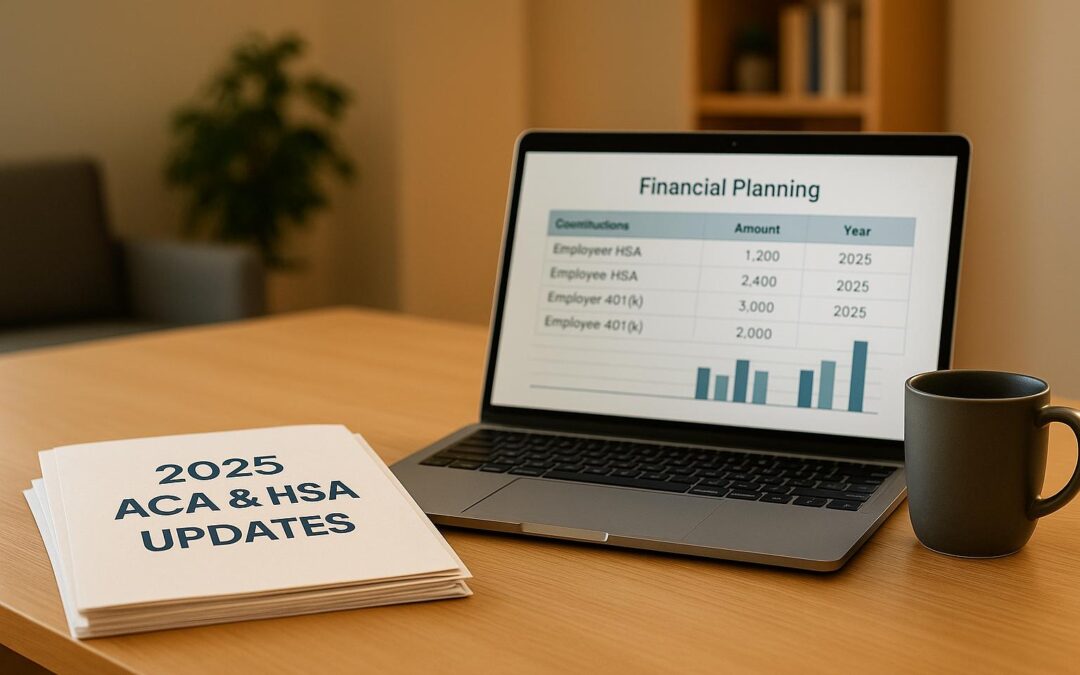
Illinois employers setting up 2026 benefits need to get both the ACA rules and the HSA rules right. The numbers that matter most this year:
- ACA Affordability Threshold: 9.96% of household income for plan years beginning in 2026, up from 9.02% in 2025. Under the federal poverty line safe harbor, a calendar-year 2026 plan is affordable if the employee’s self-only contribution is no more than $129.89 per month.
- HSA Contribution Limits: $4,400 for self-only coverage and $8,750 for family coverage. Account holders 55 and older can add $1,000.
- HDHP Requirements: Minimum deductibles are $1,700 (self-only) and $3,400 (family), with out-of-pocket caps of $8,500 and $17,000.
Large employers that get affordability wrong face 2026 employer shared responsibility payments of $3,340 or $5,010 per full-time employee. The practical answer is to set premium contributions with a safe harbor, keep HSA contributions comparable (or run them through a cafeteria plan), and explain the plan clearly to employees. If your plan renews in January 2027, note that the affordability percentage rises again to 10.22%.
HSA and HDHP Limits: Video Overview (Recorded With 2025 Figures)
2026 HSA Contribution Limits and Eligibility Rules
The HSA limits and eligibility rules shape how much Illinois employers can put into employee accounts and which plans qualify. The limits are set each year by the IRS, and a 2025 federal budget law changed several eligibility rules starting in 2026. The video above uses 2025 figures, so use the numbers below for 2026 planning.
2026 HSA Contribution Limits
The IRS raised HSA limits for 2026, and it has already published the 2027 limits for employers planning next year’s contributions. The $1,000 catch-up for account holders 55 and older is set by statute and does not change with inflation. These limits cover employer and employee contributions combined.
| Coverage Type | 2025 Limit | 2026 Limit | 2027 Limit |
|---|---|---|---|
| Self-Only Coverage | $4,300 | $4,400 | $4,500 |
| Family Coverage | $8,550 | $8,750 | $9,000 |
| Catch-up (Age 55+) | $1,000 | $1,000 | $1,000 |
HSA Eligibility Requirements
To contribute to an HSA in 2026, an employee generally must be covered by a qualified High Deductible Health Plan (HDHP). For 2026, an HDHP must have:
- Minimum Deductibles: $1,700 for self-only coverage and $3,400 for family coverage.
- Maximum Out-of-Pocket Limits: $8,500 for self-only coverage and $17,000 for family coverage.
Employees generally can’t contribute if they also have other health coverage that pays before the deductible, such as a traditional plan or a general-purpose health FSA. People enrolled in Medicare and people who can be claimed as a dependent on someone else’s tax return can’t contribute either. Three changes from the 2025 budget law (Public Law 119-21) matter for 2026:
- Telehealth: An HDHP can now cover telehealth and other remote care before the deductible without affecting HSA eligibility. This relief is permanent for plan years beginning on or after January 1, 2025.
- Direct primary care: Starting January 1, 2026, joining a qualifying direct primary care arrangement no longer disqualifies someone from an HSA, as long as total fees are no more than $150 per month for one person ($300 for an arrangement that covers more than one person). Members can also pay those fees from their HSA tax-free.
- Bronze and catastrophic plans: Starting in 2026, bronze and catastrophic plans available as individual coverage through an Exchange count as HSA-compatible even if they don’t meet the normal HDHP deductible and out-of-pocket rules. This applies to individual coverage, including plans bought with an ICHRA. It does not apply to small-group or SHOP plans, which still have to meet the standard HDHP test.
Mid-Year Eligibility Contributions
Employees who become HSA-eligible partway through the year generally get a prorated limit based on the number of months they are eligible. Eligibility is determined on the first day of each month. To prorate, divide the annual limit by 12 and multiply by the eligible months. For example, an employee with self-only coverage who becomes eligible on July 1, 2026 can contribute $2,200, which is half of the $4,400 annual limit.
The Last-Month Rule lets an employee who is HSA-eligible on December 1 contribute the full annual limit, even if they weren’t eligible all year. The catch is that they must stay eligible through a testing period that runs through December 31 of the following year. For example, someone who uses the rule for 2026 must remain eligible from December 1, 2026 through December 31, 2027 to avoid extra income tax and a penalty.
Employers should have a clear process for mid-year eligibility changes. That includes:
- Tracking which employees are HSA-eligible each month.
- Calculating prorated limits correctly.
- Explaining the Last-Month Rule and its testing period.
- Keeping employer and payroll contributions within IRS limits.
- Stopping payroll contributions when an employee says they have reached the limit.
ACA Employer Requirements and Affordability Rules for 2026
Illinois employers with 50 or more full-time employees, counting full-time equivalents, are Applicable Large Employers (ALEs) under the Affordable Care Act. An ALE must offer full-time employees and their dependents coverage that is affordable and provides minimum value, or it risks an employer shared responsibility payment. HSA strategy should be set with these rules in mind.
2026 ACA Affordability Threshold
For plan years beginning in 2026, coverage is affordable if the employee’s contribution for the lowest-cost self-only plan that provides minimum value is no more than 9.96% of household income. That is up from 9.02% in 2025. The plan must also provide minimum value, meaning it pays at least 60% of the total cost of covered services. For plan years beginning in 2027, the IRS has already set the percentage at 10.22%.
The 2026 penalty amounts are higher too. If an ALE fails to offer coverage to at least 95% of full-time employees and at least one full-time employee receives a premium tax credit, the payment is $3,340 per full-time employee per year, excluding the first 30 employees. If the ALE offers coverage but it is unaffordable or fails minimum value, the payment is $5,010 per year for each full-time employee who receives a premium tax credit through the Marketplace. The IRS has set the 2027 amounts at $3,780 and $5,670.
ALEs also report offers of coverage on Forms 1094-C and 1095-C. For 2025 coverage, Forms 1095-C were due to employees by March 2, 2026, and electronic filing with the IRS was due March 31, 2026. Plan for a similar schedule for 2026 coverage in early 2027, and confirm the exact dates once the IRS posts its 2026 instructions.
How HSA Contributions Affect Affordability
Employer HSA contributions do not reduce the employee’s premium share for the affordability test. Only the required premium contribution counts. HSA money still makes a high-deductible plan more attractive, because it helps employees cover the deductible. Illinois employers should set premium sharing first so the lowest-cost HDHP stays within the 9.96% limit, then decide how much HSA funding to add on top.
Next, let’s look at the safe harbor methods that make affordability easier to prove.
Safe Harbor Affordability Rules
Employers rarely know an employee’s household income, so the IRS offers three affordability safe harbors based on information employers do have. If you meet a safe harbor for an employee, the coverage counts as affordable for penalty purposes even if it would not be affordable based on that employee’s actual household income.
Federal Poverty Line Safe Harbor:
Coverage is affordable if the employee’s monthly contribution for the lowest-cost self-only plan does not exceed 9.96% of the federal poverty line for a single person, divided by 12. Employers may use any poverty guideline in effect within six months before the plan year starts. For a January 1, 2026 plan year, that is the 2025 guideline of $15,650 for the 48 contiguous states, which works out to $129.89 per month.
This is the simplest safe harbor because it gives you one fixed dollar amount for every employee. If at least one minimum value plan costs employees $129.89 per month or less for self-only coverage, you have met the affordability test for everyone offered that plan. Plans with later start dates may be able to use the 2026 guideline, which was published in January 2026.
Rate of Pay Safe Harbor:
The employee’s monthly contribution cannot exceed 9.96% of monthly salary, or for hourly employees, 9.96% of the hourly rate times 130 hours. For example, for an employee earning $20 per hour, the maximum monthly contribution would be $258.96.
Form W-2 Safe Harbor:
This method uses the employee’s Box 1 wages from the Form W-2 for the current year. The employee’s contribution for the year cannot exceed 9.96% of those wages. Because Box 1 wages aren’t final until year-end, employers usually handle this by setting contributions as a fixed percentage of pay, which makes it more work to run.
Employers can use different safe harbors for different reasonable groups of employees, as long as they apply one method consistently within each group. Businesses with many lower-wage employees often find the federal poverty line safe harbor easiest. Companies with higher-paid, salaried staff may prefer the rate of pay safe harbor because it allows higher contributions.
| Safe Harbor Method | 2026 Calculation | Best For |
|---|---|---|
| Federal Poverty Line | Maximum $129.89/month (calendar-year 2026 plans using the $15,650 guideline) | Simple compliance, especially for lower-wage workforces |
| Rate of Pay | 9.96% of monthly salary or (hourly rate × 130 hours) | Salaried or higher-wage employees |
| Form W-2 | 9.96% of current-year Box 1 wages | Stable workforce with predictable earnings |
Employer HSA Contribution Methods
Once the plan is ACA-compliant, the next decision is how to fund employee HSAs. For Illinois employers, the right method depends on your payroll setup, your budget, and what your employees need. The main compliance rule to keep in mind is comparability.
Types of Employer Contributions
Employers usually fund HSAs in one of three ways: lump sum, periodic deposits, or matching. Each works, but they carry different compliance rules.
- Lump-Sum Contributions: The simplest option. The employer deposits the full annual amount at the start of the plan year. Employees can use the money right away for early-year medical bills, and there are fewer payroll entries to manage. The downside is that an employee who leaves early keeps the full deposit, because HSA money belongs to the employee.
- Periodic Contributions: Contributions are spread over the year, usually per pay period or monthly. For example, an employer contributing $1,200 a year could deposit $100 each month. This helps employer cash flow and limits the cost for employees who leave mid-year.
- Matching Contributions: The employer matches what employees contribute, either dollar-for-dollar up to a cap or at a partial rate. Matching encourages employees to save, but it generally has to run through a Section 125 cafeteria plan.
Comparability rules: If you contribute to employee HSAs outside a cafeteria plan, you must make comparable contributions to all comparable participating employees. That means the same dollar amount or the same percentage of the deductible for employees with the same coverage tier and employment category (such as full-time or part-time). Contributions that aren’t comparable trigger a 35% excise tax on the employer’s HSA contributions. Contributions made through a cafeteria plan, including matching, are exempt from the comparability rules but must pass the Section 125 nondiscrimination tests.
Whatever method you choose, report employer HSA contributions, plus any employee pre-tax contributions through a cafeteria plan, on the employee’s Form W-2 in Box 12 using code W.
Contribution Strategy Guidelines
HSA contributions work best as part of your overall benefits plan, not as a separate add-on.
- Annual Budget Planning: Review contribution levels at each renewal. Look at employee participation, claims trends, premium increases, and what other local employers offer.
- Coordination with Premium Sharing: HSA contributions don’t count toward affordability, so set premium sharing first. For a calendar-year 2026 plan, that could mean keeping the lowest-cost HDHP at or below the $129.89 monthly federal poverty line safe harbor, then using HSA contributions to help with the higher deductible.
- Clear Communication: Tell employees how much they will receive and when. Put it in enrollment materials and the employee handbook, and let employees know when deposits post so they can plan their medical spending.
- Catch-Up Contribution Policies: Employees 55 and older can put in an extra $1,000. Decide in advance whether your match applies to catch-up contributions, and write that into the plan.
- Direct Primary Care and Telehealth: If you are thinking about offering direct primary care or first-dollar telehealth, the new rules make both easier to pair with an HSA. Check the details with your benefits advisor before changing the plan.
Employee Education Programs
An HSA program only helps if employees understand how to use it.
- HSA Basics Training: Many employees don’t know how HSAs work. Explain the triple tax advantage, the fact that unused money rolls over every year, and how an HSA differs from a flexible spending account.
- Investment Education: As balances grow, many HSA providers let employees invest part of their account. Show employees where to find those options and point them to the provider’s resources.
- Year-Round Resources: Keep the conversation going after open enrollment. Contribution calculators, short videos, group sessions, and one-on-one meetings all help employees stay engaged.
- Retirement Planning Integration: An HSA can also work as a retirement account. After 65, withdrawals for non-medical expenses no longer carry the 20% penalty, though they are taxed as income. Withdrawals for qualified medical expenses remain tax-free.
sbb-itb-a729c26
2026 HSA and HDHP Compliance Limits Table
Illinois employers need accurate 2026 numbers for plan design and employee materials. HSA and HDHP limits rose modestly for 2026, while the ACA out-of-pocket maximum rose sharply. The tables below compare 2026 to 2025.
| HSA and HDHP Requirements | 2026 | 2025 | Change |
|---|---|---|---|
| Annual HSA Contribution Limit (combined employer and employee) | Self-only: $4,400 Family: $8,750 |
Self-only: $4,300 Family: $8,550 |
Self-only: +$100 Family: +$200 |
| HSA Catch-Up Contribution (age 55 or older) | $1,000 | $1,000 | No change |
| Minimum Annual HDHP Deductible | Self-only: $1,700 Family: $3,400 |
Self-only: $1,650 Family: $3,300 |
Self-only: +$50 Family: +$100 |
| Maximum HDHP Out-of-Pocket Limit | Self-only: $8,500 Family: $17,000 |
Self-only: $8,300 Family: $16,600 |
Self-only: +$200 Family: +$400 |
| ACA Requirements | 2026 | 2025 | Change |
|---|---|---|---|
| ACA Maximum Out-of-Pocket Limit (all non-grandfathered plans) | Self-only: $10,600 Family: $21,200 |
Self-only: $9,200 Family: $18,400 |
Self-only: +$1,400 Family: +$2,800 |
The ACA out-of-pocket maximum for in-network essential health benefits is now well above the HDHP maximum. If you offer both a traditional plan and an HDHP, the HDHP limits ($8,500 self-only and $17,000 family) are the ones that decide whether the plan works with an HSA.
How to Use the Compliance Table
Use the table to check that your HDHP meets the 2026 deductible and out-of-pocket rules. For family coverage with an embedded individual deductible, that deductible must be at least $3,400, the family minimum.
All non-grandfathered plans also need an embedded individual out-of-pocket limit of no more than $10,600, even when the family limit is higher. This applies to HDHPs and traditional plans alike.
Update every plan document that shows these numbers to the 2026 limits, including summary plan descriptions, enrollment guides, and any online tools employees use to understand their benefits. If your plan renews in 2027, start from the 2027 figures noted above.
If you offer more than one plan, this table helps keep your options consistent. Aligning each plan with these limits keeps you compliant and your benefits competitive through 2026.
Illinois Health Agents Support for Employers
Keeping ACA and HSA rules straight takes time most Illinois employers don’t have. Illinois Health Agents helps businesses stay compliant and build benefits employees actually use.
Illinois Health Agents Services
Illinois Health Agents supports employers with ACA compliance questions and HSA-compatible plan design. The work doesn’t stop once a plan is placed. The agency provides ongoing guidance as rules and rates change.
"We’re here to help you compare the best choices from the highest-reviewed carriers. Services include employee education, contribution strategies, new hire processing, annual reviews, and tax-saving guidance." – Illinois Health Agents
Employee education is a big part of that support: explaining the 2026 HSA limits, the new eligibility rules for telehealth and direct primary care, and how employer contributions fit into total benefits. The team also helps employers design contribution strategies, including flat-dollar amounts, percentage-of-deductible contributions, or cafeteria plan matches, while keeping premium sharing within ACA affordability limits.
For businesses with frequent hiring and turnover, help with new hire and termination processing makes it easier to track HSA eligibility through the year, including mid-year changes.
Annual review meetings are a chance to look at your current strategy, review employee participation, and get recommendations for the next renewal. With the 2027 affordability percentage and HSA limits already published, this fall is a good time to plan.
Illinois Health Agents can also help with Section 125 plans, COBRA questions, and ACA reporting so employers have fewer vendors to manage.
Illinois Health Agents has built its reputation on practical, ongoing support rather than one-time sales. That service is backed by knowledge of the Illinois market, as described below.
Local Support for Illinois Businesses
Illinois Health Agents is an independent, licensed insurance agency. Because it isn’t tied to one carrier, it can recommend options that fit each business.
Local knowledge helps when Illinois insurance rules and carrier options overlap with federal ACA and IRS requirements. The agency works with small and midsize Illinois businesses to find group coverage that fits their size and budget.
Illinois Health Agents doesn’t take a one-size-fits-all approach. The team works with each employer to build group coverage that fits the company’s culture, budget, and employees.
HSA support includes help choosing HSA-compatible plans, setting up contributions, and teaching employees how to get the most from their accounts. That guidance matters more in 2026, with higher limits and new eligibility rules giving employees more ways to save.
Key Points for Employers
Your ACA compliance and HSA strategy should be planned together. If your business has 50 or more full-time employees, including full-time equivalents, you need to offer at least one minimum value plan that is affordable for self-only coverage.
For 2026, affordability is 9.96% of household income. Under the federal poverty line safe harbor, a calendar-year 2026 plan meets the test if the employee’s self-only contribution is no more than $129.89 per month. The percentage and the poverty guidelines change every year, and the percentage rises to 10.22% for 2027 plan years, so review your contribution levels at each renewal.
Pairing HDHPs with HSAs can give employees valuable tax savings while keeping employer costs predictable. Keep employer HSA contributions comparable, or run them through a cafeteria plan, and explain plan options, affordability, and contributions clearly so employees can make informed choices.
Expert help makes these rules easier to manage. Illinois Health Agents supports Illinois businesses with group health plans, ACA questions, and benefits planning, with practical solutions that keep your benefits program in line with current requirements.
Staying ahead of compliance and communicating clearly protects your business and helps your employees build long-term financial security.
FAQs
How can Illinois employers ensure their health plans comply with the 2026 ACA affordability requirements and avoid penalties?
2026 ACA Affordability Requirements for Illinois Employers
For plan years beginning in 2026, Illinois employers that are Applicable Large Employers need to keep the employee’s contribution for the lowest-cost self-only plan that provides minimum value at or below 9.96% of household income. Because employers don’t know household income, most use an IRS safe harbor. For a calendar-year 2026 plan, the federal poverty line safe harbor is $129.89 per month.
To avoid 2026 penalties of $3,340 or $5,010 per full-time employee, review your plans before each renewal. Confirm they meet the IRS standards for minimum value and affordability, and adjust employee contributions if needed. For plans renewing in 2027, the percentage rises to 10.22%, so a contribution that works today may not work next year.
What are the pros and cons of different ways employers can contribute to HSAs?
Each HSA funding method has trade-offs. Direct employer contributions are simple and tax-free to employees, but if they are made outside a cafeteria plan, they must be comparable for all employees in the same coverage tier and employment category. Matching contributions encourage employees to save, but they generally need to run through a Section 125 cafeteria plan and pass its nondiscrimination tests, and costs rise as participation grows.
For employees, HSAs offer real advantages: tax-free contributions, tax-free growth, and tax-free withdrawals for qualified medical expenses. The risk is that an employee who contributes little can face a large deductible with little money saved, especially early in the year.
In the end, employer-funded HSAs can be a valuable benefit that employees appreciate. They just need planning to fit your budget, meet the comparability or cafeteria plan rules, and meet employees’ needs.
What is the ‘Last Month Rule,’ and how does it impact HSA contributions for employees who become eligible later in the year?
The ‘Last-Month Rule’ lets an employee who is HSA-eligible on December 1 contribute the full annual limit for that year, even if they became eligible later in the year. For 2026, that means up to $4,400 for self-only coverage or $8,750 for family coverage, plus $1,000 for those 55 or older. It is especially useful for employees who move to a high-deductible health plan late in the year.
The catch: the employee must stay HSA-eligible for the whole testing period, which runs from December 1 through December 31 of the following year. If they lose eligibility for any reason other than death or disability, the contributions that were only allowed by the rule are added to their taxable income, plus an additional 10% tax. Employers and employees should both understand these rules before relying on them.
Recent Comments