

If you’re an Illinois employer offering group health insurance, the Consumer Coverage Disclosure Act (CCDA) requires you to provide employees with a written comparison of your health plan’s benefits versus Illinois’s essential health benefits. This applies to all employers with workers in Illinois, regardless of the type of health plan (including self-insured and ERISA plans).
Key Points:
- Who Must Comply: All Illinois employers offering group health insurance, no matter the size or location.
- What to Disclose: A written comparison of your health plan benefits against Illinois’s benchmark essential health benefits.
- When to Disclose:
- During new hire onboarding
- Annually (e.g., during open enrollment)
- Upon employee request (respond within 30 days)
- Penalties for Non-Compliance:
- Up to $500 for small employers (fewer than 4 employees) for the first offense.
- Up to $1,000 for larger employers for the first offense.
- Repeat offenses result in higher fines (up to $5,000).
Compliance Tips:
- Use resources from the Illinois Department of Labor (IDOL), like the model disclosure form and essential health benefits list.
- Keep records for at least one year to prove compliance.
- Work with your insurance broker to ensure your disclosures are accurate and complete.
Failing to comply can lead to fines, so it’s crucial to stay informed and organized. Including disclosures in onboarding and annual benefits materials helps streamline this process.
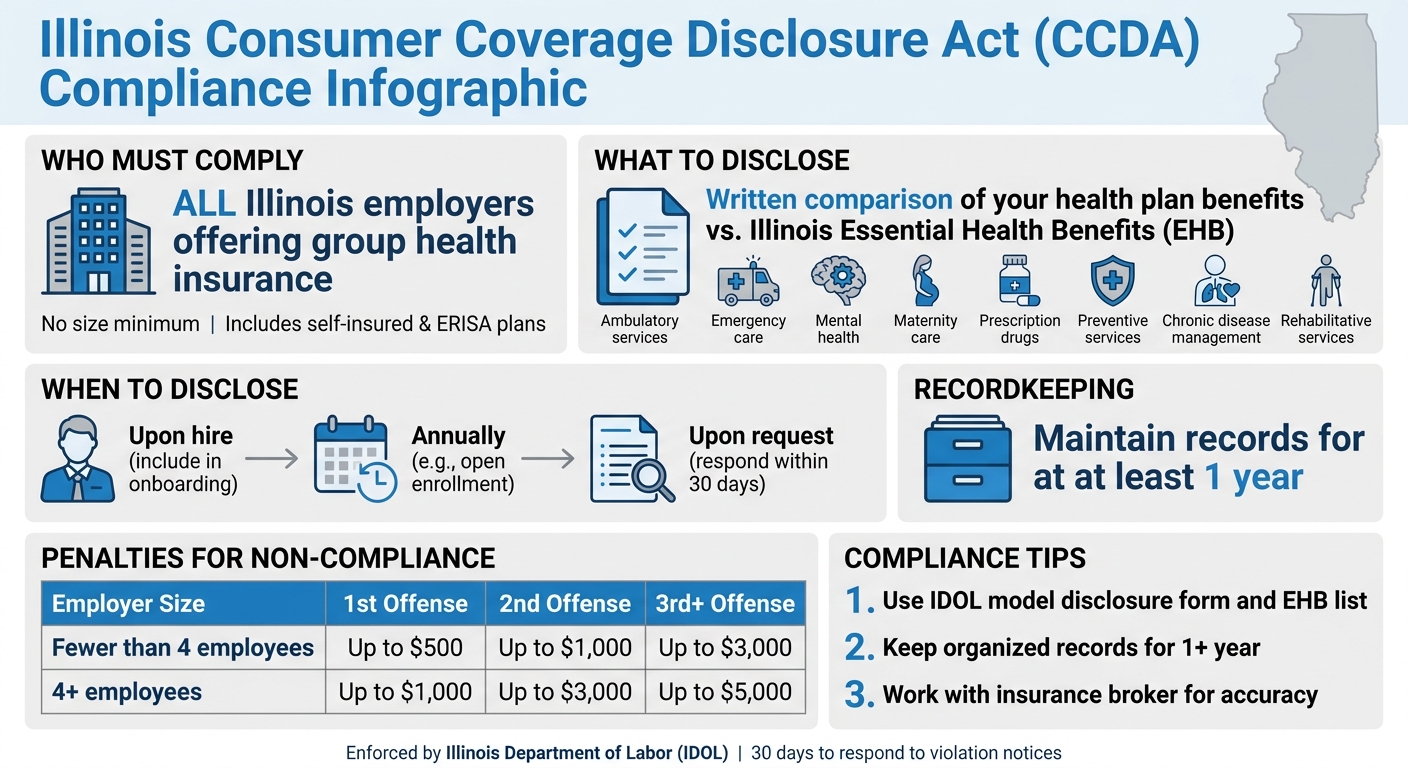
Illinois CCDA Compliance Requirements and Penalty Structure for Employers
What the CCDA Does and Who It Covers
Main Objectives of the Act
The Consumer Coverage Disclosure Act (CCDA) focuses on increasing transparency in group health insurance coverage. It requires employers to provide a written comparison of their group health insurance benefits versus Illinois’s state-regulated essential health benefits (EHBs). However, it does not dictate what specific coverage employers must offer. According to Marsh MMA, this comparison helps employees make informed decisions about whether to stick with their employer-provided plan or explore individual market options, such as those available through Get Covered Illinois.
This initiative allows employees to evaluate which option better suits their healthcare needs – whether it’s their employer’s plan or a marketplace alternative. It’s worth noting that the CCDA does not require employers to include specific benefits in their plans. Its role is purely to ensure employees are informed about the benefits provided.
Now that the Act’s purpose is clear, let’s look at which employers are required to comply.
Which Employers Must Comply
The Act applies broadly to any employer offering group health insurance in Illinois, with no exceptions based on size or location. There’s no minimum number of employees required for compliance. The term "employer" here covers a wide range of entities, including individuals, partnerships, corporations, associations, trusts, and other organizations with employees working in Illinois. It also includes public entities like the State of Illinois, state agencies, local government units, and school districts.
An "employee" under the Act is defined as anyone allowed to work by their employer. This means the disclosure requirement applies to all workers in Illinois, regardless of their role or employment type.
Since the CCDA focuses solely on notifying employees about benefits and does not impose specific coverage requirements, it applies universally to all employer-provided health plans, including self-insured or ERISA-governed plans.
sbb-itb-a729c26
What Employers Must Disclose
Information You Need to Provide
Employers must provide a written comparison of their plan’s covered benefits against the state’s essential health benefits (EHB). This includes areas like ambulatory services, emergency care, mental health and substance use treatment, maternity and newborn care, prescription drugs, preventive and wellness services, chronic disease management, and rehabilitative services.
If a benefit is covered but does not fully align with the state benchmark, label it as "Partial" and clearly explain any differences. To ensure accuracy, coordinate with your insurance carrier or broker to map your plan’s benefits to the Illinois EHB list.
When to Provide Disclosures
Disclosures must be provided at three key times: upon hiring a new employee, annually, or whenever an employee requests it. To streamline this process, consider aligning the annual disclosure with your company’s open enrollment period. For new hires, including the notice in their onboarding materials helps meet the "upon hire" requirement. If an employee requests the disclosure, it must be issued within 30 days, and records of these disclosures should be kept for at least one year. Make sure the delivery method complies with the established guidelines detailed below.
Acceptable Disclosure Formats
After determining when disclosures are needed, the next step is selecting an appropriate format. The Illinois Department of Labor offers a 2025 model form as a reference. While using this form is not mandatory, it can serve as a helpful guide to ensure compliance with the Consumer Coverage Disclosure Act (CCDA). The Department of Labor clarifies:
"You do not have to provide employees the specific form provided by the Department of Labor. However, your disclosure must comply with the requirements of the Consumer Coverage Disclosure Act, such as providing your employees clear information about which Essential Health Benefits your employer-provided group health insurance covers and which Essential Health Benefits are not covered."
Disclosures can be delivered in multiple ways, including email, posting on a regularly accessed website (like a company intranet or benefits portal), or providing a printed document. The statute explicitly allows electronic delivery, stating:
"An employer may comply with the requirements of subsection (a) by providing the required information by email to its employees or providing the information on a website that an employee is able to regularly access."
How to Stay Compliant
Employers in Illinois, including those with self-insured or ERISA-governed plans, must follow the rules outlined in the Consumer Coverage Disclosure Act (CCDA).
ERISA and Self-Insured Plans
There’s a common misconception that self-funded or ERISA plans are exempt from state-level disclosure requirements. However, the Illinois Department of Labor has made it clear: the CCDA applies to all Illinois employers because it focuses on notification requirements, not on the specifics of insurance coverage or benefit levels. As the Department explains:
"Because the Consumer Coverage Disclosure Act creates a benefits notification requirement for all Illinois employers, regardless of the type of insurance they provide, and does not mandate insurance provisions or otherwise have any direct impact on employer-provided group health insurance coverage, employers who provide self-insured plans and ERISA plans are subject to the provisions of the Act."
What does this mean for you? Whether your plan is fully insured or self-funded, the compliance steps remain the same. Work closely with your broker to compare your plan’s benefits against the Illinois essential health benefits list, especially when marking items as "Partial" coverage. Be sure to keep detailed records of all disclosures to employees.
Keeping Records and Documentation
The law requires employers to keep documentation for at least one year, showing when and how they provided the required disclosures to employees. This includes tracking delivery for three key moments: upon hire, annually, and upon request. Digital records, like email copies, signed acknowledgment forms, or logs from your benefits portal, can help you meet this requirement.
If the Illinois Department of Labor conducts an inspection, you’ll need to prove that all eligible employees received the necessary disclosures. To make this easier, include the CCDA disclosure in your new hire packets and annual open enrollment materials. For employee requests, respond within 30 days and keep records of both the request and your response. Solid recordkeeping not only supports compliance but also minimizes enforcement risks.
Penalties for Non-Compliance
The Illinois Department of Labor oversees CCDA enforcement through inspections and hearings. If violations occur, they’ll issue a "notice to show cause", giving you 30 days to address the issue before penalties are applied. Penalty amounts depend on your company’s size and the number of offenses:
| Employer Size | 1st Offense | 2nd Offense | 3rd or Subsequent Offense |
|---|---|---|---|
| Fewer than 4 employees | Up to $500 | Up to $1,000 | Up to $3,000 |
| 4 or more employees | Up to $1,000 | Up to $3,000 | Up to $5,000 |
When determining penalties, the Department takes into account your business size, the severity of the violation, and your compliance efforts. Showing that you’ve made a genuine effort – like maintaining organized records and responding promptly to notices – can make a big difference during enforcement proceedings.
Steps Illinois Employers Should Take
Now that you’re familiar with compliance requirements and the penalties involved, it’s time to take actionable steps to ensure your business is prepared.
Available Tools and Resources
Start by using the updated IDOL model disclosure form (the most recent version is available here). You can also download the List of Essential Health Benefits in either Excel or PDF format from the IDOL website. These resources make it easier to create your comparison chart. Additionally, the department’s CCDA webpage includes a helpful FAQ document that answers common questions from employers.
When filling out your disclosure, if your health plan covers a benefit but doesn’t fully match the Illinois Benchmark Plan, mark it as "Partial" and provide a brief explanation. Using the IDOL model form and downloadable tools from the Department of Labor streamlines the process of creating your required disclosure comparison.
If a violation is identified, you’ll receive a "notice to show cause", which gives you 30 days to correct the issue.
Working with Health Insurance Brokers
While the tools and resources provided by IDOL are helpful, working with a health insurance broker can make compliance much easier. Given the complexity of CCDA requirements, brokers and insurance carriers often assist by comparing your plan’s benefits to the Illinois Benchmark Plan. Many brokers even include preparation of the required disclosure chart as part of their standard services.
For example, Illinois Health Agents (https://ilhealthagents.com) specializes in helping Illinois employers navigate CCDA compliance while finding the right group health insurance solutions. Their team evaluates your current plan against the Essential Health Benefits list, prepares accurate disclosure forms, and ensures these documents are included in both new hire packets and annual open enrollment materials.
Here’s how their services break down:
- For businesses with 10 or fewer employees, the service costs $250 per year, but the fee is waived if 10 employees enroll.
- Larger employers receive these services at no cost.
In addition to compliance, they offer employee education, contribution strategy planning, and annual review meetings to keep your benefits program running smoothly. This kind of support can be invaluable for staying on top of evolving requirements while maintaining a competitive benefits package.
Conclusion
The Consumer Coverage Disclosure Act (CCDA) applies to all Illinois employers offering group health insurance, regardless of the company’s size or the type of plan. Employers must provide written disclosures to employees at the time of hire, annually, or upon request, while maintaining records for at least one year.
Failing to meet these requirements can lead to penalties. First offenses result in fines of $500 or $1,000, depending on the employer’s size. Repeat violations increase these fines to $3,000 or $5,000.
To help employers stay compliant, the Illinois Department of Labor provides tools like model disclosure forms and lists of essential health benefits. If a violation notice is issued, employers typically have 30 days to address the issue before penalties are enforced.
Partnering with a knowledgeable health insurance broker can make the compliance process much easier. For example, Illinois Health Agents (https://ilhealthagents.com) offers assistance by comparing plans to Illinois benchmarks, preparing accurate disclosures, and integrating them into hiring and enrollment materials. Their services are free for larger employers, while smaller businesses with 10 or fewer employees pay $250 annually – though this fee is waived if all 10 employees enroll.
Since the CCDA became effective in August 2021, the Illinois Department of Labor has actively enforced its rules. Including these disclosures in your hiring packets and open enrollment materials can help your business avoid costly fines and stay prepared for audits.
Taking the time to prepare ensures that compliance becomes a seamless part of managing employee benefits.
FAQs
Does the CCDA apply to ERISA or self-funded plans?
The Consumer Coverage Disclosure Act does not apply to ERISA or self-funded plans. These types of plans are generally regulated by federal law and are exempt from state-mandated disclosure requirements because of ERISA preemption.
How do I decide if a benefit is ‘Partial’ vs. covered?
Employers provide a benefit as ‘Partial’ when it’s available only to certain employees or under specific conditions. A benefit is considered ‘Covered’ if it’s included in the employer’s health plan and available to all eligible employees. Under the Illinois Consumer Coverage Disclosure Act, employers must clearly outline which benefits are fully covered and which are offered partially.
What proof should I keep if IDOL audits my CCDA disclosures?
Keeping thorough records of all employee disclosures is crucial. This includes maintaining copies of written notices, delivery records (such as signed acknowledgment forms or electronic receipts), and any related requests or responses. These documents play a key role in ensuring compliance and can be indispensable if you’re ever subject to an IDOL audit.
Recent Comments