
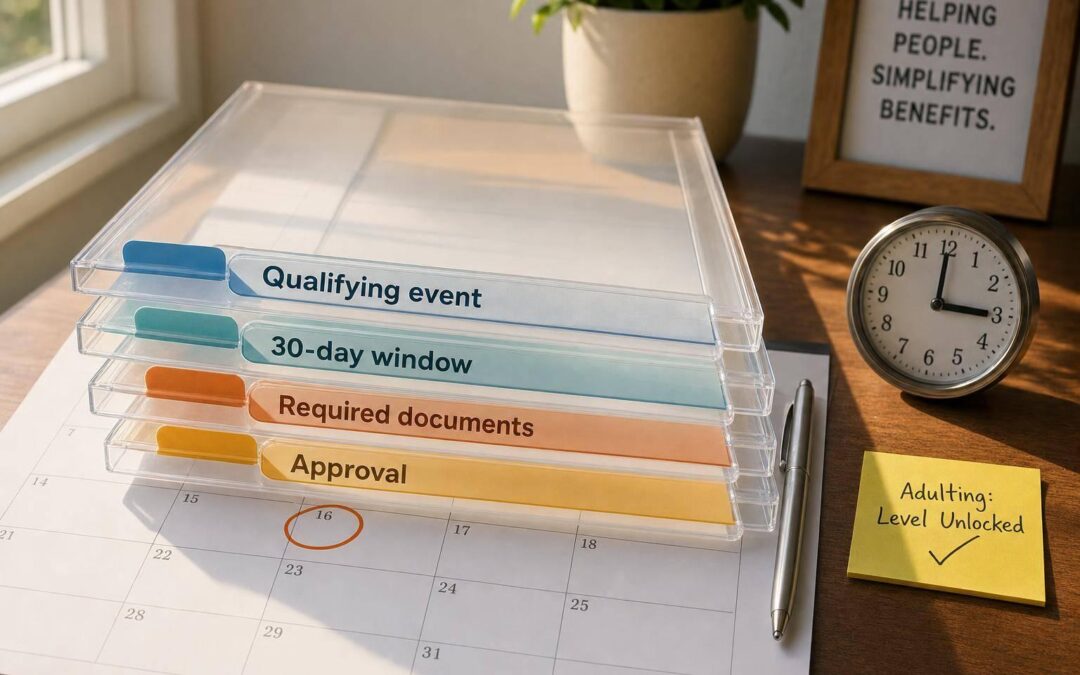
Miss the deadline by one day, and coverage may be delayed until open enrollment. That’s the core issue employers deal with when handling special enrollment requests.
If I boil this topic down, here’s what matters most:
- Most requests must be made within 30 days
- Medicaid/CHIP events get 60 days
- Birth, adoption, and placement for adoption usually start coverage on the event date
- Marriage and loss of other coverage usually start on the first day of the next month
- Bad notices and bad tracking are common compliance problems
- Illinois employers may have extra carrier and state-rule steps, especially with fully insured plans
In plain English: I’d treat special enrollment as a deadline-and-document process. The employer has to confirm the event, count the days the right way, set the right start date, update payroll and the carrier, and keep dated records. If any one of those steps goes wrong, claims can be denied and fixed later.
A few numbers show why this matters: 15.9% of reviewed group health plans had special enrollment violations, and 76% of those violations involved the required notice. So this is not just an HR form issue. It affects coverage, payroll, and compliance.
Quick comparison
| Event | Request window | Usual coverage start |
|---|---|---|
| Marriage | 30 days | First day of the next month |
| Loss of other coverage | 30 days | First day of the next month |
| Birth | 30 days | Date of birth |
| Adoption / placement for adoption | 30 days | Date of event |
| Medicaid/CHIP change | 60 days | First day of the next month |
If I were summarizing the article in one line, it would be this: employers need a simple, written process that applies the right event, deadline, documentation, and effective date every time.
The Legal Rules Employers Must Follow
Federal HIPAA and ACA Special Enrollment Requirements
Federal law gives employees and dependents 30 days to ask for special enrollment after most qualifying events. For Medicaid or CHIP premium-assistance events, that window extends to 60 days.
| Event Type | Request Window | Coverage Effective Date |
|---|---|---|
| Loss of coverage, marriage | 30 days | First day of the next calendar month after the plan receives the request |
| Birth, adoption, placement for adoption | 30 days | Date of the event if the request is timely |
| Medicaid/CHIP loss or new premium assistance | 60 days | First day of the next calendar month after the plan receives the request |
That timing matters. A request that comes in on day 31 instead of day 30 can change whether the employee gets into the plan right away or has to wait for open enrollment.
Illinois Rules That Add State-Level Requirements
For Illinois employers, the main issue is how state insurance rules fit with the plan’s written process. Illinois fully insured group plans may be subject to state-specific enrollment and continuation rules, so employers need to follow both the plan document and the carrier’s deadlines. Self-funded plans are usually governed by ERISA.
In plain English: the answer often depends on how the plan is funded. That’s why employers can’t rely on a one-size-fits-all rule.
Notice Duties and Plan Document Requirements
Federal rules require employers to give employees a notice of special enrollment rights at or before the time they are first offered the chance to enroll in the plan. The notice should spell out the qualifying events and the filing deadlines. Most employers include it in new-hire enrollment packets, SPDs, and online benefits portals.
A separate Medicaid/CHIP notice is also required for employers in states where employees may qualify for premium assistance, including Illinois. This notice must be sent annually and should include current state contact information.
These notices are not just paperwork sitting in a folder somewhere. The Department of Labor’s compliance history shows why they matter: in one review, 15.9% of plans had a special enrollment violation, 76% of those violations involved the special enrollment notice, and 12.1% of reviewed plans were cited for failing to provide it.
Employers should keep plan documents, enrollment forms, and day-to-day administration in sync so the rules on paper match what happens in practice. After that, the next job is to verify the event, the deadline, and the correct effective date before making any coverage change.
Compare group health plans for your Illinois business. Our local, licensed agents shop the top carriers and send you side by side quotes at no cost.
Get Group Quotes
How Employers Typically Process Special Enrollment Requests
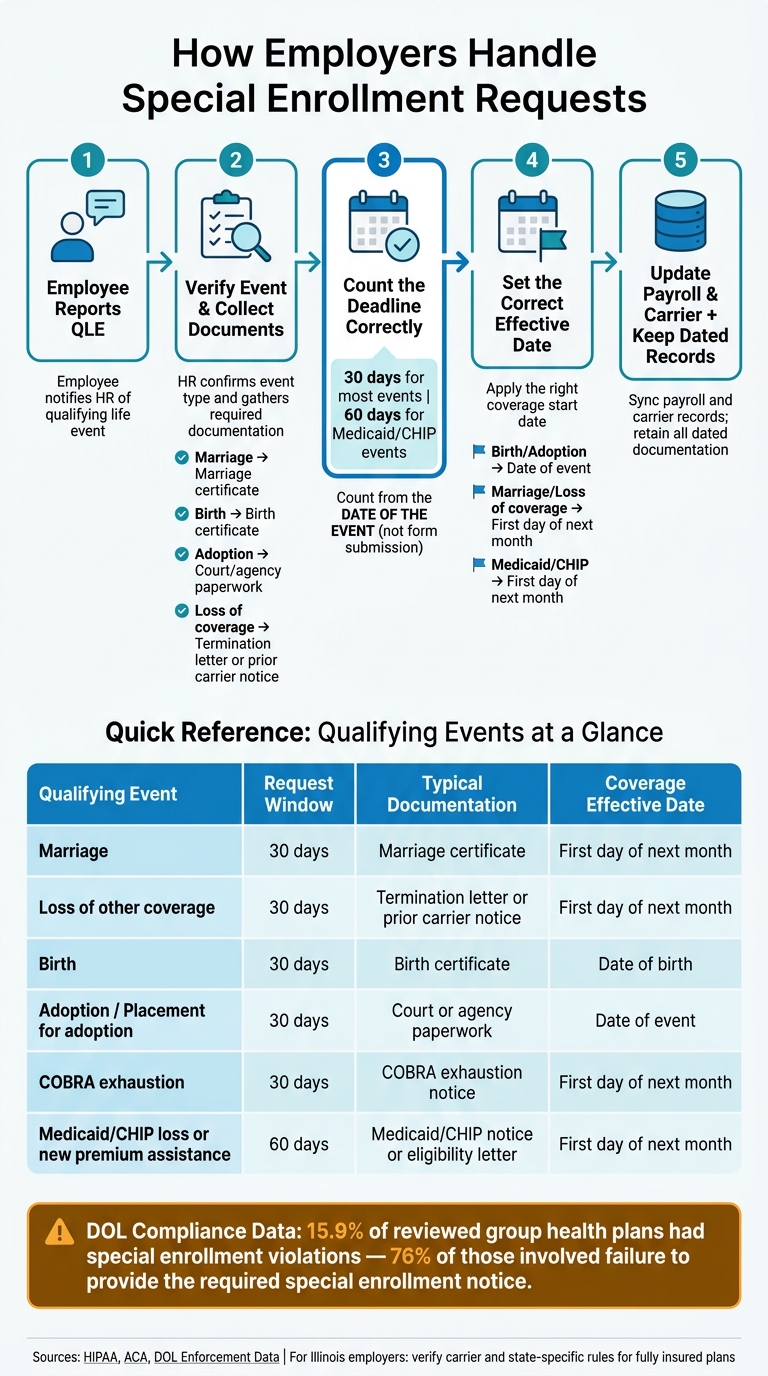
Special Enrollment Request Workflow: Deadlines, Docs & Effective Dates
Standard Workflow From Employee Notice to Coverage Update
After a QLE notice comes in, HR usually works through a pretty set sequence: verify the event, collect the right documents, process the election, update payroll, and send the change to the carrier. That sounds simple on paper. In practice, each step affects whether coverage goes through on time and whether the employer can support the decision under the plan rules.
If the employee gives notice late, or sends partial documents, the request can get stuck fast. That’s why clear handoffs matter. HR usually owns intake and verification, payroll updates deductions, and one assigned contact handles carrier file submissions and reconciliation. When that ownership is fuzzy, things slip.
The paperwork depends on the event. For example:
- For marriage, employers usually ask for a marriage certificate.
- For birth, they usually ask for a birth record.
- For adoption or placement for adoption, they usually ask for court or agency paperwork.
- For loss of other coverage, they usually ask for a termination letter or prior carrier notice that shows the coverage end date.
Once the request is verified, the next job is to apply the right deadline and the right effective date.
Deadlines, Documentation, and Effective Date Decisions
Effective dates need to be set before payroll changes and carrier updates go out. Get that part wrong, and the rest of the process can unravel. The table below shows the usual documents and timing employers apply for each event.
| Qualifying Event | Typical Documentation | Coverage Effective Date |
|---|---|---|
| Birth or adoption | Birth certificate, adoption or court order | Date of the event |
| Marriage | Marriage certificate | First day of the next month after the plan receives the request |
| Loss of other coverage | Termination letter or prior carrier notice | First day of the next month after the plan receives the request |
| Medicaid/CHIP loss or new premium assistance | Medicaid/CHIP notice or eligibility letter | First day of the next month after the plan receives the request |
| COBRA exhaustion | COBRA exhaustion notice | First day of the next month after the plan receives the request |
Check the plan document for any Illinois-specific newborn processing rules.
Where Employers Run Into Administrative Problems
Most problems don’t start with the rule itself. They start with messy handoffs and weak coordination between HR, payroll, and carriers. The same three trouble spots show up again and again:
- Deadline miscounts: HR may count from the date the employee turned in the form instead of the date of the qualifying event. That can make an on-time request look late, or make a late request look on time.
- Missing ownership: If no one person tracks the request from intake through carrier confirmation, it’s easy for it to get lost.
- Payroll-carrier mismatch: Payroll and carrier records often drift apart. Deductions may change in payroll while the carrier record stays untouched, or the other way around.
When those mistakes happen, the fallout is pretty direct: denied claims, retroactive fixes, and a higher risk of complaints. An enrollment portal can help cut down on these errors by connecting elections, payroll, and carrier files.
What Research Shows About Compliance Risk and Better Administration
Common Compliance Failures and Their Consequences
Those handoff problems don’t just stay in the background. They show up in enforcement data.
DOL enforcement data shows that special enrollment errors are a recurring compliance problem. Among group health plans cited for HIPAA violations, 15.9% had special enrollment violations, and 76% of those were failures to provide the required special enrollment notice. In plain English, most of these issues come from process mistakes, not from confusion about who qualifies.
DOL data also points to other repeat errors. Some plans failed to offer special enrollment after a loss of coverage (5.2%), while others missed it after a new dependent event (3.0%).
Once that happens, the problem can spread fast. A wrong effective date can lead to retroactive corrections, claim disputes, and payroll fixes. And if the employer can’t show records proving when the request came in, when it was reviewed, and when it was processed, the compliance risk gets higher.
Process Controls That Reduce Errors
The fix is usually pretty simple: use the same workflow every time. That means written procedures, intake forms, event checklists, deadline tracking, and carrier confirmation before payroll updates.
HR teams also need training on:
- qualifying events
- accepted documents
- request windows
- effective dates
That matters because staff can fall back on habit instead of the plan rule. And that’s where mistakes start, especially since special enrollment rights apply throughout the year, not only during open enrollment.
Record retention pulls the whole process together. Employers should keep dated records showing when the employee reported the event, what documents were reviewed, when the request was approved or denied, and when the carrier and payroll system were updated. Those dated records can make a big difference if the decision is later challenged.
Illinois employers must then align those controls with plan funding and carrier rules.
Illinois Employer Takeaways and Conclusion
Illinois-Specific Administration Support
Illinois employers need a simple, documented process for special enrollment requests. Even small timing mistakes can lead to coverage gaps and compliance trouble.
Once that process is in place, the next challenge is using it the same way every time. That’s where broker support can help. Carrier rules, effective dates, and Illinois requirements don’t always line up neatly with normal HR workflows. A broker can help turn plan rules into day-to-day steps, including midyear enrollment changes and carrier coordination.
Key Points Employers Should Remember
In day-to-day terms, special enrollment compliance usually comes down to four decisions: identify the qualifying event, track the right request window, apply the right effective date, and keep dated records.
The request windows are fixed:
- 30 days for most qualifying events
- 60 days for Medicaid or CHIP events
Effective dates matter just as much. Birth and adoption coverage usually starts on the event date, while marriage and loss of coverage usually begin on the first day of the next month. Those rules should live in plan documents and be checked with carriers. They shouldn’t be left to HR judgment one case at a time.
Documentation holds the whole process together. Dated records showing the event, the employee request, the review, and the carrier confirmation can help protect an employer if someone later disputes a decision or if a DOL inquiry shows up. It also makes sense to review the process each year along with plan documents and carrier requirements.
FAQs
What counts as a qualifying life event?
A qualifying life event is a major change that lets you enroll in or switch health insurance outside the standard open enrollment period.
Common examples include:
- Marriage or domestic partnership
- Birth or adoption
- Loss of existing coverage
- Moving to a new area
- Certain income changes
- Changes to legal status
One thing to watch out for: voluntary plan cancellations do not qualify.
What happens if I miss the 30-day deadline?
If you miss the 60-day Special Enrollment Period after a qualifying life event, you’ll usually need to wait until the next Open Enrollment Period to enroll in or change your coverage. That can leave you with a gap in health insurance.
In some cases, Medicaid, COBRA, or indemnity plans can help fill that gap, depending on your situation. Illinois Health Agents can help you keep track of enrollment deadlines so you don’t miss your window.
What records should employers keep for special enrollment?
Employers should keep detailed records for the full special enrollment process. That paper trail can help head off disputes about eligibility or coverage effective dates.
That means saving proof of when forms were received, when they were sent in, and when the carrier confirmed them. Employers should also keep employee documents that support the qualifying life event, such as marriage, birth or adoption, or loss of prior coverage.
Copies of related emails, notices, and paperwork can help show compliance if questions come up later.
Recent Comments