Illinois cut its uninsured problem by pairing ads with local, one-on-one enrollment help. I see three main patterns in these campaigns: people signed up when they understood their options, heard the message from groups they knew, and got direct help finishing enrollment.
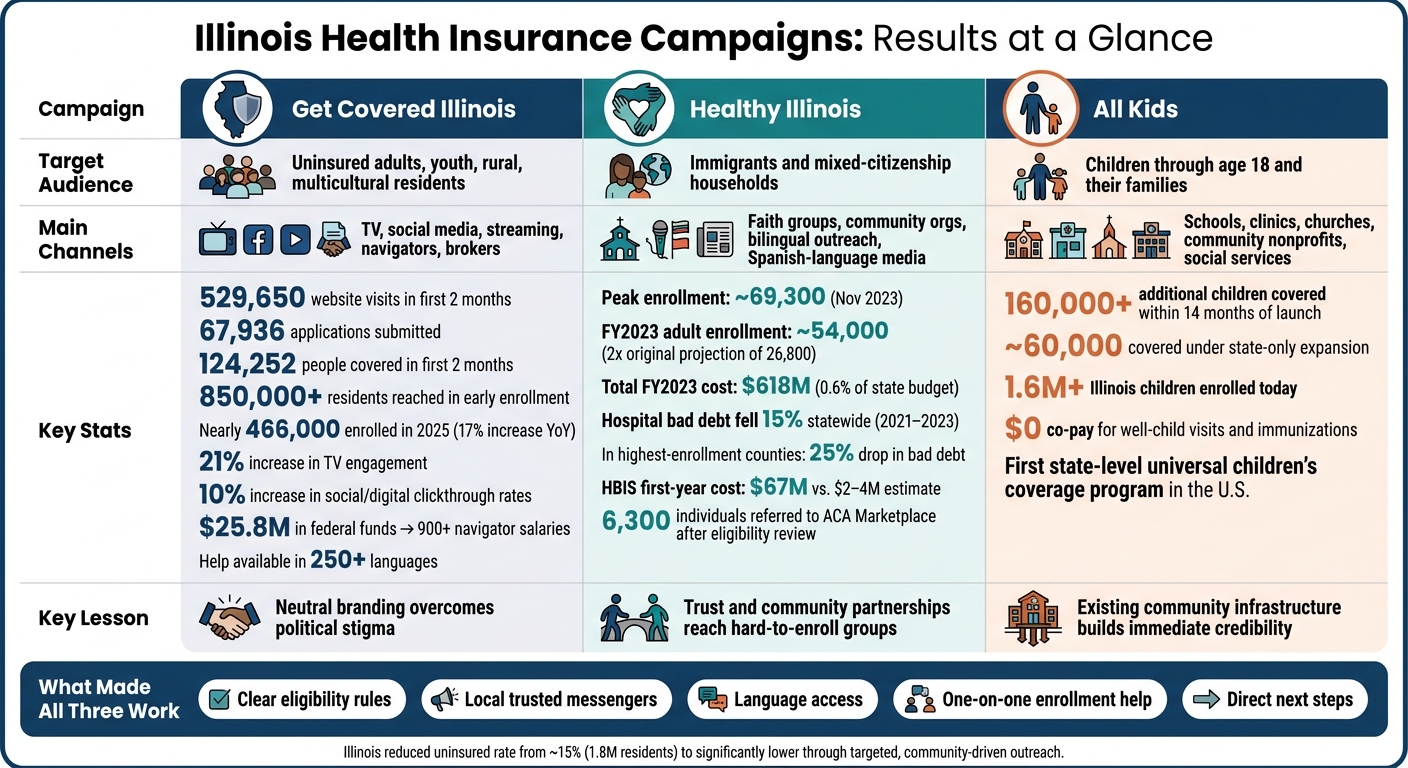
Before reform, about 1.8 million Illinois residents – 15% of the state – lacked insurance. Early marketplace outreach brought 529,650 website visits, 67,936 applications, and coverage for 124,252 people in the first two months. Other efforts reached immigrant families and children through local groups, schools, clinics, and faith networks.
Here’s the short version:
- Get Covered Illinois used a neutral state brand, broad media, navigators, and brokers to help move people from awareness to enrollment.
- Healthy Illinois focused on immigrant communities, where trust, language help, and clear public-charge guidance shaped whether families applied.
- All Kids kept the message simple and used schools, clinics, and community groups to help families enroll children.
What I’d take from all three:
- Clear rules beat confusing rules
- Local help beats ads alone
- Language access matters
- Trust shapes action
- Enrollment support needs a direct next step
| Campaign | Main audience | Main approach | Main result |
|---|---|---|---|
| Get Covered Illinois | Uninsured adults and families | Media + navigators + brokers | 850,000+ residents reached through early enrollment efforts |
| Healthy Illinois | Immigrant adults and seniors | Community groups + bilingual outreach | Peak enrollment of about 69,300 |
| All Kids | Children and families | Schools + clinics + trained helpers | 160,000+ more children covered in 14 months |
If I had to sum it up in one line, it would be this: coverage campaigns worked when Illinois made health insurance easier to understand and easier to act on.
Illinois Health Insurance Campaigns: Results at a Glance
Understanding Get Covered Illinois Health Insurance
sbb-itb-a729c26
Case Study 1: Get Covered Illinois Marketplace Campaign
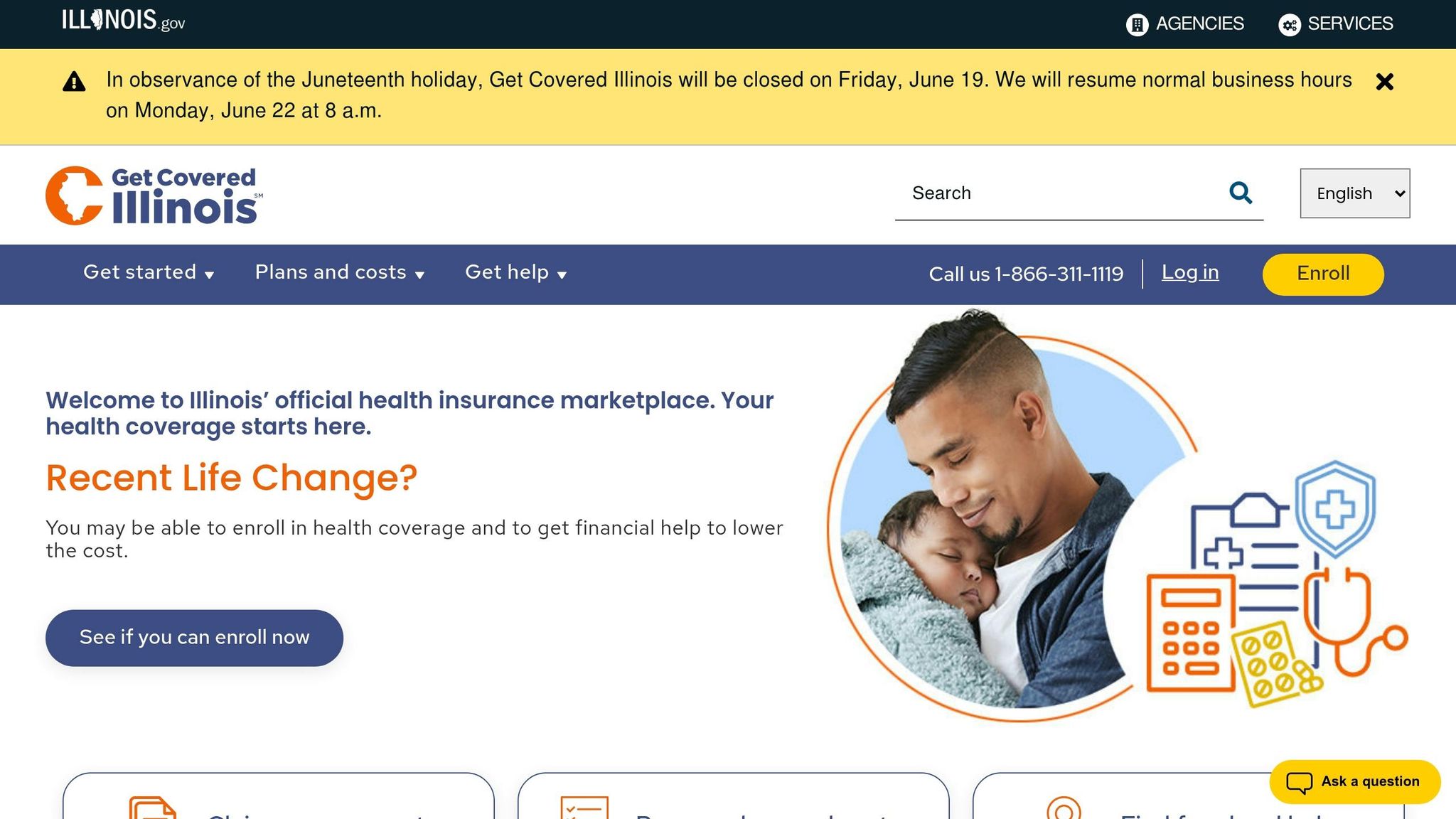
Get Covered Illinois paired a neutral state brand with broad media reach and local enrollment help. The idea was simple: use a name people could approach without baggage, put the message in front of them in many places, and back it up with real human support.
Campaign Strategy: Branding, Media, and Enrollment Support
The Get Covered Illinois name gave the marketplace a neutral, state-focused identity instead of using "Obamacare". From there, the campaign showed up across TV, radio, print, out-of-home, social media, and streaming audio, with video used to pull attention.
The messaging also changed based on who it was trying to reach. Instead of using the same pitch for everyone, the campaign built outreach for African American and Latino residents, LGBTQ communities, young adults, and rural populations. For Spanish-speaking audiences, it created dedicated video content. One testimonial video, Carlos’ Story, even won an Emmy.
Just as important, Illinois didn’t stop at ads. The state used a distributed in-person enrollment support model and directed about $25.8 million in federal funds to more than 900 navigator salaries during early enrollment periods. Navigators met people where they already were: community events, churches, schools, and public meetings. A customer assistance center provided help in more than 250 languages. Illinois also grew its broker network and gave licensed agents co-branded marketing materials so they could reach lower-income households and small business employees.
Documented Results and What Drove Them
These efforts improved engagement and helped move people toward sign-up. A multicultural marketing campaign from Flowers Communications Group (FCG) used a customized "Navigator personality" to make enrollment feel more human, not cold or bureaucratic. That effort led to a 21% increase in TV engagement and a 10% increase in clickthrough rates across social media, digital banners, and online streaming. It also won the PRSA Skyline Award and the PRSA Chicago Best Healthcare Campaign award.
RAND researchers found that enrollment was shaped by trust, partnership, and the availability of federal resources for enrollment.
"Operating our own marketplace means we can offer better support to Illinoisans. This includes access to free, local help through our navigator and broker network." – Morgan Winters, Director of Get Covered Illinois
Lessons for Illinois Consumers and Employers Today
The big lesson is plain: awareness only goes so far if people can’t get clear, local help when they need it. For Illinois households and small businesses, licensed brokers can offer plan-specific recommendations, while navigators can walk residents through the enrollment process.
That split matters. Brokers help people compare options and choose a plan. Navigators help people get through the system without feeling lost. When both are easy to find, the whole process gets less intimidating.
"There are so many variables, and (the agent) put them into easily understandable piles for us to go through and make our own informed decisions."
Case Study 2: Healthy Illinois Campaign and Immigrant Coverage Expansion
The first campaign focused on broad awareness. Healthy Illinois went after a different problem: the trust gap in immigrant communities.
Healthy Illinois, a coalition of immigrant-rights advocates, won state funding for health coverage for noncitizens who couldn’t get federal Medicaid. That effort led to two major programs:
- Health Benefits for Immigrant Seniors (HBIS) for noncitizens age 65 and older, launched in December 2020
- Health Benefits for Immigrant Adults (HBIA) for adults ages 42 to 64, launched in 2021
Illinois became the first state in the country to offer this type of coverage to older noncitizens.
Coalition Outreach Built on Trust and Community Fit
This campaign worked because it met people where they were. Faith groups, neighborhood groups, and immigrant-rights partners handled bilingual, community-based outreach and helped calm fears around public charge. Groups like the Shriver Center on Poverty Law explained that these state-funded programs were separate from federal public-charge determinations.
That distinction mattered. For many families, enrollment didn’t hinge only on whether coverage existed. It hinged on whether they believed it was safe to apply.
The campaign also used research to back up its message. Reports from the University of Illinois Chicago (UIC) and the University of Chicago found that covering immigrants improved labor force participation and cut financial strain for Illinois hospitals. That gave advocates solid evidence to bring to lawmakers.
Policy Outcomes, Enrollment Impact, and Cost Effects
The outreach produced clear results. Enrollment peaked at about 69,300 in November 2023. In FY 2023, adult enrollment reached nearly 54,000 – about double the first projection of 26,800 – and total costs reached $618 million, or 0.6% of the state budget.
That growth also lined up with less uncompensated care. Hospital bad debt fell by an average of 15% across Illinois between 2021 and 2023. In counties with the highest enrollment, the drop reached 25%.
At the same time, the price tag came in far above early forecasts. The HBIS program alone cost $67 million in its first year, compared with original estimates of just $2 million to $4 million. That budget strain later led to enrollment caps and pauses on new applications in 2023.
"We recognize the real fiscal challenges facing the state, but urge both the General Assembly and the governor to pass a FY25 budget that fully funds the existing HBIA and HBIS programs as they currently exist in statute, with no caps and no co-pays." – Tovia Siegel, Director, Healthy Illinois
Lesson: Connect Equity Messaging to Clear Enrollment Steps
Healthy Illinois showed a simple truth: outreach works better when people also get clear help on what to do next.
Families need plain guidance on eligibility rules, including the five-year rule that applies to some legal permanent residents, plus help figuring out what happens if they need to move to ACA Marketplace coverage. A 2024 eligibility review found that about 6,300 individuals were not eligible for state programs but could be referred to the ACA Marketplace instead.
For families losing HBIA or HBIS eligibility, that handoff can’t be vague. It needs to be direct, with a clear path to ACA Marketplace enrollment help. Illinois Health Agents can help review the next step.
That same local-partner model also shaped outreach for children’s coverage through All Kids.
Case Study 3: Children’s Coverage Outreach Through All Kids and Community Partnerships
Illinois built on the same local-partner approach when it launched All Kids in July 2006. It became the first state-level universal coverage program for children in the U.S. The program was open to children through age 18, no matter their income, immigration status, or pre-existing conditions.
That broad eligibility did more than expand access. It also made the program easier to explain. Families didn’t have to sort through a maze of rules before asking for help, and the message was simple: if you have a child in Illinois, All Kids may cover them. That kind of clarity can go a long way. It also cut some of the stigma that often comes with public coverage.
How Schools, Clinics, and Social Services Reached Families
Illinois relied on a trained application helper model. The state trained insurance agents, medical providers, and community groups to help families fill out one user-friendly application for Medicaid, SCHIP, and the state-funded expansion. Instead of pushing families toward government offices alone, outreach showed up in places people already knew, like schools, churches, and neighborhood centers.
HFS and DHS also worked together to smooth out enrollment. That matters more than it may sound at first. When agencies work in separate lanes, families often end up repeating the same steps over and over. Illinois tried to cut that friction.
Community-based nonprofits played a big part too. They helped with language access and trust, serving as a bridge between families and the state. For schools, clinics, and nonprofits, the setup was straightforward enough to explain in plain English without turning every conversation into a policy seminar.
"Medicaid’s use of community-based nonprofit organization as liaisons between government and clients served as an important public-private collaboration to improve enrollment and retention." – Rebecca F. Winitzer and Colleen Grogan, University of Chicago
Results: Lower Children’s Uninsured Rates and Better Care Access
The results came fast. Within 14 months of launch, more than 160,000 additional children gained coverage through All Kids. About 60,000 of them were covered under the state-only expansion for children who were not eligible for federal Medicaid or SCHIP.
Today, more than 1.6 million Illinois children are enrolled in the program.
Coverage also translated into better access to care. All Kids links most children with a primary care provider for coordinated care. Well-child visits and immunizations come with a $0 co-pay for every enrolled child, no matter the family’s income level.
Lesson for Families and Small Employers Covering Dependents
For families, All Kids can help when job-based coverage is too expensive or doesn’t fully cover dependents. That’s a common pinch point. A parent may have access to a workplace plan, but adding children can push the monthly premium too high.
For small employers, this creates another option to keep in mind. Some dependents may qualify for lower-cost public coverage instead of joining a high-cost family plan.
Across Illinois’s campaigns, the pattern stayed the same: people act when the message comes from someone they know and trust.
What These Illinois Success Stories Mean for Future Campaigns
Common Success Factors Across the Case Studies
Taken together, these three case studies point to a simple pattern: awareness worked only when people also had clear, trusted help to enroll.
Each campaign combined outreach with enrollment support. Trusted local messengers, language access, and repeated follow-up helped turn interest into sign-ups. That repeated outreach also made health coverage feel normal, familiar, and easier to act on.
Campaign Goals, Tactics, and Outcomes Compared
The table below shows how each campaign used the same basic approach in a different setting.
| Campaign | Target Population | Main Outreach Channels | Main Result | Key Lesson |
|---|---|---|---|---|
| Get Covered Illinois | Uninsured residents; youth, rural, multicultural | TV, social media, streaming, navigators, brokers | Nearly 466,000 enrolled in 2025, a 17% increase from the previous year | Neutral branding overcomes political stigma |
| Healthy Illinois / Immigrant Outreach | Immigrants and mixed-citizenship households | Local health departments, community organizations, Spanish-language media | HBIA and HBIS expanded coverage for immigrant adults and seniors | Trust and community partnerships reach hard-to-enroll groups |
| All Kids / Children’s Coverage | Families and dependents | Schools, clinics, religious institutions, doctors | More than 160,000 children gained coverage in 14 months | Existing community infrastructure builds immediate credibility |
Key Takeaways for Illinois Households and Businesses
These lessons still matter as enrollment rules and premium costs keep shifting. The clearest takeaway across all three campaigns is simple: confusion is the enemy of coverage.
When programs made eligibility easier to understand and paired that with real-person help, enrollment increased. When that support was missing, more people stayed uninsured because the process felt too hard to handle on their own.
That matters even more now. The 2026 enrollment cycle brings real pressure. Enrollees face an average monthly premium increase of 78% due to expiring federal tax credits. New federal rules have also added barriers for DACA recipients and certain non-citizens.
For many Illinois households and small businesses, this is where local help can make a big difference. Working with a local broker can offer the same one-on-one enrollment support that helped make these campaigns work.
FAQs
Why did local enrollment help matter so much?
Local enrollment work mattered because it leaned on trusted community partners to reach people who were often harder to engage, including people with low literacy, immigrants, and rural residents.
With in-person help, these partners cut through skepticism, confusion, and low awareness about insurance options. They helped residents sort through coverage choices and build trust along the way.
How did Illinois build trust with immigrant communities?
Illinois built trust through outreach shaped for each community and partnerships with local groups people already knew. By working with community-based organizations, the state gave residents in-person help from leaders with deep ties to the areas they served.
The campaigns also put a strong focus on native-language support, with outreach in more than 17 languages. They spoke directly to common concerns, including data privacy, HIPAA protections, medical debt, and access to care regardless of immigration status.
What can families do if coverage rules feel confusing?
If health insurance rules feel confusing, you’re not alone. State officials say it’s fine to slow down, look things over, and not rush into a decision.
Families can get free, one-on-one help from trained navigators and licensed brokers in person, online, or by phone in more than 250 languages. Illinois Health Agents also offers personal guidance to help individuals and families pick plans that fit their needs and budget.
Recent Comments