

Medicare premiums can help lower your taxes, but most Americans don’t know how. Here’s what you need to know:
- Medicare premiums are tax-deductible: This includes premiums for Part B, Part D, Medicare Advantage (Part C), and even voluntary Part A (if paid out-of-pocket).
- Two deduction options:
- Itemized Deduction: Deduct medical expenses exceeding 7.5% of your adjusted gross income (AGI) on Schedule A.
- Self-Employed Deduction: Deduct 100% of premiums directly on Schedule 1, without itemizing or meeting the 7.5% threshold.
- Higher earners (IRMAA): Additional Medicare surcharges due to income also qualify as deductible premiums.
Proper documentation, like Form SSA-1099 or proof of payments, is essential. Whether you’re retired or self-employed, understanding these rules can reduce your tax burden. Let’s dive into the details.
Itemized Medical Expense Deductions for Medicare Premiums
Eligibility for Itemized Deductions
If you want to deduct Medicare premiums, you’ll need to itemize your deductions on Schedule A instead of taking the standard deduction. For the 2025 tax year, the standard deduction is $15,000 for single filers and $30,000 for married couples filing jointly. So, itemizing only makes sense if your total deductions surpass these amounts.
Here’s the catch: you can only deduct medical expenses that exceed 7.5% of your adjusted gross income (AGI). As the IRS explains in Publication 502:
"You can deduct on Schedule A (Form 1040) only the part of your medical and dental expenses that is more than 7.5% of your adjusted gross income (AGI)."
For example, if your AGI is $60,000, only expenses over $4,500 qualify for a deduction. To meet that threshold, you can combine your Medicare premiums with other unreimbursed medical costs like dental, vision, hearing aids, and even medical mileage (21¢ per mile in 2025). Once you’ve hit the threshold, it’s time to figure out which Medicare expenses you can deduct.
Deductible vs. Non-Deductible Medicare Expenses
Understanding what’s deductible can help you make the most of your claim. Medicare Part B and Part D premiums are eligible, as are premiums for Medicare Advantage (Part C) and Medigap policies. For instance, the standard Part B premium is $202.90 per month in 2026, and any IRMAA (Income-Related Monthly Adjustment Amount) surcharges are included in the deductible total.
Medicare Part A, however, is a different story. Most people (about 99%) don’t pay premiums for Part A because they qualify for it through work credits. But if you voluntarily pay for Part A due to insufficient work credits, those premiums are deductible.
Here’s a quick breakdown:
| Deductible Premiums | Non-Deductible Costs |
|---|---|
| Medicare Part B and Part D premiums (including IRMAA surcharges) | Medicare tax withheld from wages or self-employment tax |
| Medicare Advantage (Part C) and Medigap premiums | Premiums paid by an employer or through a pre-tax plan |
| Voluntary Medicare Part A premiums | Expenses reimbursed by insurance or a Health Savings Account (HSA) |
| Part B deductibles, co-pays, and co-insurance | Non-prescription drugs (except insulin) |
It’s also important to watch out for IRS rules that prevent claiming the same expense twice.
Limits on Itemized Deductions
The IRS has strict rules to avoid duplicate deductions. For example, if you claim Medicare premiums under the Self-Employed Health Insurance Deduction on Schedule 1, you can’t include those same premiums on Schedule A. Similarly, if you’ve used tax-free HSA funds to pay for medical expenses, those amounts can’t be deducted again.
On average, taxpayers who itemize medical expenses claim nearly $17,000 in health-related costs each year. Combining multiple types of expenses (like premiums, co-pays, and other out-of-pocket costs) can help you clear the 7.5% AGI threshold and maximize your deductions.
Can I Deduct My Medicare Premiums?
Self-Employed Health Insurance Deduction for Medicare Premiums
If you’re self-employed, there’s a helpful tax break you should know about. You can claim an above-the-line deduction that lets you deduct 100% of your Medicare premiums directly on Schedule 1 (Form 1040), line 17. The best part? You don’t need to itemize deductions or deal with the 7.5% AGI threshold.
Eligibility for the Self-Employed Health Insurance Deduction
To qualify for this deduction, you need to meet one of these criteria:
- Have net profit from self-employment (reported on Schedule C or F)
- Be a partner with net earnings from self-employment
- Be a more-than-2% shareholder in an S corporation receiving W-2 wages
However, there’s a key limitation: the deduction cannot exceed your net business income: it can’t result in a business loss. Additionally, you can’t claim this deduction for any month you or your spouse were eligible for an employer-subsidized health plan, even if you chose not to enroll. The IRS evaluates eligibility on a month-by-month basis. Now, let’s look at which Medicare premiums qualify.
Medicare Premiums Eligible for Self-Employed Individuals
Good news: all parts of Medicare count as qualifying insurance for this deduction. That includes:
- Medicare Part B
- Medicare Part D
- Medicare Advantage (Part C)
- Voluntary Medicare Part A premiums
- Medigap (Medicare Supplement) policies
The IRS clarifies in the instructions for Form 7206:
"Medicare premiums you voluntarily pay to obtain insurance in your name that is similar to qualifying private health insurance can be used to figure the deduction."
Even premiums deducted directly from your Social Security benefits qualify. These eligible expenses are important to keep in mind as we dive into some special rules.
Special Rules for Medicare Premium Deductions
There are a few specific rules to consider:
- If your net business income is less than your total premiums, you can only deduct up to your business income on Schedule 1. Any remaining premiums can still be claimed as itemized medical expenses on Schedule A, subject to the 7.5% AGI threshold.
- The deduction extends to premiums paid for your spouse, dependents, and children under age 27 at the end of the year, even if the child isn’t your dependent.
- For more-than-2% shareholders in an S corporation, the corporation must either pay or reimburse the premiums and report them as wages on your W-2 for you to claim the deduction.
If you run multiple businesses, file Form 2555, or include long-term care insurance premiums, you’ll need to use Form 7206 to properly calculate the deductible amount.
sbb-itb-a729c26
How IRMAA Affects Medicare Premium Deductions
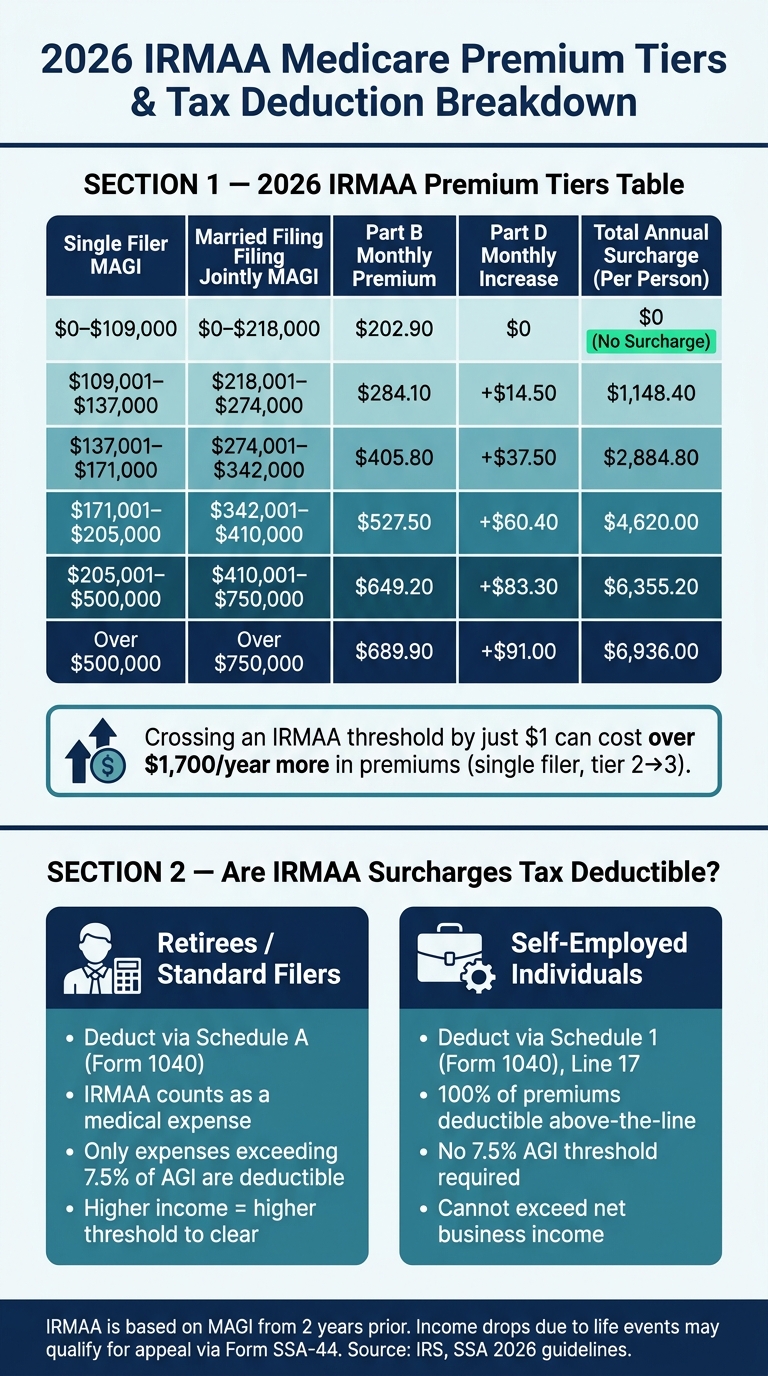
2026 IRMAA Medicare Premium Tiers & Tax Deduction Breakdown
Higher incomes can lead to increased Medicare costs, which come with specific tax implications.
What Is IRMAA and How Does It Work?
IRMAA, or Income-Related Monthly Adjustment Amount, is an additional charge applied to Medicare Part B and Part D premiums if your income exceeds set thresholds. The Social Security Administration (SSA) calculates IRMAA based on your Modified Adjusted Gross Income (MAGI) from two years prior. For example, your 2026 premiums will be determined using your 2024 tax return.
IRMAA uses a "cliff" system, if your income crosses a threshold, you pay the full surcharge for that tier. Here’s a breakdown of the 2026 IRMAA tiers:
| 2026 MAGI (Single) | 2026 MAGI (Married Filing Jointly) | Part B Monthly Premium | Part D Monthly Increase | Total Annual Surcharge (Per Person) |
|---|---|---|---|---|
| $0-$109,000 | $0-$218,000 | $202.90 | $0 | $0 |
| $109,001-$137,000 | $218,001-$274,000 | $284.10 | +$14.50 | $1,148.40 |
| $137,001-$171,000 | $274,001-$342,000 | $405.80 | +$37.50 | $2,884.80 |
| $171,001-$205,000 | $342,001-$410,000 | $527.50 | +$60.40 | $4,620.00 |
| $205,001-$500,000 | $410,001-$750,000 | $649.20 | +$83.30 | $6,355.20 |
| Over $500,000 | Over $750,000 | $689.90 | +$91.00 | $6,936.00 |
Once IRMAA is applied, it becomes part of your total Medicare premium, which has specific tax implications.
IRS Treatment of IRMAA Surcharges
The IRS classifies IRMAA surcharges as part of your Medicare premiums, not as a separate penalty. This means they qualify for the same tax deductions as standard Medicare premiums.
- If you itemize deductions, IRMAA is included as a medical expense on Schedule A (Form 1040). However, medical expenses are only deductible to the extent they exceed 7.5% of your AGI.
- For self-employed individuals, IRMAA can be included in the above-the-line deduction on Schedule 1, as long as the total deduction doesn’t exceed your net business income.
- If Medicare premiums (including IRMAA) are deducted from Social Security benefits, federal withholding is calculated after these deductions are applied.
How AGI Interacts with IRMAA-Adjusted Premiums
Your AGI plays a critical role in determining how IRMAA-adjusted premiums affect your taxes. For itemized deductions, the 7.5% AGI threshold means that higher incomes require a larger total of medical expenses to qualify for deductions. This makes it harder for high earners to benefit, even as their IRMAA costs rise.
Self-employed individuals avoid this hurdle with the above-the-line deduction, which directly reduces AGI. For those who itemize, staying just below an IRMAA threshold can result in substantial savings. For example, keeping MAGI under $137,000 as a single filer instead of exceeding it by just $1 could save over $1,700 annually in combined Part B and Part D costs.
If your income drops due to a qualifying life event, such as retirement or the loss of a spouse, you can appeal your IRMAA determination using Form SSA-44. This makes it essential to monitor both your AGI and income thresholds when planning for Medicare costs and tax deductions.
Applying IRS Guidelines for Illinois Medicare Beneficiaries
Common Scenarios for Illinois Residents
IRS rules impact Illinois retirees and self-employed individuals in distinct ways. For retirees, Medicare Part B premiums, set at $185.00 per month in 2025: are typically deducted directly from Social Security benefits. These premiums can be claimed as medical expenses on Schedule A, but only if your total unreimbursed medical costs exceed 7.5% of your Adjusted Gross Income (AGI). Since the average taxpayer claiming medical deductions reports nearly $17,000 in annual health expenses, keeping precise records is critical to maximizing this benefit.
For self-employed individuals in Illinois (such as freelancers, consultants, or independent contractors), there’s an advantage. Medicare premiums can be deducted "above the line" on Schedule 1 of Form 1040, which means you avoid the 7.5% AGI threshold entirely. This approach directly reduces your taxable income.
However, Illinois does not allow itemized medical deductions on state income tax returns. As a result, these Medicare premium deductions apply only at the federal level.
Accurate documentation is essential to ensure these deductions are accepted without issue.
Documentation and Reporting Requirements
To claim Medicare premium deductions, proper recordkeeping is non-negotiable. Here’s what you’ll need:
| Document | Purpose |
|---|---|
| Form SSA-1099 | Details the Part B premiums withheld from Social Security benefits |
| Premium notices or billing statements | Verifies Part D or Medicare Advantage premiums paid directly to private insurers |
| Proof of payment (e.g., bank statements, canceled checks) | Confirms out-of-pocket premium payments not listed on SSA-1099 |
| Form 7206 | Used by self-employed individuals to calculate the above-the-line deduction |
| Schedule K-1 or Form W-2 | Confirms premiums were reported correctly for partners or S-corp shareholders |
Important: Premiums paid with tax-free HSA distributions cannot be deducted, as this would constitute double-dipping, which the IRS prohibits. If you overlooked claiming qualifying premiums in a prior year, you typically have three years from the original filing date to amend your return using Form 1040-X and request a refund.
By keeping these records organized, you can confidently handle the deduction process and avoid unnecessary complications.
How Illinois Health Agents Can Help

Your choice of Medicare plan plays a role in determining deductible premium amounts. For instance, while Medicare Advantage (Part C) premiums qualify for both itemized and self-employed deductions, the cost-sharing structure differs from Medigap plans. This may affect your total out-of-pocket expenses and whether you surpass the 7.5% AGI threshold.
Illinois Health Agents can assist in understanding how different plans impact your deductible premiums. While they don’t provide tax advice, their expertise in local coverage options ensures you’re informed about the healthcare side of the equation. This preparation makes it easier to collaborate with your tax professional, ensuring you know which premiums qualify and how much you’ve paid. This teamwork between your insurance agent and tax advisor can simplify the filing process and help you make the most of your deductions.
Conclusion
Knowing the right strategies for deducting Medicare premiums can make a big difference in your tax planning. By understanding IRS rules, you can reduce your tax burden, but the key is figuring out which method works for you. For retirees, Medicare premiums are typically deducted through Schedule A, subject to the 7.5% AGI threshold. On the other hand, self-employed individuals can avoid that threshold entirely by claiming an above-the-line deduction on Schedule 1, which directly lowers taxable income.
Interestingly, a 2021 survey highlighted that many people remain unaware of these deduction options. This lack of awareness is significant, especially as Medicare costs steadily climb.
Looking ahead, the 2025 tax changes bring a $6,000 "Senior Bonus" for taxpayers aged 65 and older, raising the bar for itemizing deductions. With these shifts, careful planning becomes even more important. Mark Steber, Chief Tax Officer at Jackson Hewitt, offers this advice:
"Try it both ways (ie, the self-employed health insurance deduction or an itemized deduction) and see which is a better bottom-line tax deduction."
To navigate these decisions, consulting a tax professional is crucial. Additionally, resources like Illinois Health Agents can help you identify eligible Medicare premiums and provide the proper documentation, ensuring you and your tax advisor have all the details needed for accurate filing.
FAQs
Do Medicare premiums lower my taxes if I take the standard deduction?
If you take the standard deduction, Medicare premiums won’t lower your taxes. However, if you choose to itemize deductions, you might be able to deduct Medicare premiums as part of your medical expenses. Keep in mind, though, that only the portion of your medical expenses exceeding 7.5% of your adjusted gross income (AGI) is deductible.
Where do I deduct Medicare premiums on my tax return?
If you itemize deductions on Schedule A (Form 1040), you can include Medicare premiums as part of your medical expenses. However, your total medical expenses need to exceed 7.5% of your adjusted gross income (AGI) to qualify. Be sure to check the IRS guidelines for the most accurate and detailed information.
Can I deduct IRMAA surcharges and premiums taken from Social Security?
Yes, IRMAA surcharges and premiums count as medical expenses and can be deducted on Schedule A if you choose to itemize your deductions. However, to claim these, your total medical expenses need to surpass 7.5% of your adjusted gross income (AGI).
Related Blog Posts
- Self-Employed Health Insurance Deduction Guide
- How to Claim Tax Deductions for Medigap Premiums
- How to Claim Medigap Premiums on Taxes
- Medicare Premium Tax Deductions for Self-Employed
Recent Comments