

If I want the lowest 2026 Marketplace cost in Illinois, I need to get three things right: my tax household, my yearly income, and my plan level. That’s what decides whether I can get a premium tax credit, whether I can get extra out-of-pocket help, and whether I might owe money back at tax time.
Here’s the short version:
- Premium tax credits can lower my monthly premium.
- Cost-sharing reductions can lower my deductible, copays, coinsurance, and out-of-pocket limit.
- CSR only works with Silver plans.
- My help is based on household size, MAGI, ZIP code, and age.
- If I take advance premium tax credits and my income ends up too high, I may have to repay part of the credit when I file taxes.
- The main fix is simple: use a solid full-year income estimate and report changes fast.
A few numbers matter most:
- PTC: usually for households in the 100% to 400% FPL range
- CSR: usually for households in the 100% to 250% FPL range
- Benchmark plan: the second-lowest-cost Silver plan in my area sets the tax credit math
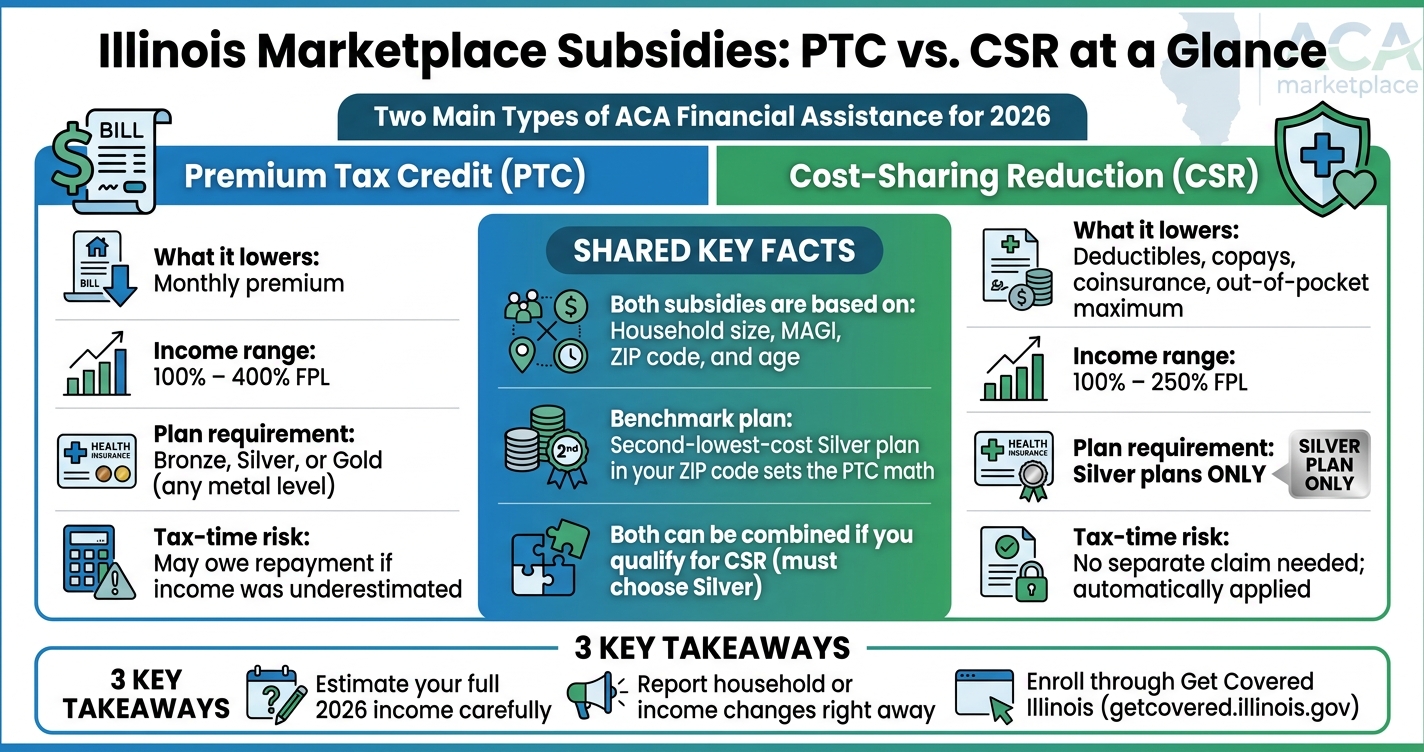
Illinois Marketplace Subsidies: PTC vs. CSR at a Glance
Impact of ACA subsidies cut in Illinois
sbb-itb-a729c26
Quick comparison
| Help type | What it lowers | Income range | Plan rule | Tax-time issue |
|---|---|---|---|---|
| Premium Tax Credit (PTC) | Monthly premium | 100%–400% FPL | Works with Bronze, Silver, or Gold | May need repayment if income was too low on application |
| Cost-Sharing Reduction (CSR) | Deductible, copays, coinsurance, out-of-pocket max | 100%–250% FPL | Silver only | No separate claim, but only applies if enrolled in Silver |
What I take from this article is simple: estimate carefully, compare plans before enrolling, pick how much credit to use in advance, and keep my Marketplace account updated all year. That is the main way to keep coverage costs down and avoid a tax bill later.
Check your subsidy eligibility based on household size and income
Your subsidy eligibility comes down to two things: who counts in your household and your expected 2026 household income. Those two details decide how much financial help you may get.
How the Marketplace counts household size
The Marketplace looks at your tax household. That means you, your spouse if you file jointly, and anyone you claim as a tax dependent on your 1040.
Some people may live with you but still don’t count. A roommate, an unmarried partner, or a parent who files their own tax return is not part of your household size for Marketplace purposes, even if you split bills or share living costs.
When you fill out your application, include every person in your tax household, even if some of them aren’t applying for coverage.
How income is measured and what the 2026 ranges mean
After household size, income is the other big factor that affects your subsidy amount. Marketplace subsidies use your Modified Adjusted Gross Income (MAGI). In plain English, that’s your expected yearly household income, adjusted for certain tax items.
Some tax deductions are added back when MAGI is figured out. That’s why it’s smart to estimate your full-year 2026 income as closely as possible. This is the number you’ll use when you preview plans and apply for help.
The Marketplace then compares your MAGI to the Federal Poverty Level (FPL) for your household size. That comparison decides what kind of help you can get.
| Subsidy Type | Income Range (FPL) | Plan Requirement | Benefit |
|---|---|---|---|
| Premium Tax Credit (PTC) | 100% – 400% FPL | Any metal level | Lowers monthly premium |
| Cost-Sharing Reduction (CSR) | 100% – 250% FPL | Silver plans only | Lowers deductibles, copays, and out-of-pocket max |
Why Silver plans are the only option for cost-sharing reductions
Premium tax credits give you more room. You can use them with Bronze, Silver, or Gold plans.
Cost-sharing reductions work differently. They’re only available with Silver-level Marketplace plans. So if you qualify for CSR, a Silver plan will often give you the best deal because it includes those extra savings on deductibles, copays, and your out-of-pocket maximum.
Once you know your household size and income range, you’re ready to preview your plan savings before you enroll.
Estimate your savings before you enroll
Once you know your household size and income range, estimate your savings before you pick a plan. That gives you a clearer picture of your likely monthly premium and subsidy amount.
Use Get Covered Illinois to preview plans and financial help
Use GetCovered.Illinois.gov’s Shop/Enroll or Compare Plans tool. Enter your ZIP code, household size, and expected 2026 household income.
The tool shows estimated monthly premiums after tax credits, so you can look at plan options before you apply. Final amounts are confirmed after your application is verified.
How premium estimates are calculated
This estimate matters because the credit is tied to your local benchmark plan.
Your premium tax credit is based on the second-lowest-cost Silver plan in your ZIP code, called the benchmark plan. That means two Illinois households with similar incomes can still get different subsidy amounts. Why? Because benchmark plans vary by ZIP code, and age also affects premiums. So your household’s age mix changes the math too.
When to get local enrollment help
If your numbers aren’t clear yet, get help before you submit the application. If your income changes or is hard to predict, an off-base estimate can lead to repayment risk at tax time.
Illinois Health Agents helps Illinois residents review subsidy estimates and plan choices. You can reach them directly at 1-866-440-1885 to get help before you apply.
Apply for subsidies and keep your information accurate during the year
Once you’ve estimated your savings, the next step is to submit your application and keep your details up to date during the year.
How to complete the Get Covered Illinois application correctly
After you know your estimated savings, fill out the application using the same income and household numbers. The form asks for your household size, your estimated annual income, and where you live in Illinois.
One thing matters here: estimate your full 2026 income, not just what you’re earning right now. If your pay changes during the year, try to account for that before you submit. And if you want a second set of eyes on the form, get local enrollment help before sending it in.
Advance premium tax credits vs. claiming the credit at tax time
Next, pick how you want to receive the credit. You can use it in advance each month to lower your premium right away, wait and claim the full amount when you file your federal tax return, or split the difference by taking part now and the rest at tax time.
| Option | Monthly Premium | Tax Return Impact |
|---|---|---|
| Take All (Advance) | Reduced by the maximum eligible amount | May owe money back if income was underestimated |
| Take Some (Advance) | Partially reduced | Claim the remaining difference at filing |
| Take None (Wait) | You pay the full premium each month | Receive the entire credit as a lump sum or tax reduction |
If your income tends to move up and down, taking less of the credit in advance can help lower the chance that you’ll have to pay some of it back later.
Report income and household changes right away
Report any income or household change as soon as it happens. That helps keep your advance credit in line with your current situation and lowers the chance of a surprise at tax time.
When your information stays current, your subsidy is more likely to match your actual income during the year.
Common Illinois subsidy mistakes and key takeaways
Mistakes that cost you savings or create repayment risk
Once you estimate your subsidy and apply, the biggest problem is simple: giving the Marketplace old or wrong information. Even a small mistake on your application can change how much help you get each month.
The most common slip-up is underestimating your annual income. If that happens, your advance premium tax credit may be too high, and you could have to pay part of it back when you file your taxes. Using the wrong household size can also change your credit amount.
A couple of other issues can lead to surprises at tax time.
- Overlooking cost-sharing reductions. These apply automatically if you qualify and can lower out-of-pocket costs like deductibles, copays, and coinsurance.
- Using an estimate tool and stopping there, without checking your income and household details one more time.
How tax reconciliation works at year end
If you used advance premium tax credits, the final review happens when you file your taxes. The IRS compares the advance payments you received with the credit you were actually allowed to get, based on your actual income and household size.
If your income ended up higher than you expected, you may have to pay some of the credit back. That’s why it matters to keep your income and household details up to date during the year. It helps keep your monthly credit closer to the amount you actually qualify for.
Conclusion: How to stay on track
Enroll through Get Covered Illinois (getcovered.illinois.gov), use accurate household and income numbers, and report changes during the year. If you want local help, Illinois Health Agents offers personalized help with ACA enrollment.
FAQs
What counts as MAGI for Marketplace subsidies?
For Marketplace subsidies, MAGI begins with your AGI from your most recent tax return. That’s Line 11 on IRS Form 1040.
From there, you add back a few types of income:
- Tax-exempt interest
- Non-taxable Social Security benefits
- Untaxed foreign income
It also pulls in income from your tax household, including wages, self-employment profit, unemployment, and investment income.
Some money does not count toward Marketplace MAGI. That includes SSI, child support, gifts, inheritances, and veterans’ disability payments.
Should I take all of my premium tax credit in advance?
You can use premium tax credits in one of two ways: take them upfront to lower your monthly premium, or claim the full credit when you file your federal tax return.
Taking the credit in advance can make your monthly bill easier to handle. But there’s a catch: the final amount is based on your actual annual income, not the estimate you gave earlier.
If you earn more than expected, or you don’t report income or household changes, you may have to pay back extra subsidy amounts when you file your taxes. Starting in 2026, those repayment amounts will have no cap.
What changes do I need to report during the year?
Report any mid-year changes in income, household size, or access to other coverage to the Marketplace as soon as they happen.
That includes things like:
- a new job or promotion
- losing a job
- marriage or divorce
- adding a new dependent
- becoming eligible for Medicaid, Medicare, or an employer-sponsored plan
Fast updates help keep your premium tax credits and cost-sharing reductions in line with your current situation. They can also help you avoid unpleasant tax-time surprises.
Recent Comments