

Medicare is split into two primary parts: Part A (Hospital Insurance) and Part B (Medical Insurance). Together, they form the foundation of Medicare coverage, but each serves a distinct purpose.
- Part A: Covers inpatient care like hospital stays, skilled nursing facilities, hospice, and some home health services. Most people don’t pay a premium for Part A if they have sufficient work history.
- Part B: Focuses on outpatient care, including doctor visits, preventive services, medical equipment, and emergency room services (unless admitted). It requires a monthly premium, starting at $202.90 in 2026.
Quick Comparison
| Feature | Medicare Part A | Medicare Part B |
|---|---|---|
| Primary Focus | Inpatient care | Outpatient services |
| Monthly Premium | $0 for most; up to $565 if unqualified | $202.90 (standard) |
| Deductible (2026) | $1,736 per benefit period | $283 annually |
| Coinsurance | Varies by hospital stay length | 20% after deductible |
| Eligibility | Based on work history | No work history required |
Part A is often automatic for those eligible through work credits, while Part B requires active enrollment (and comes with penalties if delayed without qualifying coverage). Understanding these differences helps you make informed decisions about your healthcare needs.
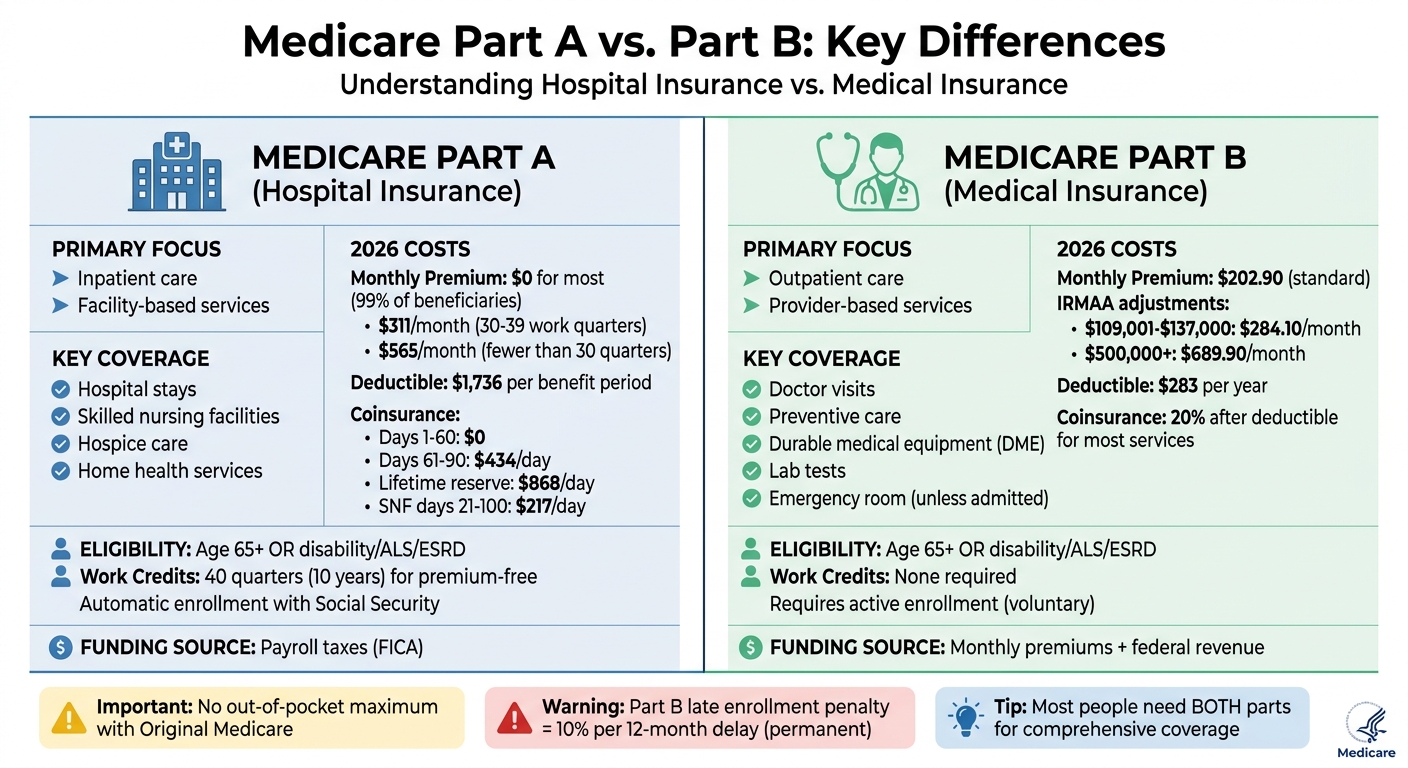
Medicare Part A vs Part B Comparison Chart: Coverage, Costs, and Eligibility
What Each Part Covers
Medicare Part A Coverage

Medicare Part A is primarily focused on inpatient and intensive care services. It covers hospital stays in general or psychiatric facilities, which include a semi-private room, meals, general nursing care, medications given during your stay, and other necessary supplies.
It also provides coverage for Skilled Nursing Facility (SNF) care, but only after a qualifying hospital stay of at least three days. This care includes specialized rehabilitation or nursing services. For the first 20 days of each benefit period, there is no coinsurance cost. Hospice care is another service under Part A, available for terminally ill patients at minimal or no cost. However, there are small copayments for certain outpatient medications and respite care. Additionally, limited home health services are available for homebound individuals who need intermittent skilled nursing or therapy.
While Part A handles hospital facility costs like room and board, it does not cover doctor fees. These fall under Medicare Part B.
Medicare Part B Coverage
Medicare Part B shifts the focus to outpatient and provider-based services, covering care received outside of hospital stays. This includes visits to doctors and specialists, whether in offices, clinics, or outpatient facilities.
One standout feature of Part B is its comprehensive preventive care coverage, which is often fully covered without requiring a deductible or coinsurance. Preventive services include annual wellness visits, vaccinations (such as flu, pneumonia, COVID-19, and Hepatitis B), and screenings for conditions like cancer, diabetes, and heart disease. This preventive approach highlights how Part B complements Part A by addressing different aspects of healthcare.
Part B also covers durable medical equipment (DME), such as wheelchairs, walkers, hospital beds, and oxygen equipment. After meeting the deductible, beneficiaries are responsible for 20% coinsurance.
Emergency room visits generally fall under Part B unless you’re formally admitted to the hospital, which then shifts coverage to Part A. It’s important to note that outpatient observation status can influence costs and eligibility for follow-up SNF care.
Get Medicare Supplement Quotes
How Much Each Part Costs
Part A Costs
For most Medicare beneficiaries, around 99%, Part A comes with no monthly premium. That’s because they, or their spouse, paid Medicare taxes for at least 10 years during their working years. If you don’t qualify for premium-free Part A, you’ll pay either $311 per month (if you worked 30-39 quarters) or $565 per month (if you worked fewer than 30 quarters).
The deductible for Part A in 2026 is $1,736 per benefit period, which is $60 higher than in 2025. A benefit period starts when you’re admitted to a hospital and ends after 60 consecutive days without inpatient care. If you have multiple benefit periods, you’ll need to pay the deductible each time.
Once the deductible is met, the first 60 days of inpatient care are covered at no additional cost. However, for days 61-90, you’ll pay $434 per day, and for lifetime reserve days, the cost jumps to $868 per day. Skilled nursing facility care also has costs: days 21-100 come with a $217 daily charge.
Part B Costs
Unlike Part A, everyone pays a monthly premium for Part B. In 2026, the standard premium is $202.90 per month, an increase of $17.90 from the previous year. If you’re a higher earner, you’ll pay more based on the Income-Related Monthly Adjustment Amount (IRMAA). For instance, individuals earning between $109,001 and $137,000 will pay $284.10 per month, while those earning $500,000 or more will pay $689.90 per month.
"The increase in the 2026 Part B standard premium and deductible is mainly due to projected price changes and assumed utilization increases that are consistent with historical experience."
, Centers for Medicare & Medicaid Services (CMS)
The annual deductible for Part B is $283 in 2026, and you only pay it once per calendar year. After meeting the deductible, you’ll typically pay 20% coinsurance for most services. It’s important to note that neither Part A nor Part B includes a maximum out-of-pocket limit, meaning costs can add up if you don’t have supplemental insurance.
Here’s a quick comparison of the costs for Parts A and B:
Cost Comparison Table
| Cost Category | Medicare Part A | Medicare Part B |
|---|---|---|
| Monthly Premium | $0 for most; up to $565 if unqualified | $202.90 (standard); higher for IRMAA |
| Annual Deductible | $1,736 per benefit period | $283 per year |
| Coinsurance | $0 for first 60 days; $434/day for days 61-90 | Typically 20% after deductible |
| Basis for Premium | Work history (Social Security quarters) | Annual income (MAGI from 2 years prior) |
These cost details provide a clear picture of how Parts A and B differ, laying the groundwork for understanding eligibility requirements.
Who Qualifies for Each Part
Part A Eligibility
To qualify for premium-free Part A at age 65, you or your spouse need to have worked and paid Medicare taxes for at least 10 years (or 40 quarters). This applies to about 90% of Medicare beneficiaries based on age alone.
If you’re under 65, eligibility can come through a disability or certain medical conditions after 24 months of receiving Social Security Disability Insurance (SSDI). However, there are two notable exceptions:
- If you have ALS (Amyotrophic Lateral Sclerosis), also known as Lou Gehrig’s disease, you qualify immediately upon receiving disability benefits: there’s no waiting period.
- Similarly, if you have End-Stage Renal Disease (ESRD) requiring dialysis or a kidney transplant, you qualify without the 24-month waiting period.
For those who don’t meet the work credit requirement, Part A can still be purchased. The monthly cost is $311 or $565, depending on your work history, but enrollment in Part B is also required. Additionally, all applicants must be U.S. citizens or legal residents who have lived in the U.S. continuously for at least five years.
Part B Eligibility
Unlike Part A, Part B eligibility doesn’t depend on work credits. Everyone pays a monthly premium for Part B. In 2026, the standard premium is $202.90, though individuals with higher incomes will pay more due to IRMAA adjustments.
The same disability, ALS, and ESRD rules for Part A apply to Part B. The age requirement is also the same: you qualify at 65 or earlier if you meet the medical conditions.
One key distinction is that you can enroll in Part B without having Part A. However, if you need to purchase Part A, you must also enroll in Part B. Additionally, if you’re already receiving Social Security benefits at least four months before turning 65, you’ll be automatically enrolled in both Part A and Part B.
These differences highlight why most people receive premium-free Part A, while Part B requires a monthly payment from everyone.
Eligibility Comparison Table
| Eligibility Criteria | Medicare Part A | Medicare Part B |
|---|---|---|
| Age Requirement | 65 or older | 65 or older |
| Work Credits | 40 credits for premium-free; fewer credits require a monthly premium | No work credits required; everyone pays a premium |
| Disability | Eligible after 24 months of SSDI | Eligible after 24 months of SSDI |
| ALS | Eligible immediately upon disability benefits | Eligible immediately upon disability benefits |
| ESRD | ESRD eligible | ESRD eligible |
| Residency | U.S. citizen or 5-year legal resident | U.S. citizen or 5-year legal resident |
This breakdown makes it clear how eligibility for Parts A and B differs, laying the groundwork for understanding their coverage distinctions.
Medicare Part A and Part B Explained: Costs, Coverage, and Enrollment
Main Differences Between Part A and Part B
This section breaks down the key distinctions between Medicare Part A and Part B, focusing on their coverage, costs, and enrollment processes.
Medicare Part A, often called hospital insurance, primarily covers inpatient care and facility-based services. On the other hand, Medicare Part B, or medical insurance, is geared toward outpatient care and services provided by healthcare professionals.
When it comes to funding, the two parts are financed differently. Part A is funded mostly through payroll taxes (FICA), while Part B relies on monthly premiums and federal revenue.
The cost structures also differ. Part A operates on a benefit period system, meaning each hospitalization could start a new period, potentially requiring payment of the $1,736 deductible multiple times in a year. In contrast, Part B has an annual deductible of $283, with most services requiring a 20% coinsurance after that.
Enrollment processes vary, too. Part A enrollment is generally automatic for those receiving Social Security benefits, but Part B requires individuals to actively sign up unless they have qualifying employer coverage. For those who need to purchase Part A, enrolling in Part B is usually mandatory.
Differences Summary Table
| Feature | Medicare Part A | Medicare Part B |
|---|---|---|
| Common Name | Hospital Insurance | Medical Insurance |
| Primary Focus | Inpatient/Facility-based care | Outpatient/Provider-based care |
| Key Services | Hospital stays, SNF care, Hospice, Home health | Doctor visits, DME, Lab tests, Preventive care |
| Funding | Payroll taxes (FICA) | Monthly premiums & federal revenue |
| 2026 Monthly Premium | $0 for most; up to $565 if purchased | $202.90 (standard) |
| 2026 Deductible | $1,736 per benefit period | $283 per year |
| Enrollment | Generally automatic with Social Security | Voluntary; requires active signup |
Conclusion
Grasping the differences between Medicare Part A and Part B is crucial for safeguarding both your health and finances. While Part A focuses on hospital stays, Part B covers outpatient services. Together, they create a safety net, with each addressing gaps the other might leave. Understanding these distinctions is key for making informed enrollment decisions.
One critical point to remember: delaying Part B enrollment without qualifying employer coverage can lead to a permanent 10% penalty for every 12-month delay. For example, a two-year delay means you’ll face a 20% higher premium for life.
Another potential financial pitfall is observation status during hospital stays. If you’re classified as being under outpatient observation instead of formally admitted, your stay will be billed under Part B. This can lead to higher coinsurance costs and may disqualify you from covered skilled nursing facility care. Always confirm your admission status with hospital staff to avoid surprises in billing.
Original Medicare also comes with a major drawback: it lacks an out-of-pocket maximum. This means there’s no cap on your expenses unless you have supplemental coverage. To manage these costs, many beneficiaries opt for a Medigap policy or switch to a Medicare Advantage plan.
If you’re nearing age 65 or need help understanding your Medicare options in Illinois, Illinois Health Agents (https://ilhealthagents.com) provides personalized guidance. Their expertise can help you navigate your choices and steer clear of costly enrollment errors.
FAQs
Do I need both Part A and Part B?
Yes, to get full coverage under Original Medicare, most people need both Part A and Part B. Part A takes care of inpatient services like hospital stays and skilled nursing facilities, and it’s usually free if you’ve paid Medicare taxes for at least 10 years. Part B focuses on outpatient services, preventive care, and medical equipment, but it comes with a monthly premium. Together, these two parts offer a wide range of healthcare benefits.
What is a Part A benefit period?
When you’re admitted to a hospital or skilled nursing facility, your Part A benefit period begins. This period continues until you’ve been out of the facility for 60 straight days. If you’re admitted again after those 60 days, a new benefit period starts.
How do I avoid the Part B late enrollment penalty?
If you want to steer clear of the Part B late enrollment penalty, make sure to sign up during your initial enrollment period: this is typically around your 65th birthday. Alternatively, you can enroll during a Special Enrollment Period if you’re eligible. Keep in mind, delaying enrollment without qualifying for a Special Enrollment Period could cost you. You’ll face a 10% penalty for each year you were eligible but didn’t enroll, and this amount will be added to your monthly premium.
Recent Comments