
Tech startups often pay more for small group health insurance than necessary. Here’s why and how to fix it:
- High Costs: Startups are quoted significantly higher premiums – up to 20–30% more than larger companies – due to regulations that pool them with higher-risk groups.
- Common Mistakes: Many founders renew plans without review, overlook cost-saving strategies, and fail to predict long-term rate increases.
- Illinois Challenges: In Illinois, premiums are rising faster than the national average, driven by fewer insurers, new regulations, and higher healthcare costs.
- Solutions: Options like level-funded plans, ICHRAs (Individual Coverage Health Reimbursement Arrangements), and tax credits can cut costs by 15–30%.
How Startups Can Offer Health Coverage
sbb-itb-a729c26
Why Tech Startups Pay Too Much for Small Group Insurance
High premiums are not the only issue for tech startups – many founders unknowingly make avoidable mistakes that drive costs even higher. Over time, these missteps can transform what should be a manageable expense into a growing financial burden.
Errors in Plan Selection and Participation Requirements
One common mistake is accepting the carrier’s default renewal without evaluating it. This means startups miss early signs of premium hikes or reduced coverage. As Premier Financial Insurance puts it:
Not taking time to review the specifics of your group plan renewal is unquestionably one of the most costly mistakes any company can make.
Rushed decisions often result in plans that don’t align with employee needs or company budgets. Ignoring participation requirements – like minimum enrollment thresholds – can also force companies into pricier plans. Furthermore, startups often overlook creative cost-saving options, such as transitioning employees over 65 to Medicare or using subsidies for lower-salary staff, leaving premiums unnecessarily high.
Another misconception is that having a young, healthy team automatically leads to lower rates. In states with community rating regulations, premiums are uniform regardless of team health. Heiki Riesenkampf from Commonbase explains:
You’re not buying insurance for your team. You’re buying a share of the entire small group risk pool in your state.
These missteps in plan selection are only part of the problem – administrative complexities add another layer of financial strain.
Overlooking Administrative Work and Complexity
Managing group insurance plans is more time-consuming and complicated than many startups expect. Tasks like enrollment, compliance, and coordinating across multiple states can quickly become overwhelming. Research indicates that administrative expenses make up about 10% of the challenges small businesses face in offering employee benefits.
Additionally, the confusing jargon of insurance – terms like deductibles, co-pays, and out-of-pocket maximums – can lead to decision paralysis. Without integrated HR systems, manual errors are common, which can result in compliance issues. These administrative hurdles not only eat up valuable time but also increase the likelihood of costly mistakes that inflate overall insurance expenses.
Failing to Predict Long-Term Costs and Rate Increases
Another major issue is failing to account for long-term cost increases. Insurers estimate that healthcare costs, often referred to as the "medical trend", rise by about 9% annually. For example, while the median proposed premium increase for 2026 was 11%, some insurers requested hikes of 20% or more due to rising specialty drug costs – like GLP-1 medications for diabetes and weight loss – and a destabilized risk pool.
In some areas of New York, small group premiums jumped 36% to 45% between 2020 and 2024, while the number of covered lives dropped by 24%. Small group markets are highly volatile; a single employee with a serious health condition can push a carrier’s loss ratio above 100%, leading to steep rate corrections. For instance, THP Insurance Company reported a 116% loss ratio in 2024 for its small group business, largely due to low membership and unpredictable claims.
Operating in such unstable risk pools, startups can face double-digit premium increases through no fault of their own. Understanding these long-term cost factors is critical for startups aiming to manage their insurance expenses and avoid financial surprises during renewals.
The High Cost of Traditional Small Group Plans in Illinois
For tech startups in Illinois, the price tag on traditional small group insurance plans is climbing, thanks to a mix of regulatory changes and shifting market conditions. Knowing what’s behind these rising costs can help founders make smarter decisions about their insurance budgets. Let’s break it down.
Premium Costs and Price Trends Over Time
Small group insurance premiums in Illinois are increasing at a pace that’s hard to ignore. By 2026, these premiums are expected to jump by 13.3%, outpacing the national median increase of 11%.
Adding to the challenge, big names like Aetna, Health Alliance Medical Plans, and Quartz Health are pulling out of Illinois’ small group market for 2026. Fewer players in the game mean less competition, which often leads to higher prices. This shrinking pool of insurers highlights the importance of understanding how regulations are shaping the market.
Illinois Regulations That Increase Group Plan Costs
State mandates are also playing a big role in driving up costs. Starting in 2025, Illinois requires small group plans to include comprehensive mental health parity, which is expected to add 3% to 5% to premiums. On top of that, new rules around specialty medications and biosimilars are pushing prices even higher.
As The Provant Group explains:
"Small group plans are seeing the steepest increases, particularly for PPO options that offer broad provider networks."
Another factor adding to the price surge is the renegotiation of contracts between major hospital systems and insurers. These new agreements come with higher reimbursement rates, which are being passed down to employers in the form of increased premiums.
For startups relying on traditional small group plans, these combined pressures from market trends and regulatory changes create a tough environment. Understanding these cost drivers is a critical step in finding insurance solutions that better align with your budget.
How Tech Startups Can Reduce Insurance Costs
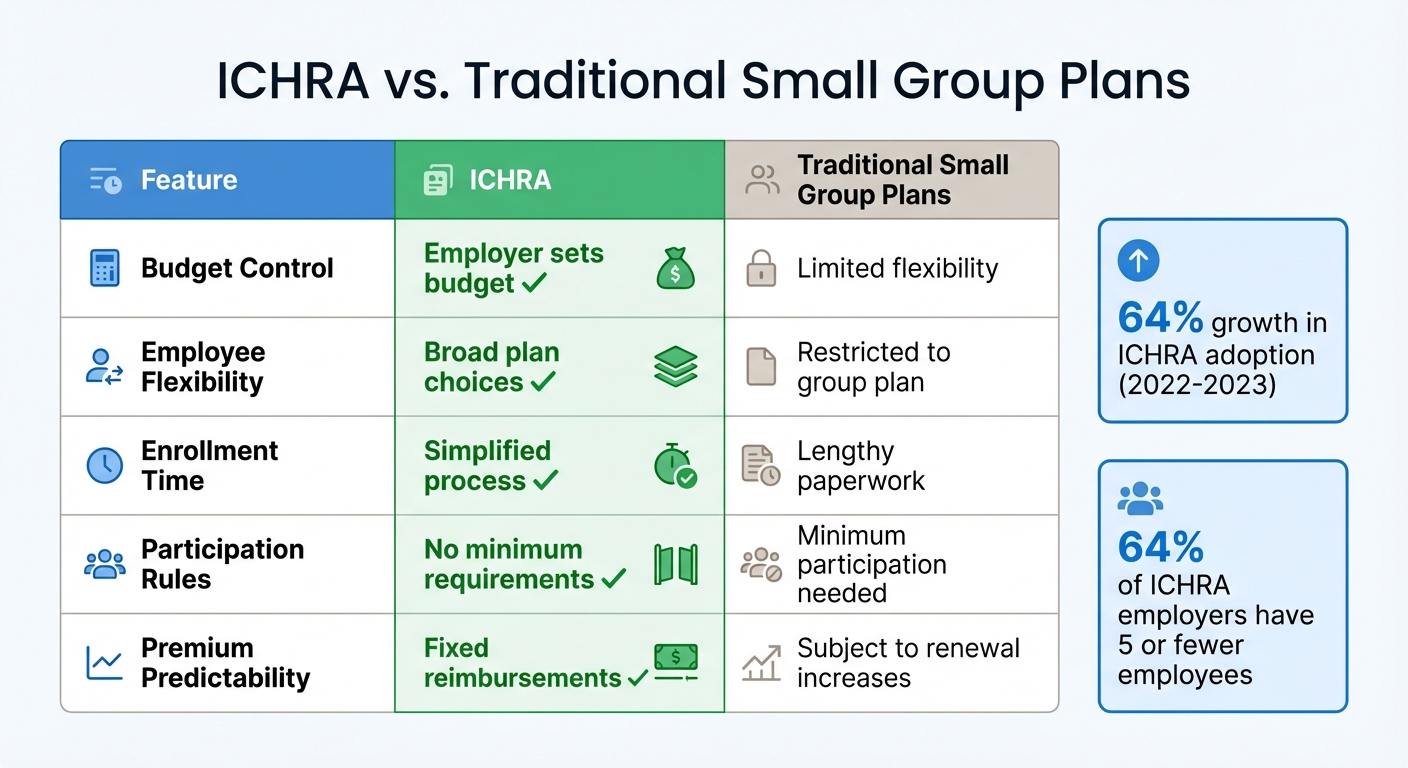
ICHRA vs Traditional Small Group Health Insurance Plans Comparison
With rising premiums, tech startups need smart strategies to manage insurance expenses without sacrificing benefits. The key lies in tailoring these approaches to match the size, location, and budget of your team.
Working with Specialized Brokers like Illinois Health Agents
High premiums make partnering with a specialized broker more important than ever. Illinois Health Agents, for example, helps small businesses navigate group health insurance challenges, offering solutions like tax credit identification and cost-effective plan designs.
One such solution is level-funded plans, which base costs on your team’s specific health profile instead of a broad state risk pool. For younger, healthier teams, this can mean savings of 15% to 30% compared to standard renewals. Plus, if claims are lower than expected, your company may get money back – a big difference from traditional plans, where unused premiums go straight to the insurer’s bottom line.
Another option Illinois Health Agents recommends is pairing High-Deductible Health Plans (HDHPs) with Health Savings Accounts (HSAs). This approach reduces monthly premiums while giving employees tax-advantaged savings for medical costs. Additionally, they can check if your startup qualifies for the Small Business Health Care Tax Credit, which can offset up to 50% of premium costs for companies with fewer than 25 full-time employees and an average salary of $56,000 or less.
For smaller startups (10 or fewer employees), Illinois Health Agents charges $250 annually for group health services, but this fee is waived if all 10 employees enroll. Larger teams (more than 10 employees) receive these services free of charge.
Another effective cost-control method is using ICHRAs to give employees more choice while keeping expenses predictable.
Using ICHRA for Budget Control and Employee Choice
Individual Coverage Health Reimbursement Arrangements (ICHRA) offer startups a different way to manage health benefits. Instead of selecting a single group plan, you allocate a fixed monthly allowance that employees use to buy their own health insurance.
This model has grown rapidly, with the number of employers offering ICHRAs increasing by 64% between 2022 and 2023, rising from about 2,500 to 4,100 companies. Nearly 64% of these employers have five or fewer employees, making ICHRA especially appealing for early-stage startups.
Why the popularity? ICHRA allows you to control exactly how much you spend, lets employees choose plans that suit their needs, and avoids the hassle of meeting minimum participation requirements. For startups with remote teams spread across different states, ICHRA eliminates the complexity of managing state-specific group plans.
| Feature | ICHRA | Traditional Small Group Plans |
|---|---|---|
| Budget Control | Employer sets budget | Limited flexibility |
| Employee Flexibility | Broad plan choices | Restricted to group plan |
| Enrollment Time | Simplified process | Lengthy paperwork |
| Participation Rules | No minimum requirements | Minimum participation needed |
| Premium Predictability | Fixed reimbursements | Subject to renewal increases |
This flexibility makes ICHRA a valuable tool for startups looking to manage insurance costs effectively.
Saving Money with Tax Credits and HSAs
Two often-overlooked resources can significantly lower insurance costs: the Small Business Health Care Tax Credit and Health Savings Accounts (HSAs).
The tax credit applies to startups with fewer than 25 full-time equivalent employees earning average salaries below $56,000. If your company pays at least 50% of employee premiums, you could get up to 50% back as a tax credit (35% for non-profits). For a startup spending $100,000 annually on health insurance, that’s $50,000 back in your budget.
HSAs, when paired with high-deductible plans, offer immediate premium savings while providing employees with a tax-free way to handle out-of-pocket medical expenses. Contributions are tax-deductible, grow tax-free, and can be withdrawn tax-free for qualified expenses. Even better, unused funds roll over each year and remain with employees even if they leave the company.
Illinois Health Agents can help you figure out the best mix of these strategies for your startup, potentially saving an average of $1,620 per employee annually.
Conclusion
Tackle rising insurance costs with practical strategies. From level-funded plans to ICHRAs and tax credits, these options give you more control over one of your largest expenses. With Illinois premiums expected to climb by 6–8% in 2025, planning ahead is essential.
This shift in health insurance mirrors the changes in retirement benefits years ago. Just as companies transitioned from pensions to 401(k)s, health insurance is moving from a defined benefit model to a defined contribution approach. This change provides employers with predictable costs while offering employees more flexibility and choice in their coverage.
To make these transitions smoother, partnering with a specialized broker can be a game-changer. Illinois Health Agents can help implement these strategies – whether it’s level-funded plans or ICHRA setups – ensuring you achieve savings without added administrative headaches. For teams of 10 or fewer, their $250 annual fee is waived if all employees enroll. Larger teams benefit from their services at no cost.
Don’t wait for your next renewal. Take steps now: reassess team needs, explore alternative funding models, and confirm your eligibility for tax credits. With the right plan, you could save 15–30% on premiums while giving your employees better coverage and more control over their health insurance.
FAQs
How do I know if my renewal increase is reasonable?
To figure out if your renewal increase makes sense, start by comparing your plan details against industry benchmarks. For example, small businesses are expected to see a median premium increase of 11% in 2026. By reviewing your plan specifics and speaking with an insurance agent, you can determine whether your increase aligns with market trends or includes unnecessary expenses. If the increase seems unusually high, it might be worth digging deeper or negotiating.
When should a startup choose an ICHRA instead of a group plan?
Startups aiming for flexibility and cost control should take a closer look at an ICHRA (Individual Coverage Health Reimbursement Arrangement). Here’s why: ICHRAs allow employers to set a defined budget for health benefits and reimburse employees for their individual health insurance premiums. This approach often helps small businesses manage expenses more effectively compared to traditional group health plans.
ICHRAs can be particularly appealing for startups with a younger, healthier workforce or those who want to sidestep the often steep costs and administrative challenges tied to traditional group plans under ACA regulations. By giving employees the freedom to choose their own insurance, startups can offer tailored benefits without the financial strain of a one-size-fits-all plan.
Do we qualify for the Small Business Health Care Tax Credit?
Your small business might qualify if you have fewer than 25 full-time equivalent employees, pay average wages below $64,800, and cover at least 50% of employee premiums. Additionally, eligibility requires purchasing coverage through the SHOP Marketplace. Review these criteria to see if your business can benefit from potential savings on health insurance costs.
Recent Comments