

Illinois residents don’t face penalties for being uninsured, but businesses with 50+ employees must comply with ACA rules to avoid fines. Here’s a quick breakdown:
- No Individual Penalty: Since 2019, the federal penalty for not having health insurance is $0. Illinois does not have a state-level penalty either.
- Employer Penalties: Businesses with 50+ full-time employees must offer affordable, minimum essential coverage or pay fines:
- $3,340 per employee in 2026 for failing to offer coverage.
- $5,010 per employee in 2026 if coverage is unaffordable or inadequate.
- Key Deadlines: Employers must file ACA compliance forms (1094-C, 1095-C) by March 2 annually for employees and electronically by March 31 for the IRS.
To avoid penalties, ensure compliance with ACA standards, use safe harbors for affordability calculations, and consider working with brokers for guidance.
Avoid Big ACA Fines With These Simple Tips!
sbb-itb-a729c26
Federal Individual Mandate Penalty: What Changed
The federal individual mandate penalty, known officially as the "Shared Responsibility Payment", required most U.S. citizens and permanent residents to have minimum essential health coverage or face a tax penalty when filing federal returns. However, the Tax Cuts and Jobs Act of 2017 effectively eliminated this penalty by reducing it to $0 starting January 1, 2019.
"The Affordable Care Act’s individual mandate technically still exists in the tax code, but it has no teeth." – LegalClarity Team
Although the mandate itself remains in federal law, the penalty’s elimination means Illinois residents face no federal or state penalties for being uninsured. Unlike states such as California, Massachusetts, New Jersey, Rhode Island, and the District of Columbia, Illinois has not enacted its own individual mandate.
How the Federal Penalty Worked Before 2019
Before 2019, the penalty was calculated based on whichever was greater: a flat dollar amount per person or a percentage of household income above the tax filing threshold. The penalty was phased in over three years, starting in 2014, and reached its full amounts by 2016.
| Tax Year | Flat Dollar Amount (Per Adult) | Percentage of Income | Family Maximum (Flat Fee) |
|---|---|---|---|
| 2014 | $95 | 1.0% | $285 |
| 2015 | $325 | 2.0% | $975 |
| 2016 | $695 | 2.5% | $2,085 |
| 2017 | $695 | 2.5% | $2,085 |
| 2018 | $695 | 2.5% | $2,085 |
Children under 18 were charged half the adult flat rate. For example, a middle-income family of four earning $60,000 in 2018 faced a penalty of $2,085. The average penalty per tax filer rose from around $210 in 2014 to $667 in 2016, peaking at $774 in 2017.
The penalty was capped at the national average annual cost of a Bronze-level health plan. In 2018, the cap for a single individual was $283 per month. Certain groups were exempt from the penalty, such as those whose insurance costs exceeded 8% of their income, members of Native American tribes, incarcerated individuals, and those with religious objections. Additionally, no penalty was applied for coverage gaps shorter than three consecutive months.
This entire calculation process became moot once Congress reduced the penalty to $0 starting in 2019.
When and Why the Federal Penalty Ended
Congress eliminated the financial impact of the penalty through the Tax Cuts and Jobs Act of 2017, which set the penalty to $0 beginning with the 2019 tax year. The mandate itself was not repealed but rendered ineffective to comply with Senate reconciliation rules, allowing the legislation to pass with a simple majority of 50 votes.
"Since January 1, 2019, the requirement to maintain health insurance coverage… has remained in statute, but the penalty for noncompliance has been effectively eliminated by being reduced to zero." – Ryan J. Rosso, Analyst, Congressional Research Service
This change aimed to remove the financial burden on Americans who chose to forgo health insurance, as the mandate was one of the most debated and unpopular parts of the Affordable Care Act. The penalty has remained at $0 for every tax year from 2019 through 2026.
While individuals no longer face penalties, Illinois employers with 50 or more full-time employees must still meet ACA compliance requirements and could face penalties for noncompliance.
Illinois ACA Compliance and Coverage Requirements
Illinois does not impose a state-level penalty for residents without health insurance. Instead, the focus is on providing access to affordable coverage through Get Covered Illinois, the state’s official health insurance marketplace, and other programs aimed at connecting uninsured residents with affordable options. Employers with 50 or more full-time equivalent employees are required to offer affordable, minimum essential coverage to avoid federal penalties.
Get Covered Illinois and the State Marketplace
Get Covered Illinois is the state-run health insurance marketplace where residents can shop for, compare, and enroll in ACA-compliant health plans. Starting with the 2026 plan year, Illinois transitioned from using the federal HealthCare.gov platform to a fully state-managed marketplace. This shift allows the state to have greater control over enrollment processes and customer support.
"Get Covered Illinois is the state’s official health insurance marketplace where Illinoisans can shop for, compare and enroll in high-quality health insurance vetted by the state." – Get Covered Illinois
For the 2026 coverage year, 448,568 Illinois residents selected plans through the marketplace, with 80% qualifying for premium subsidies. After applying these subsidies, the average monthly premium dropped to $142, with enrollees saving an average of $688 per month through federal tax credits. All marketplace plans include the 10 essential health benefits required under the ACA, such as maternity care, mental health services, emergency care, and prescription drug coverage.
Illinois has also implemented a Tax Time Easy Enrollment program. This initiative allows uninsured residents to start the enrollment process while filing their state income taxes. By simply checking a box on Form IL-1040, individuals can share their contact and income details with state agencies, which then assess their eligibility for Medicaid or marketplace subsidies offering free or low-cost coverage.
| Marketplace Feature | Illinois Status |
|---|---|
| State-Level Penalty | None |
| Marketplace Type | State-Based (Get Covered Illinois) |
| Tax Time Enrollment | Available via Form IL-1040 |
| Pregnancy as Qualifying Event | Yes (Starting 2026) |
| Short-Term Plans | Capped at 3 months; no renewals |
These marketplace reforms are part of broader efforts to ensure individual coverage and provide guidance for employer compliance.
Illinois Has No State-Level Penalty
Illinois has opted not to penalize uninsured residents at the state level. Instead, the state has expanded Medicaid eligibility to include adults aged 19–64 with incomes up to 138% of the Federal Poverty Level. For 2023, this translates to $19,392 annually for an individual or $39,750 for a family of four.
Employers with 50 or more full-time equivalent employees are required to provide affordable, minimum essential coverage that meets "minimum value" standards, meaning it must cover at least 60% of healthcare costs. Employers failing to comply face federal penalties, which can reach up to $2,880 per full-time employee (excluding the first 30 employees) or $4,060 per employee for offering inadequate or unaffordable coverage.
ACA Tax Penalties for Illinois Employers
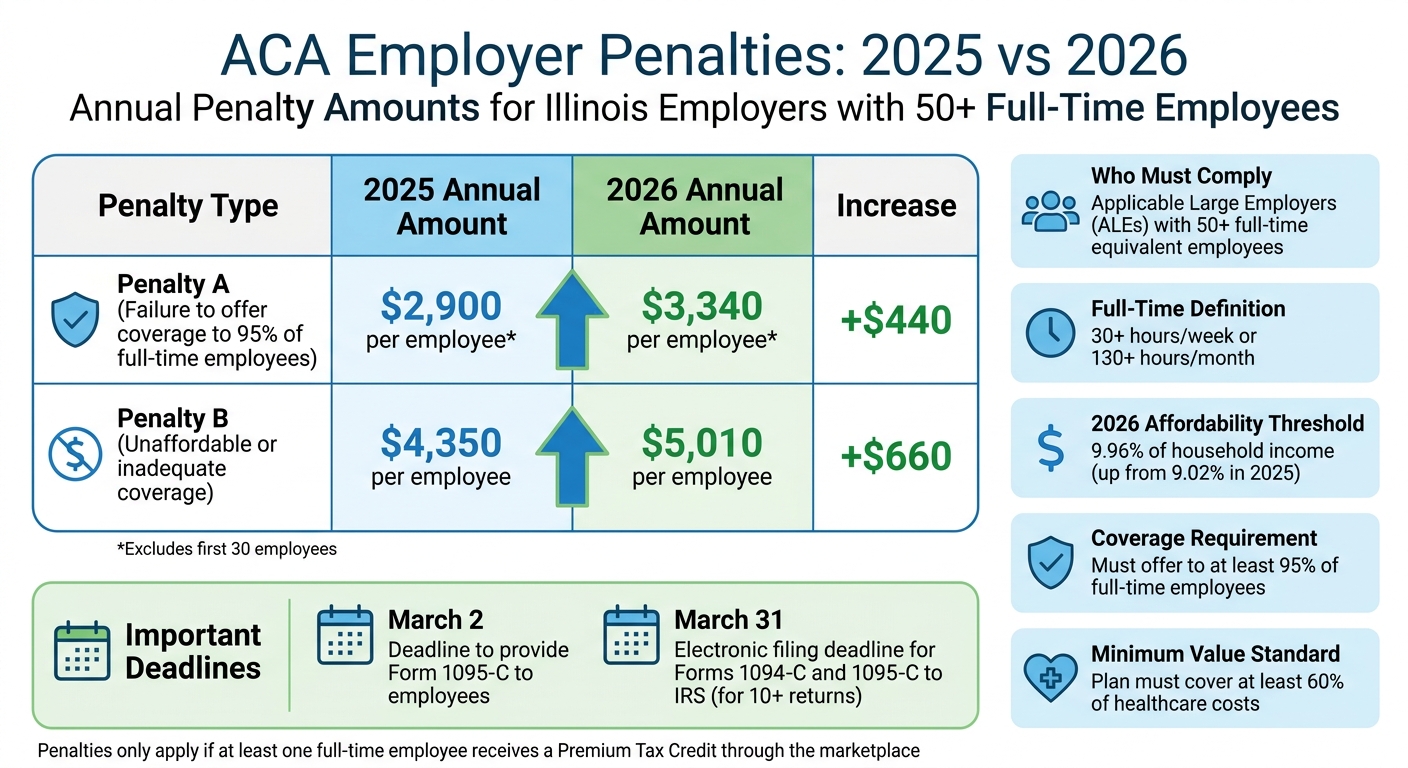
ACA Employer Penalties 2025 vs 2026 Comparison for Illinois Businesses
Employers in Illinois with 50 or more full-time employees need to meet federal compliance standards under the Affordable Care Act (ACA). Failing to provide ACA-compliant health coverage can lead to penalties, but these only apply if at least one full-time employee uses a Premium Tax Credit to buy coverage through Get Covered Illinois or another marketplace. The IRS calculates these penalties on a monthly basis, with amounts adjusted regularly for inflation.
Employer Shared Responsibility Provisions Explained
Applicable Large Employers (ALEs) are defined as businesses with an average of at least 50 full-time employees (including full-time equivalents) during the previous calendar year. A full-time employee is someone working at least 30 hours per week or 130 hours per month. ALEs must provide Minimum Essential Coverage that covers at least 60% of healthcare costs and is affordable to at least 95% of full-time employees and their dependents.
"The employer shared responsibility provisions were added under section 4980H of the Internal Revenue Code by the Affordable Care Act." – Internal Revenue Service
For 2026, health coverage is considered affordable if the employee’s share of the premium does not exceed 9.96% of their household income, an increase from 9.02% in 2025. Employers are also required to file Form 1094-C and Form 1095-C annually to report coverage details to the IRS and employees, with a permanent March 2 deadline for providing copies to employees.
Illinois employers face two types of penalties:
- Penalty A: Applies when businesses fail to offer coverage to at least 95% of full-time employees. For 2026, this penalty is $3,340 per full-time employee, excluding the first 30 employees, up from $2,900 in 2025.
- Penalty B: Applies if the offered coverage is either unaffordable or does not meet minimum value standards. This penalty is $5,010 per employee receiving a Premium Tax Credit in 2026, compared to $4,350 in 2025.
| Penalty Type | 2025 Annual Amount | 2026 Annual Amount |
|---|---|---|
| Penalty A (Failure to offer coverage) | $2,900 per employee | $3,340 per employee |
| Penalty B (Unaffordable/inadequate coverage) | $4,350 per employee | $5,010 per employee |
Employers hovering around the 50-employee threshold should closely monitor employee hours, as ALE status is determined on a monthly basis. Additionally, related or commonly owned businesses are combined for ALE calculations. Businesses filing 10 or more information returns must submit electronically by March 31, 2026.
"ACA penalties are actually excise taxes, so while you’ll hear the word ‘penalty’ often, you actually must deal with these assessments as if they’re excise taxes." – Kari Brummond, EA, TaxCure
These provisions highlight not only the financial risks but also the reporting responsibilities tied to ACA compliance.
The Cadillac Tax Repeal
The Cadillac Tax, a proposed 40% excise tax on high-cost employer health plans, has been permanently repealed. Initially set to take effect in 2018, this tax targeted employer-sponsored plans exceeding specific cost thresholds. However, after multiple delays, Congress eliminated the tax entirely, removing a potential compliance burden for businesses offering comprehensive health benefits. This repeal simplifies matters for companies already meeting ACA requirements.
How to Avoid ACA Penalties in Illinois
Meeting ACA requirements in Illinois can be straightforward with the right approach. By selecting compliant coverage and seeking expert advice, both employers and individuals can avoid penalties while optimizing tax benefits.
Why Select ACA-Compliant Health Plans
Choosing an ACA-compliant health plan is a critical step in avoiding tax penalties. For businesses, this means offering coverage that meets Minimum Essential Coverage standards to at least 95% of full-time employees and their eligible dependents. Additionally, plans must provide Minimum Value, covering at least 60% of healthcare costs, and adhere to IRS affordability guidelines.
To simplify affordability calculations, employers can use one of the IRS-approved safe harbors:
- W-2 Safe Harbor: Based on Box 1 wages.
- Rate of Pay Safe Harbor: Tied to an employee’s hourly or salary rate.
- Federal Poverty Line Safe Harbor: Uses the federal poverty level to determine affordability.
These safe harbors streamline compliance and reduce administrative complexity. Illinois Health Agents specializes in helping businesses and individuals find ACA-compliant plans that meet federal standards while staying within budget.
Leveraging Health Savings Accounts (HSAs) for Tax Benefits
Pairing a high-deductible health plan with a Health Savings Account (HSA) is a smart way to reduce taxes while staying compliant. HSAs offer three key tax advantages:
- Pre-Tax Contributions: Contributions are made before taxes, lowering taxable income.
- Tax-Free Growth: Funds in the account grow tax-free over time.
- Tax-Free Withdrawals: Withdrawals for qualified medical expenses are not taxed.
For 2026, contribution limits are $4,300 for individuals and $8,550 for families, with an additional $1,000 allowed for those aged 55 and older. Any unused funds roll over annually, building a financial cushion for future healthcare expenses. Employers also benefit – HSA contributions are tax-deductible and exempt from payroll taxes, reducing overall costs. Illinois Health Agents can help structure HSA-compatible plans that benefit both employers and employees while ensuring ACA compliance.
Partnering with Local Insurance Brokers
Navigating ACA requirements can feel overwhelming, but working with experienced brokers simplifies the process. Illinois Health Agents assists businesses in determining their Applicable Large Employer status and ensures accurate filing of Forms 1094-C and 1095-C. With access to top-rated carriers in Illinois, they provide competitive rates and comprehensive coverage options.
For individuals and families, Illinois Health Agents offers guidance through the Get Covered Illinois marketplace. They help maximize tax credits and find affordable, compliant coverage. By partnering with knowledgeable brokers like Illinois Health Agents, businesses and individuals can achieve smooth compliance and avoid costly penalties.
Conclusion
In Illinois, ACA tax penalties come down to a few key points. On January 1, 2019, the federal individual mandate penalty was reduced to $0, meaning Illinois residents no longer face a federal fine for not having health insurance. Unlike states such as California, Massachusetts, New Jersey, Rhode Island, and Washington, D.C., Illinois does not impose its own state-level penalty either. While there are no penalties, having health insurance is still crucial for financial security.
For employers, the rules are a bit more complex. Businesses with 50 or more full-time equivalent (FTE) employees are required to offer affordable, minimum essential coverage to at least 95% of their full-time staff. Failing to do so could result in federal penalties. Smaller employers – those with fewer than 50 FTEs – are not obligated to provide coverage. However, they may qualify for tax credits through the SHOP Marketplace if they choose to offer insurance.
To stay compliant, employers must ensure their coverage meets affordability standards, which are set at 9.96% of household income for 2026. The IRS provides safe harbor methods, like using W-2 wages, rate of pay, or the federal poverty line, to simplify compliance. Additionally, HSA contribution limits for 2026 will be $4,300 for individuals and $8,550 for families.
For both businesses and individuals, working with experienced brokers like Illinois Health Agents can make navigating these requirements easier. From determining employer obligations and filing forms like the 1095-C to finding affordable health plans through Get Covered Illinois, their expertise ensures compliance and access to competitive rates from top carriers. These resources highlight the importance of protecting both personal and business interests in Illinois.
FAQs
How do I know if my business is an ALE?
Your business qualifies as an Applicable Large Employer (ALE) if it had an average of 50 or more full-time employees (or their equivalents) during the previous calendar year. A full-time employee is defined as someone who works at least 30 hours per week or 130 hours per month on average.
What counts as “affordable” coverage in 2026?
In 2026, the Affordable Care Act (ACA) considers a health plan "affordable" if the employee’s share of the cost for self-only coverage is no more than 9.96% of their household income. This threshold, established by the IRS, is a key factor in ensuring employers meet ACA compliance standards.
What if an employee gets a Premium Tax Credit?
If an employee qualifies for a Premium Tax Credit, it indicates that their employer-sponsored health coverage did not meet the affordability standards set by the ACA. This situation can have serious implications for employers, particularly those classified as Applicable Large Employers (ALEs). Failing to meet ACA requirements could result in penalties for these employers. Moreover, the employee receiving the credit might also impact the employer’s reporting obligations under ACA regulations.
Recent Comments