In Illinois, Blue Cross Blue Shield of Illinois (BCBSIL) and UnitedHealthcare (UnitedHealthcare) are two major health insurance providers. BCBSIL is the largest insurer in the state, covering over 8.9 million members, while UnitedHealthcare operates under UnitedHealth Group, a national leader with a 16.07% market share. Choosing between them depends on factors like network size, premium costs, and plan options. Here’s a quick breakdown:
- BCBSIL: Known for its extensive statewide PPO network, high customer satisfaction, and strong Medigap offerings. It’s a top choice for rural residents and those seeking broad provider access.
- UnitedHealthcare: Offers competitive Medicare Advantage plans with high star ratings, advanced digital tools, and lower premium increases for ACA plans in 2026.
Quick Comparison
| Feature | BCBSIL | UnitedHealthcare |
|---|---|---|
| Network Size | 1.7M providers nationally | 1.3M providers nationally |
| BBB Rating | A+ | F |
| 2026 Rate Increases | Avg. 28.2% (max 60.3%) | Avg. 21.9% (max 36.4%) |
| Medicare Advantage Rating | 3.5 stars (HMO) | Up to 4.5 stars |
| Digital Tools | Standard | Highly rated mobile app |
Key Takeaway: BCBSIL is ideal for those prioritizing network size and customer service, while UnitedHealthcare stands out for Medicare Advantage and tech-savvy users. Your location, provider preferences, and coverage needs will guide the best choice.
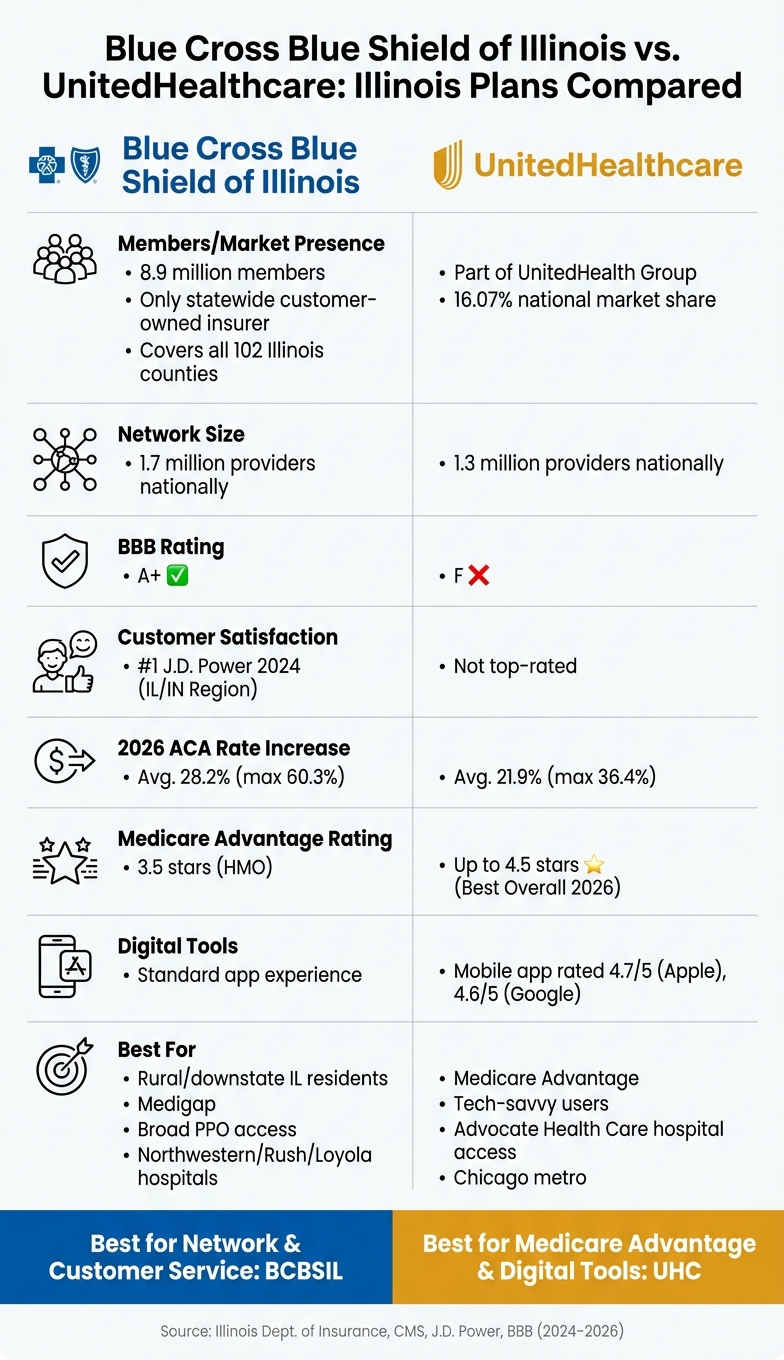
Blue Cross Blue Shield vs. UnitedHealthcare Illinois: Side-by-Side Comparison
Blue Cross Blue Shield and UnitedHealthcare in Illinois: A Quick Overview
Blue Cross Blue Shield of Illinois
Blue Cross Blue Shield of Illinois (BCBSIL) stands out as the only statewide, customer-owned health insurer in Illinois, serving all 102 counties and over 8.9 million members. This local ownership allows BCBSIL to prioritize the needs of Illinois residents.
One of BCBSIL’s biggest strengths is its extensive network. Thanks to the Blue Cross Blue Shield Association, members gain access to a national network of 1.7 million healthcare providers, making it the largest health insurance network in the U.S. BCBSIL primarily relies on PPO networks, giving members the flexibility to see specialists and access care without needing referrals. This is particularly beneficial for those in rural or urban areas. The insurer holds an A+ rating from the Better Business Bureau and secured the highest customer satisfaction score in the Illinois/Indiana region in J.D. Power‘s 2024 rankings.
In comparison, UnitedHealthcare operates differently within Illinois.
UnitedHealthcare in Illinois
UnitedHealthcare (UnitedHealthcare) operates in Illinois as part of its broader, national strategy under UnitedHealth Group, one of the largest for-profit health insurance companies in the U.S.
UnitedHealthcare offers a variety of plan types, including HMO, PPO, EPO, and POS plans, across individual, employer group, and Medicare markets. The company has a strong presence in Medicare Advantage and provides a suite of digital tools, such as a mobile app with a high rating of 4.7/5 stars. However, UnitedHealthcare’s F rating from the Better Business Bureau stands in stark contrast to BCBSIL’s top-tier rating.
Provider Network Comparison
The size of a provider network can significantly impact access to in-network care, especially for those living outside major metropolitan areas. Here’s a side-by-side comparison of the two carriers:
| Feature | BCBSIL | UnitedHealthcare |
|---|---|---|
| National Provider Count | 1.7 million | 1.3 million |
| Hospital & Facility Access | Covers all 102 Illinois counties | 6,700+ hospitals nationally |
| BBB Rating | A+ | F |
| J.D. Power (IL/IN Region) | #1 in 2024 | Not top-rated |
| Ownership | Customer-owned, Illinois-based | Subsidiary of UnitedHealth Group |
While UnitedHealthcare’s digital tools and urban-focused plans may attract tech-savvy members, BCBSIL’s broader network and strong local emphasis make it a compelling choice for many Illinois residents.
sbb-itb-a729c26
ACA Individual and Family Plans: BCBSIL vs. UnitedHealthcare
Plan Types and Network Structures
When it comes to ACA plans in Illinois, both BCBSIL and UnitedHealthcare offer options across the Bronze, Silver, and Gold tiers, but their network setups are quite different.
BCBSIL provides both PPO and HMO plans. The Blue Choice Preferred PPO offers statewide access without the need for referrals, includes out-of-network benefits, and extends coverage through the BlueCard® program for travel outside Illinois. On the other hand, the Blue Precision HMO is more restrictive, available only in certain areas like Chicago, Peoria, and Rockford. It requires selecting a primary medical group and typically does not cover out-of-network care except for emergencies.
UnitedHealthcare organizes its ACA plans into branded tiers: Essential, Value, Standard, Advantage, and Copay Focus. A standout feature of the Copay Focus plan is its $0 medical deductible, available across all metal levels. Additionally, some UnitedHealthcare plans include dental and vision perks, such as two annual dental checkups and a $150 allowance for vision frames.
These differences in structure play a significant role in premium costs, which we’ll explore next.
Cost Comparison
Premium costs for both BCBSIL and UnitedHealthcare plans are influenced by five factors: age, location, tobacco use, enrollment type (individual or family), and metal tier. The rate increases for 2026 reveal some noteworthy contrasts.
The Illinois Department of Insurance‘s 2026 filings show that BCBSIL has an average individual rate increase of 28.2%, with some plans seeing hikes as high as 60.3%. Meanwhile, UnitedHealthcare’s average increase is lower at 21.9%, with a maximum increase of 36.4%.
| Carrier | Avg. Rate Increase | Max Rate Increase | Min Rate Increase |
|---|---|---|---|
| BCBSIL | 28.2% | 60.3% | -8.1% |
| UnitedHealthcare of IL | 21.9% | 36.4% | -1.4% |
(Source: Illinois Department of Insurance Final PY 2026 Filings)
For households not eligible for subsidies, UnitedHealthcare’s lower average rate increase might make it a more affordable choice in 2026. However, it’s worth noting that several competitors are leaving the Illinois marketplace next year, which could impact plan options and pricing in certain areas.
How Illinois Health Agents Can Help with ACA Plans
Deciding between BCBSIL and UnitedHealthcare requires careful consideration of factors like premiums, subsidies, ZIP code, and provider networks. This is where Illinois Health Agents can assist. They guide individuals and families through the Get Covered Illinois marketplace, helping to compare plans based on location, household income, and subsidy eligibility.
Most Illinois residents qualify for Premium Tax Credits, and those who choose a Silver-tier plan may also benefit from Cost-Sharing Reductions (CSRs) to lower out-of-pocket costs like deductibles and copays. An agent can help you determine which carrier and metal tier will save you the most money after applying these subsidies.
Employer Group Health Plans: BCBSIL vs. UnitedHealthcare
Plan Design Options
When shifting from individual plans to employer-sponsored group options, Illinois businesses have a variety of choices from BCBSIL and UnitedHealthcare, each offering distinct solutions.
BCBSIL organizes its group plans based on company size. Small businesses (2–50 employees) can select the Blue Choice Preferred PPO, while mid-sized employers (51–150 employees) have access to the BluePrint PPO, which includes over 23,000 doctors and 200 hospitals in Illinois. Larger organizations (151+ employees) can choose between the Blue Choice Select PPO and the Blue Advantage HMO. Notably, the Blue Advantage HMO offers up to 25.2% savings compared to broader PPO plans.
For employers looking to reduce costs further, the Blue High-Performance Network (BlueHPN) is available in over 65 major markets across the U.S. This option delivers an additional 10% in savings compared to standard PPO plans.
"Employers that choose BlueHPN average more than 10% in additional savings as compared to our already industry-leading PPO." – Blue Cross and Blue Shield of Illinois
UnitedHealthcare, on the other hand, provides traditional PPO and HMO plans alongside alternative options such as short-term coverage, fixed indemnity plans, and critical illness insurance. Both BCBSIL and UnitedHealthcare also support high-deductible health plans (HDHPs) that pair with Health Savings Accounts (HSAs).
Wellness Programs and Digital Tools
BCBSIL offers employers access to the Blue Access for Employers (BAE) portal, simplifying tasks like enrollment, billing, and managing member ID cards. For larger companies, Health Advocacy Solutions connects employees with dedicated advocates to assist with navigating care, locating in-network providers, and managing prior authorizations.
BCBSIL’s integrated approach to pharmacy and medical benefits has shown tangible results, including a 15% reduction in inpatient utilization and annual savings of $1,452 per member for conditions like Crohn’s disease. Their Wellbeing Management program assigns employees to multidisciplinary clinical teams that address areas such as behavioral health, pharmacy, maternity, and oncology care.
"Our strategy links pharmacy and medical benefits to lower overall health care costs, improve health outcomes and deliver an unrivaled member experience." – Blue Cross and Blue Shield of Illinois
UnitedHealthcare also provides a range of digital tools and wellness resources, including quick access to specialist referrals, which makes it a strong choice for employers managing diverse and complex workforces. Both carriers emphasize employee well-being through their offerings, ensuring businesses can tailor support to meet their workforce needs.
How Illinois Health Agents Supports Employers
Selecting between BCBSIL and UnitedHealthcare involves more than just comparing premiums. Factors like employer contribution models, workforce demographics, and network access play a significant role in finding the right fit.
Illinois Health Agents partners with Illinois businesses to simplify this process. Their local expertise helps employers evaluate group health options and make informed decisions. For businesses with 10 or fewer employees, their group health service costs $250 annually, though this fee is waived when at least 10 employees enroll. For larger businesses, the service is entirely free. They also assist with crafting contribution strategies, setting up HSAs, and conducting annual reviews to ensure coverage stays aligned with both budget constraints and workforce needs.
UnitedHealthcare vs BlueCross BlueShield 🥊 (WHICH IS BETTER?!)
Medicare Plans: BCBSIL vs. UnitedHealthcare in Illinois
After analyzing ACA and group plans, let’s shift focus to Medicare options – a crucial decision for Illinois residents aged 65 and older. With approximately 2.26 million seniors in Illinois, or 17.6% of the state’s population, relying on Medicare, understanding the differences between BCBSIL (Blue Cross and Blue Shield of Illinois) and UnitedHealthcare (UnitedHealthcare) can help make an informed choice. Both providers offer Medicare Advantage, Medigap, and Part D plans, but their offerings vary in terms of plan selection, costs, and star ratings.
Medicare Advantage Plans
UnitedHealthcare provides a wider range of Medicare Advantage plans in Illinois, offering 19 to 24 options, including HMO-POS, PPO, and Special Needs Plans tailored for chronic conditions or institutional care. These plans average 3.8 stars, with some rated as high as 4.5 stars, earning UnitedHealthcare recognition as the "Best Overall" Medicare Advantage provider in Illinois for 2026. BCBSIL, on the other hand, focuses on HMO and PPO structures, with its main offering being the Medicare Advantage Secure (HMO) plan, which has a 3.5-star rating from CMS for 2026.
UnitedHealthcare’s HMO-POS plans stand out for offering more flexibility with out-of-network care, which may be important if your preferred doctors are not in-network.
| Feature | BCBSIL Secure (HMO) | UnitedHealthcare Essentials (HMO-POS) |
|---|---|---|
| 2026 CMS Rating | 3.5 Stars | 4.0 Stars |
| Monthly Premium | $0.00 | $0.00 |
| Annual Deductible | $450 | $440 (Rx) |
| Max Out-of-Pocket | $4,750 | $2,900 |
| Network Type | HMO | HMO-POS |
One major difference is the out-of-pocket cost limit. UnitedHealthcare’s Essentials plan caps costs at $2,900, much lower than BCBSIL’s Secure HMO, which has a limit of $4,750. However, UnitedHealthcare’s CareFlex HMO-POS plan comes with a higher out-of-pocket maximum of $6,700, so it’s essential to carefully review the details of each plan.
Medicare Supplement (Medigap) Plans
Illinois residents benefit from being in a guaranteed issue state, which ensures that individuals aged 65 and older cannot be denied Medigap coverage due to health conditions. Both BCBSIL and UnitedHealthcare offer popular standardized plans, such as Plan G and Plan N, but there are some notable differences.
BCBSIL’s Medigap options include "Secure Plans" (A, F, G, and N), which offer lower rates for applicants who meet specific health criteria. Additionally, BCBSIL provides "Plus" versions of Plans G and N, which bundle extra benefits like dental, vision, hearing, and fitness perks. For instance, the Plus plans include two free dental cleanings and oral exams per year, along with a $130 reimbursement for eyeglasses or contact lenses.
The primary trade-off between Plan G and Plan N remains consistent across both carriers:
- Plan G covers Part B excess charges and does not include copays for office or emergency room visits.
- Plan N has lower monthly premiums but may charge up to $20 for office visits and $50 for emergency room visits that don’t lead to inpatient admission.
Both providers also offer "Select" versions of these plans, which reduce premiums if you use specific network hospitals for non-emergency care.
How Illinois Health Agents Can Help with Medicare
Navigating Medicare options can feel overwhelming, but local experts at Illinois Health Agents simplify the process. They provide unbiased guidance, helping you compare Medicare Advantage, Medigap, and Part D plans. Whether you need assistance verifying your doctor’s participation in a network, understanding out-of-pocket limits, or exploring Special Needs Plans, their brokers tailor recommendations to your specific needs. By working with multiple carriers, they ensure you find the plan that aligns best with your personal situation.
How to Choose Between BCBSIL and UnitedHealthcare in Illinois
Making the right choice depends on where you receive care, how you prefer to manage your plan, and your specific coverage needs.
Blue Cross Blue Shield of Illinois: Key Strengths
BCBSIL offers an extensive Blue Choice Preferred PPO network that covers all 102 Illinois counties. This includes approximately 176 hospitals and 73,027 providers, with major systems like Northwestern and Rush in the mix. This broad network is especially beneficial for residents outside the Chicago metro area. BCBSIL also boasts high customer satisfaction ratings and is a top choice for Medicare Supplement (Medigap) plans.
UnitedHealthcare: Key Strengths
UnitedHealthcare shines in Medicare Advantage plans, with CMS ratings ranging from 4.0 to 4.5 stars. Its mobile app is also highly rated, scoring 4.7/5 on Apple and 4.6/5 on Google, making it a great fit for tech-savvy users. Additionally, UnitedHealthcare includes Advocate Health Care hospitals in its marketplace networks, which are not part of BCBSIL’s standard PPO. These distinctions highlight the important factors Illinois residents need to weigh.
Decision Factors for Illinois Residents
When choosing between BCBSIL and UnitedHealthcare, consider these Illinois-specific points:
- Advocate Health Care hospitals, located in Cook, DuPage, Kane, Lake, and Will counties, are not included in BCBSIL’s Blue Choice Preferred PPO but are covered under UnitedHealthcare and BCBSIL’s BlueCare Direct HMO. Residents in Cook County can also opt for BCBSIL’s Blue FocusCare micro-network, which offers lower premiums but a narrower provider list.
- Rural Illinois residents often find BCBSIL’s statewide network coverage more reliable.
| Factor | Favor BCBSIL | Favor UnitedHealthcare |
|---|---|---|
| Hospital Preference | Northwestern, Rush, Loyola | Advocate Health Care |
| Medicare Priority | Medicare Supplement plans | Medicare Advantage (higher CMS ratings) |
| Location | Rural or downstate Illinois | Chicago metro with Advocate access |
| Digital Experience | Standard app experience | Higher-rated mobile app |
| Customer Service | A+ BBB, #1 J.D. Power | F BBB rating |
How Illinois Health Agents Can Help You Decide
Choosing the right plan can feel overwhelming, especially with variations in plan availability, hospital networks, and costs across Illinois counties. Illinois Health Agents work with both BCBSIL and UnitedHealthcare to help you compare options based on your ZIP code, preferred doctors, and budget. Whether you’re looking into ACA plans, group coverage for your business, or Medicare options, these local brokers provide customized comparisons to match your needs.
Conclusion
While BCBSIL shines with its extensive statewide network and impressive customer satisfaction, UnitedHealthcare sets itself apart with its advanced digital tools and strong Medicare Advantage options. Each provider has its strengths: BCBSIL is a solid choice for Illinois residents, particularly those outside the Chicago metro area, thanks to its reliable Medicare Supplement plans and widespread network. Meanwhile, UnitedHealthcare appeals to those seeking innovative digital resources and competitive Medicare Advantage plans.
As Dylan Tate, Insurance Content Expert, explains:
"Blue Cross Blue Shield stands out thanks to its high customer satisfaction ratings."
Ultimately, the best carrier for you depends on your location and how you plan to use your coverage.
To make the decision easier, Illinois Health Agents offers tailored side-by-side comparisons based on your ZIP code, preferred providers, and budget. Whether you’re exploring ACA plans, employer group coverage, or Medicare options, their personalized service helps you find the plan that fits your needs without the hassle.
FAQs
Which plan is best if I need my current doctors and hospitals in-network?
If staying with your current doctors and hospitals is important to you, Blue Cross Blue Shield (BCBS) might be the better option. With a network that includes approximately 1.7 million providers, BCBS offers a greater likelihood that your preferred providers will be in-network. While UnitedHealthcare also provides wide-ranging coverage, BCBS’s expansive network can help you save on out-of-pocket expenses and ensure consistent care with the providers you trust.
How do I compare real yearly costs beyond the monthly premium?
When comparing yearly healthcare costs, don’t just focus on the monthly premium. Take into account deductibles, copayments, coinsurance, and out-of-pocket maximums. A plan with a lower premium might seem appealing, but higher deductibles or copays can add up quickly if you require frequent medical care. Look closely at the coverage provided for services you expect to use and the annual out-of-pocket limit. To get a clearer picture of your total potential expenses for the year, review the plan documents thoroughly or seek advice from a professional.
When should I choose Medicare Advantage vs. Medigap in Illinois?
Choosing between Medicare Advantage and Medigap in Illinois comes down to your health needs and financial situation.
- Medicare Advantage plans usually have lower premiums and often include added perks like dental, vision, or hearing coverage. However, they typically limit your choice of healthcare providers.
- Medigap, on the other hand, gives you access to a wider network of providers and offers more predictable out-of-pocket costs. That said, these plans tend to come with higher premiums.
Your decision depends on what matters most – additional benefits or greater flexibility. For tailored advice, reach out to local experts like Illinois Health Agents.
Recent Comments