Providing health coverage to employees is expensive, especially with medical costs projected to rise by 9% in 2026. Employers in Illinois face tough choices when structuring their contributions. Two common approaches are:
- Percentage-of-premium models: Employers cover a fixed percentage of premiums, offering cost predictability but limited employee choice.
- Defined contribution models: Employers allocate a set monthly amount, giving employees flexibility to choose their own plans but shifting cost increases to them.
Each model has pros and cons, from cost control to employee satisfaction. For small businesses, the Small Business Health Care Tax Credit (up to 50% of premiums) and ACA affordability standards (employee-only premiums under 9.78% of household income) are key considerations. Choosing the right plan depends on your workforce’s needs, budget, and compliance requirements.
Employer Health Insurance Contribution Requirements
sbb-itb-a729c26
1. Percentage-of-Premium Contributions
One of the more straightforward ways for employers to manage health plan costs is through percentage-of-premium contributions. With this approach, the employer agrees to cover a fixed percentage of each employee’s monthly premium. For example, a business might pay 83% of single coverage and 73% of family coverage, which reflects the national average for U.S. employers. Employees then cover the remaining portion through payroll deductions.
Employer Cost Predictability
This model offers a level of cost stability since carriers set monthly premiums at the beginning of the plan year. However, employers still face the challenge of annual renewal rate increases, which typically range from 12% to 18%.
"Fully-funded group plans offer predictability but pass all claims risk to the employer through higher premiums – you pay the same whether your group is healthy or not." – Sam Newland, Founder, BENEFITRA
Employers have additional options for managing costs, such as composite rating and age-rated pricing. Age-rated pricing, in particular, can be advantageous for businesses with younger employees, as it results in lower premiums.
While this model provides clarity for budgeting, it’s equally important to consider how it affects employees.
Employee Impact
For employees, percentage-of-premium contributions simplify the payment process, as premiums are automatically deducted from their paychecks. However, their plan choices are limited to those selected by the employer. In Illinois, small group deductibles are typically capped at $2,000 for individuals and $4,000 for families. Additionally, to comply with ACA affordability standards in 2026, the employee-only premium must stay below 9.78% of the employee’s household income.
These factors play a key role in evaluating whether this model aligns with both employer and employee needs.
Suitability for Illinois Employers
This contribution model is particularly effective for Illinois businesses with steady workforce numbers and employees who prioritize simplicity over having a wide range of plan options. The Illinois small group market has remained stable through the 2025–2026 period, with carriers like Aetna, BCBSIL, and UnitedHealthcare continuing to participate consistently. Moreover, traditional group plans typically require 70% employee participation, but this requirement is waived during the special enrollment window from November 15 to December 15 each year.
Illinois Health Agents leverage their local expertise to help employers design group health plans that align with their cost-saving objectives while meeting the needs of their workforce.
2. Defined Contribution Models
Defined contribution models present a fresh approach to tackling rising healthcare costs. In these models, employers allocate a fixed monthly amount for employees to use toward purchasing their own individual health coverage. The two primary options here are the ICHRA (Individual Coverage Health Reimbursement Arrangement) and the QSEHRA (Qualified Small Employer Health Reimbursement Arrangement). Employees select plans independently through Get Covered Illinois – the state’s health insurance marketplace – and then submit reimbursement requests up to the employer’s set limit. This setup keeps employer expenses predictable while shifting the burden of premium changes to employees.
Employer Cost Predictability
A major benefit of defined contribution models is the ability to keep employer costs steady. Once the monthly contribution is set, it doesn’t change unless the employer decides to adjust it. If marketplace premiums increase, employees bear the additional cost, not the employer. This is a stark contrast to traditional group plans, where employers are often left covering unexpected cost increases during plan renewals.
"With a group plan, you’re promising a level of benefit and absorbing whatever cost fluctuations come with it. With defined contribution, you’re promising a dollar amount, full stop." – Take Command Health
Another advantage is the absence of participation minimums, which can be a significant barrier for small or high-turnover businesses. This makes defined contribution models more accessible to a wider range of employers.
Employee Impact
For employees, this model offers genuine choice in selecting a health plan. They can pick any qualifying plan on Get Covered Illinois that matches their specific needs – whether it’s finding a doctor they prefer, covering essential prescriptions, or staying within their budget. Another perk? The coverage is portable. If an employee leaves the company, they keep their individual plan rather than losing their health insurance.
However, employees take on financial risk if their plan’s premiums exceed the employer’s contribution. For 2026, QSEHRA reimbursements are federally capped at $6,350/year for individuals and $12,800/year for families (approximately $529/month and $1,067/month, respectively). ICHRA, on the other hand, has no federal cap, giving employers more flexibility to set contribution amounts based on their budget and workforce needs.
Administrative Complexity
Unlike traditional group plans – where insurance carriers handle most administrative tasks – defined contribution models shift some responsibilities to employers. Tasks like coverage verification and reimbursement processing now fall on the employer’s shoulders. To simplify this, many businesses use specialized HRA administration software that automates documentation, expense verification, and compliance reporting. Without such tools, the administrative burden can become significant.
While these models require more effort on the administrative side, they allow employers to tailor benefits to meet the diverse needs of their workforce.
Suitability for Illinois Employers
Since 2020, ICHRA adoption among small businesses in Illinois has grown significantly. Nationally, between 2024 and 2025, small employer ICHRA use jumped by 52%. Interestingly, 83% of employers offering an ICHRA or QSEHRA for the first time in 2025 had not previously provided any health coverage. This trend highlights how defined contribution models are enabling more businesses to offer health benefits for the first time.
Illinois employers should also be aware of ICHRA’s class-based reimbursement options. For instance, businesses can offer $400/month to employees under 30 and $700/month to those over 50. This flexibility aligns with ACA non-discrimination rules. Proper structuring of these class definitions is critical for compliance, and Illinois Health Agents can assist employers in documenting these policies correctly.
The adaptability of this model makes it an effective way to manage employer contributions while meeting the needs of a diverse workforce.
| Illinois Employer Size | Mandate Status | Recommended Defined Contribution Path |
|---|---|---|
| 1–24 FTEs | No mandate | QSEHRA (capped) or ICHRA (uncapped) |
| 25–49 FTEs | No mandate | ICHRA (class-based differentiation) |
| 50+ FTEs | Mandate applies | ICHRA (must meet 9.78% affordability standard) |
Pros and Cons
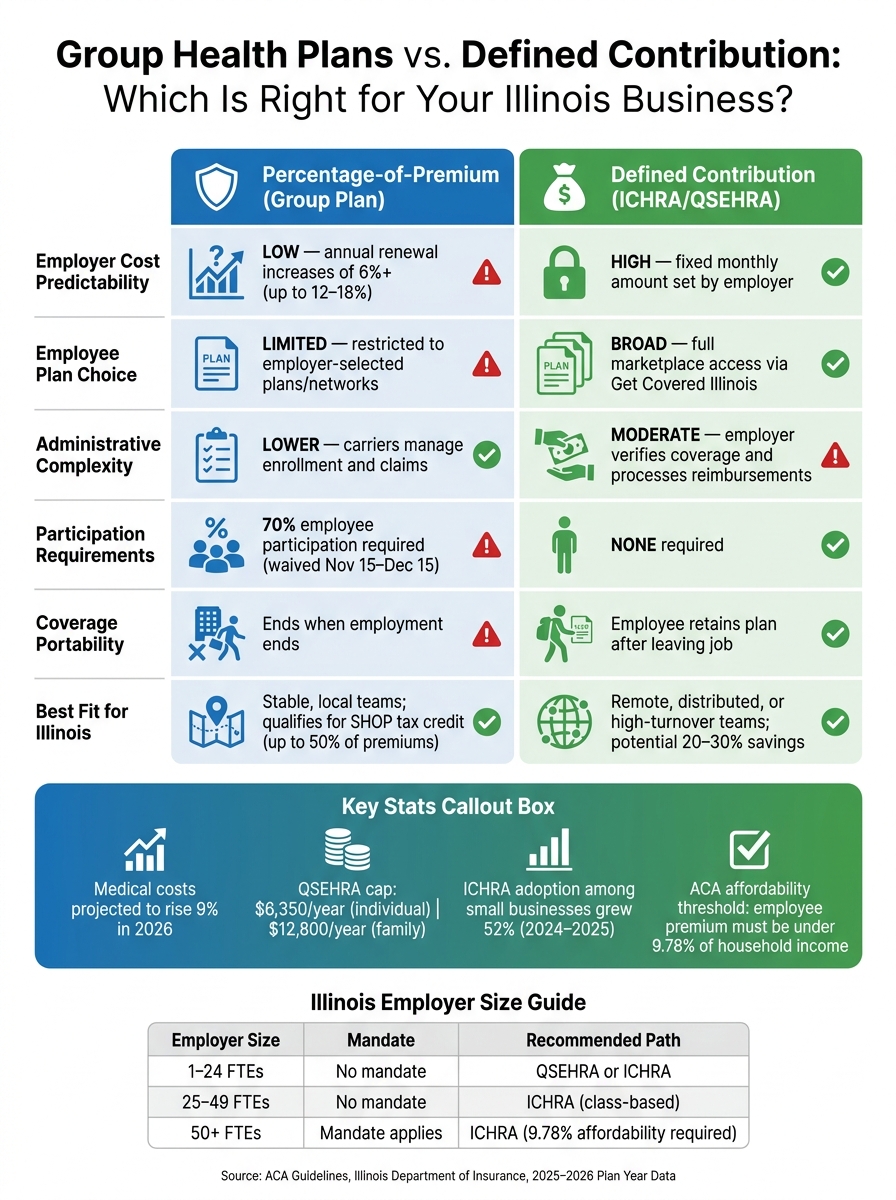
Group Health Plans vs. Defined Contribution: Illinois Employer Comparison
Choosing between these two models isn’t a one-size-fits-all decision. Each comes with its own advantages and challenges, depending on your business size, workforce dynamics, and financial goals. Here’s a side-by-side look at how they compare on key factors for Illinois employers:
| Criteria | Percentage-of-Premium (Group) | Defined Contribution (ICHRA/QSEHRA) |
|---|---|---|
| Employer Cost Predictability | Low – costs can rise annually, with average renewal increases of 6% or more | High – employers set a fixed monthly amount, offering more control over expenses |
| Employee Plan Choice | Limited to plans and networks chosen by the employer | Broad selection through the full marketplace, like Get Covered Illinois |
| Administrative Complexity | Lower – insurance carriers manage enrollment and claims | Moderate – employers handle verifying coverage and reimbursing employees |
| Participation Requirements | Typically 70% participation in Illinois (waived between Nov 15 and Dec 15) | None |
| Coverage Portability | Ends when employment does | Employees can retain their plan even after leaving the job |
| Suitability for Illinois | Ideal for stable, local teams looking to benefit from the SHOP tax credit | Best for remote, distributed, or high-turnover teams |
These comparisons highlight the unique strengths and weaknesses of each model. Employers need to weigh these factors carefully to strike the right balance between managing costs and supporting employee needs.
"Small businesses with diverse workforces often save 20–30% with defined contribution models" – ForHealthInsurance.com
For example, a single-location business with a steady team of full-time employees may find the simplicity of a group plan appealing. Meanwhile, startups with remote teams or high employee turnover might lean toward the flexibility and cost control of a defined contribution model. To make the best decision, consulting experts like Illinois Health Agents can help you run the numbers and compare options based on your workforce’s specific needs and claims history.
Conclusion
Both percentage-of-premium and defined contribution models offer practical ways to manage health benefit costs, each catering to different employer needs.
Traditional group plans are straightforward and may qualify for the Small Business Health Care Tax Credit, which can cover up to 50% of premiums for businesses with fewer than 25 full-time equivalent employees (FTEs) and average wages under $64,000 in 2026. On the other hand, defined contribution models, like ICHRA, give employers a fixed monthly budget while allowing employees to select their own coverage through platforms such as Get Covered Illinois.
The best choice depends on your workforce. For businesses with a stable, local team, group plans might be the better fit. However, companies with remote employees, diverse age demographics, or high turnover could see more savings with a defined contribution approach.
Compliance is key. Employers must meet the 9.78% ACA affordability threshold, correctly calculate FTEs, and follow Illinois state continuation rules for businesses with 2–19 employees. Staying on top of these requirements helps avoid costly penalties and ensures healthcare costs are managed effectively.
Partnering with a licensed local broker can make a big difference. Illinois Health Agents provides free assistance to businesses with more than 10 employees, helping them compare group plans, ICHRA, and QSEHRA options, verify SHOP eligibility, and stay compliant with ERISA and Illinois Department of Insurance regulations.
Selecting the right health plan structure is a critical decision. Seek expert guidance before renewal season to ensure your business is set up for success.
FAQs
How do I choose between a group plan and an ICHRA?
Choosing between a group health plan and an Individual Coverage Health Reimbursement Arrangement (ICHRA) comes down to your business priorities, financial considerations, and what your employees need.
Group plans are straightforward and typically come with broad provider networks, making them easy to manage. However, they often require a minimum level of employee participation and can bring unpredictable renewal costs. On the other hand, ICHRAs allow for more control over costs, offer flexibility for employees with varying needs, and provide tax-free reimbursements for individual health insurance plans.
To make the right choice, consider the size of your workforce, your budget, and how much administrative effort you’re prepared to take on.
Will my employees still get subsidies with an ICHRA?
Employees can still qualify for subsidies while using an ICHRA (Individual Coverage Health Reimbursement Arrangement). Since ICHRA reimbursements are tax-free, they don’t interfere with eligibility for ACA marketplace premium subsidies. This means employees can take advantage of both the ICHRA benefits and premium assistance, making it easier to manage healthcare expenses.
What counts as ACA affordability for employers in 2026?
In 2026, employer-sponsored minimum essential coverage is deemed affordable if the employee’s share of the premium for the lowest-cost self-only plan (that meets minimum value) does not exceed 9.96% of their household income. Employers have three IRS-approved affordability safe harbors to determine this: FPL (Federal Poverty Line), W-2 wages, and rate of pay. Under the FPL safe harbor, the maximum monthly employee contribution for self-only coverage is set at $129.90 for the mainland U.S.
Recent Comments