
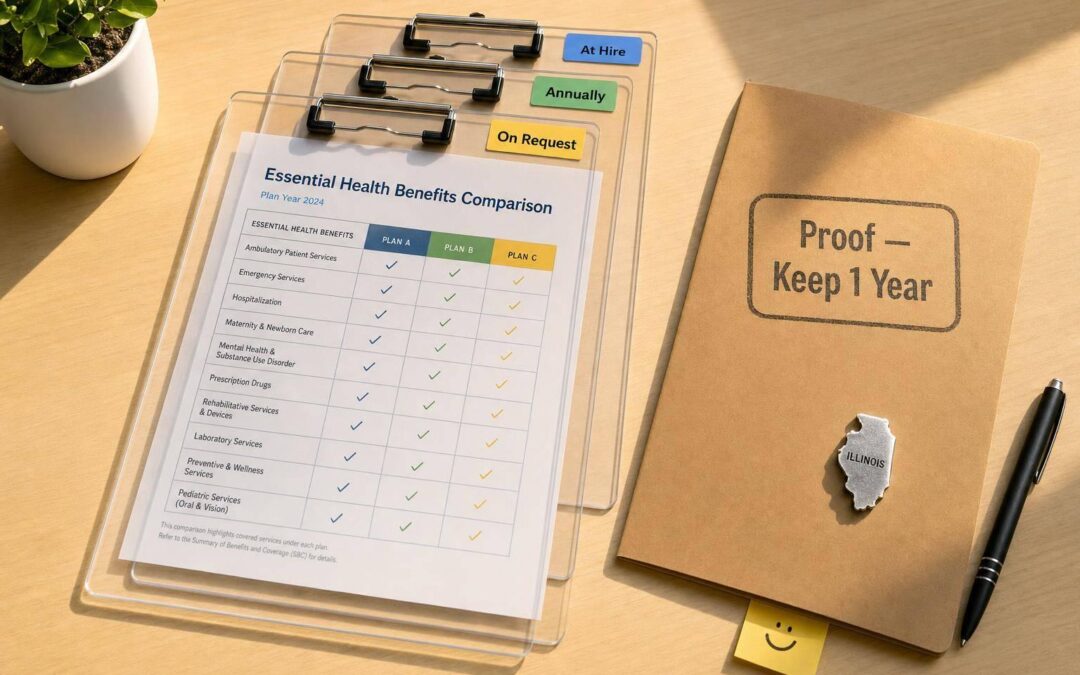
If I offer a group health plan to Illinois workers, I need more than the SPD and SBC. I also need a written Illinois CCDA disclosure that compares each plan option to the state’s EHB benchmark, give it at hire, once a year, and on request, and keep proof for at least 1 year.
Here’s the short version:
- The CCDA took effect on August 27, 2021
- It applies to many Illinois employer group health plans, including fully insured, self-funded, and ERISA plans
- I must give the notice to employees eligible for coverage, even if they have not enrolled
- The notice must show whether each EHB is covered, not covered, or partially covered
- SPD, SBC, and SMM do not replace the CCDA notice
- Penalties can range from $500 to $5,000 per violation
- If a plan only covers part of a benefit, I should mark “Partially” and explain the gap in plain English
A few points matter most. The law is about disclosure, not forcing a plan change. For remote or multi-state teams, I should look at the employee’s Illinois work base. And if I cannot sort out a close call, it is smart to document the facts and send the notice.
Quick comparison
| Item | What I need to know |
|---|---|
| Illinois CCDA notice | Compare plan benefits to Illinois EHBs |
| Who gets it | Eligible Illinois employees |
| When it’s due | At hire, annually, and on request |
| Delivery | Email, employee website, or paper |
| Recordkeeping | Keep proof for at least 1 year |
| Penalty range | $500 to $5,000 per violation |
| Key mistake to avoid | Marking “Yes” when coverage only matches in part |
If I build one simple process for plan review, delivery, and recordkeeping, I cut down the risk of missed notices and bad plan comparisons.
New Illinois State Law Imposes Disclosure Requirements on Group Health Plans
sbb-itb-a729c26
Illinois and Federal Rules That Apply to Group Plans
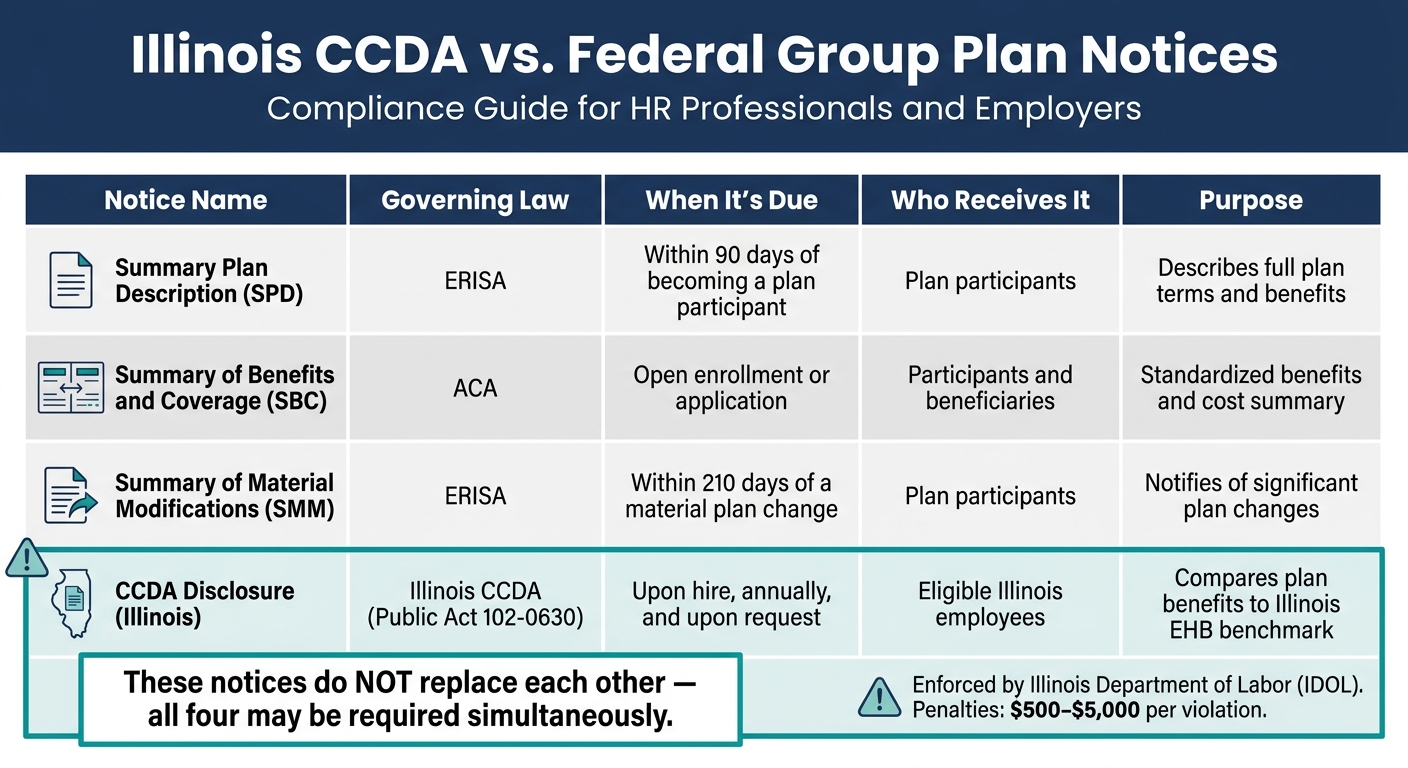
Illinois CCDA vs. Federal Group Plan Notices: Side-by-Side Compliance Guide
With the CCDA scope already set, the next step is sorting out Illinois disclosures from federal plan notices.
Illinois employers have to handle both at the same time. If you miss either one, you can end up with liability. The CCDA is a state disclosure rule. ERISA and the ACA add separate federal notice duties. So the goal isn’t to treat these as two random checklists. It’s to run them through one compliance workflow so nothing slips through.
Illinois Consumer Coverage Disclosure Act Requirements
The CCDA (Public Act 102-0630) requires employers to give employees a written comparison between their group health plan benefits and Illinois’ Essential Health Benefits (EHBs). The Illinois Department of Labor (IDOL) enforces this law.
One point matters a lot here: do not mark a benefit as "Yes" unless it matches the benchmark EHB.
Use the IDOL model template to make sure each EHB category is covered. If the plan only covers part of a benefit, mark it as "Partially" and explain the gap in plain English. That extra detail can save trouble later. A vague form might look done on paper, but it doesn’t do much if an employee can’t tell what the plan actually covers.
The CCDA applies to Illinois employers with group health plans, including:
- fully insured plans
- self-funded plans
- ERISA plans
That reach exists because the law is about disclosure, not changing benefits.
And that split matters. The CCDA has its own timing rules, while federal notices follow ERISA and ACA deadlines.
Federal Notices That Apply to Group Plans
Federal law adds a separate set of notices that employers need to track alongside the CCDA. The smart move is to use one compliance calendar so these deadlines don’t collide.
| Notice | Governing Law | When It’s Due | Who Receives It |
|---|---|---|---|
| Summary Plan Description (SPD) | ERISA | Within 90 days of becoming a plan participant | Plan participants |
| Summary of Benefits and Coverage (SBC) | ACA | Open enrollment or application | Participants and beneficiaries |
| Summary of Material Modifications (SMM) | ERISA | Within 210 days of a material plan change | Plan participants |
| CCDA Disclosure | Illinois CCDA | Upon hire, annually, and upon request | Eligible employees |
SMMs still keep their own timing when plan changes happen. That means a CCDA update doesn’t replace an SMM, and an SMM doesn’t replace a CCDA disclosure.
Late, incomplete, or inconsistent notices under any of these rules create direct employer exposure.
Who Must Comply and Which Employees Must Receive Notices
The tougher part is figuring out whether the CCDA applies to your workforce. In plain English, it usually comes down to two things: where the employee works and whether that employee can join the plan.
How to Confirm Your Plan Is Covered
The CCDA applies to Illinois employers that sponsor group health plans and have Illinois workers. That includes self-funded plans and ERISA plans, because the law deals with notice requirements, not plan design changes. So even if your main office is in another state, that doesn’t let an Illinois worksite off the hook.
Which Illinois Employees Should Receive Disclosures
Give the notice to every employee who is eligible for coverage at hire, once each year, and whenever the employee asks for it. That group includes employees who can join the plan but haven’t enrolled yet, including new hires and part-time workers who meet the plan’s eligibility rules. Many employers send the yearly notice during open enrollment.
For hybrid and multi-state teams, the headquarters location doesn’t decide the issue. For remote and multi-state workers, look at the employee’s Illinois work base to decide whether the CCDA applies. If the facts are murky, document the work location and send the disclosure.
Once you know which employees are covered, the next move is to set up a clear delivery and recordkeeping process.
How to Build a Compliant Illinois Disclosure Process
Once you know who needs the notice, the next step is building a process you can run the same way every year. The goal is simple: send the right disclosure on time and keep clear proof that it was delivered.
Trigger the disclosure at hire, during open enrollment, and whenever an employee asks for it. For the annual notice, tying it to open enrollment usually makes life easier. Just include the EHB comparison in the open enrollment packet. If plan terms change, update the disclosure before the change starts. At that point, a plain document checklist becomes the backbone of the process.
Create an Annual Disclosure Calendar and Document Checklist
Track the carrier certificate, SPD, SBC, and completed CCDA form for each plan year. Then line those documents up with the Illinois EHB template.
A simple tracking system can help you avoid last-minute scrambling. Keep each plan year’s documents together so you can see what’s missing right away instead of hunting through old files when enrollment season hits.
Match Plan Documents to the Illinois EHB Comparison
The Illinois Department of Labor (IDOL) provides a model disclosure form in Excel or PDF format, updated for 2025, that you can use to list each Essential Health Benefit category. Use the carrier certificate and SBC to complete the IDOL form line by line.
Be careful here. This part isn’t just box-checking. If a benefit only matches in part, mark it as "Partially" and give a short note about the gap.
"Answering ‘yes’ if the coverage does not match the full extent of the benchmark plan may be considered misinformation."
Your insurance carrier or a third-party administrator (TPA) can help map plan benefits against the EHB list. Also, complete a separate form for each plan option.
Set Up Delivery and Recordkeeping Controls
Use email, a regularly accessible employee website, or paper delivery with proof of receipt. Whatever method you use, keep proof for every disclosure sent.
For example:
- For email, save the sent log or request a read receipt.
- For a benefits portal, capture the confirmation timestamp.
- For paper, keep a signed acknowledgment or a dated mailing record.
"Upon request of the Department of Labor, the employer shall demonstrate that each employee received the information required by Section 10 and maintain records of providing such information for one year."
File records by plan year so they’re easy to pull during an audit. It also helps to keep a ready-to-send PDF of the current year’s form on hand, so you can respond fast if an employee asks for it. If a violation is found, you get a 30-day window after receiving a notice to show cause to fix it before penalties apply.
Next, review the most common disclosure mistakes so you can catch them early and avoid added risk.
Monitoring, Risk Reduction, and Next Steps
Common Disclosure Mistakes That Create Liability
Once the workflow is set up, review it for the slipups that most often lead to penalties.
If a plan only covers part of the required benefits, mark it as "Partially" and add a short, plain-English note. During the annual audit, pay close attention to delivery lists and plan-specific forms. The goal is simple: make sure every eligible employee got a disclosure, and make sure each plan option has its own completed form.
| Employer Size | 1st Offense | 2nd Offense | 3rd Offense |
|---|---|---|---|
| Less than 4 employees | Up to $500 | Up to $1,000 | Up to $3,000 |
| 4 or more employees | Up to $1,000 | Up to $3,000 | Up to $5,000 |
Use Annual Reviews and Local Support to Stay Current
Work the annual review into open enrollment so the form gets checked before it goes out. The Illinois Department of Labor updates its model disclosure form from time to time, so pull the latest version each year before open enrollment.
If your plan design changes in the middle of the year, update the disclosure before those changes begin. That timing matters.
Illinois Health Agents can also help with plan review, employee education, and annual disclosure checks.
Key Steps Employers Should Take Now
Start by confirming which Illinois rules apply to your plan. Then use the base-of-operations test to identify each employee who must get a notice.
From there:
- Download the current IDOL template and complete a separate form for each plan option. If coverage is partial, mark it the right way.
- Send disclosures at hire, during open enrollment, and when requested. Log each delivery and keep those records for at least one year.
Those steps help keep the disclosure process accurate, on time, and documented.
FAQs
Does the CCDA apply to out-of-state employers with Illinois workers?
Yes. The Consumer Coverage Disclosure Act applies to out-of-state employers if they have employees working in Illinois.
The Illinois Department of Labor uses a base of operations test. That means it looks at factors such as whether the employee works at an Illinois location, has an office in Illinois, or works from home in Illinois.
So the law can apply even if the employer is headquartered in another state or the plan is based somewhere else.
How do I decide if a remote employee counts as Illinois-based?
Illinois uses a base of operations test to decide whether a remote employee counts as Illinois-based for disclosure rules.
That means there isn’t a one-size-fits-all answer. It comes down to the facts in each case, including whether the employee lives in Illinois, works from a home office there, or reports to a location outside the state.
For employers, the practical move is simple: review each remote worker’s setup on its own. A small detail, like where the employee works day to day or where they report, can change the outcome.
What proof should I keep to show the notice was delivered?
Keep records of each disclosure for at least one year so you can show compliance during audits.
Your records should include the notice date, the recipient, and the delivery method. A digital log or a physical file can do the job, as long as it shows the disclosure was sent or received.
For example, you can keep:
- An email delivery confirmation
- A record showing that an employee accessed the disclosure on your company portal
That type of documentation can satisfy Illinois Department of Labor requirements.
Recent Comments