
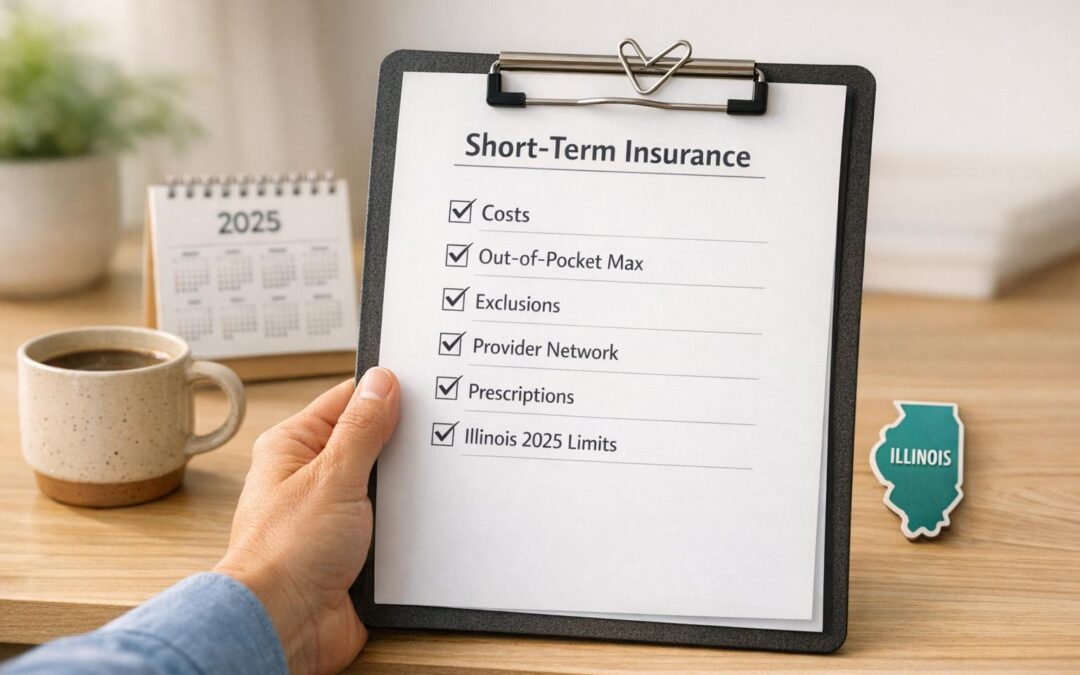
Short-term health insurance is a temporary solution for gaps in coverage, but it comes with limitations. Here’s what you need to know:
- Lower premiums: Plans start around $100/month but have high deductibles and limited benefits.
- Limited coverage: Excludes preexisting conditions, maternity care, mental health, and preventive services.
- Not renewable: In Illinois, short-term plans have been banned since January 2025.
- Financial risks: Out-of-pocket costs can be high, with no cap on spending and low benefit limits.
- Network restrictions: Confirm your providers are in-network to avoid unexpected costs.
For Illinois residents, ACA-compliant plans are the best alternative. These plans cover essential health benefits, protect against high medical expenses, and offer subsidies for most enrollees. If you’re in Illinois, report any short-term plan offers to the state insurance department, as they are no longer legal.
Quick Tip: Always review the plan’s exclusions, benefit caps, and provider network before enrolling. For assistance, consult a licensed agent or explore ACA options through Get Covered Illinois.
Eligibility and Legal Considerations in Illinois
Eligibility Requirements
Starting January 1, 2025, short-term health insurance is no longer an option for Illinois residents. A new state law has banned both new short-term policies and renewals for Illinois residents. Before this change, eligibility for these plans depended on medical underwriting. Insurers would review factors like age, health history, and current medical conditions to decide coverage. Those with significant health issues often faced rejection. This shift in regulation also affects how preexisting conditions are handled.
Preexisting Condition Exclusions
Previously, short-term plans had strict exclusions for preexisting conditions. The Illinois Department of Insurance made this clear:
"Preexisting conditions are not covered under this plan of coverage." – Illinois Department of Insurance
Unlike ACA-compliant plans, which guarantee coverage for preexisting conditions, short-term policies could deny claims – or even coverage altogether – based on conditions like diabetes, heart disease, or cancer history.
Coverage Duration and Policy Limits
Before the ban, Illinois had already imposed stricter rules on short-term plans compared to federal guidelines. State regulations capped these plans at six months, prohibited renewals, and required a 60-day waiting period before purchasing a new plan after one expired. The Illinois General Assembly solidified the ban through Public Act 103-0649, citing deceptive marketing practices that often misled consumers into believing these plans were as comprehensive as ACA-compliant options. However, certain limited benefit policies, like travel insurance or hospital indemnity plans, are still allowed.
Here’s how Illinois rules compared to federal standards before the 2025 ban:
| Policy Feature | Illinois Rule (Pre-2025) | Federal Standard (Pre-2025) |
|---|---|---|
| Maximum duration | 6 months | 364 days |
| Renewals allowed | No | Yes (up to 36 months total) |
| New plan after expiration | 60-day waiting period | No restriction |
| Sale to IL residents (2025+) | Prohibited | N/A |
If you’re uninsured in Illinois, your best option is exploring ACA-compliant plans through Get Covered Illinois. These plans are especially accessible if you qualify for a Special Enrollment Period due to a life event.
Coverage and Benefits Checklist
Key Coverage Areas
Short-term health plans are designed to handle emergencies like hospital stays, surgeries, and urgent diagnostic tests. However, they fall short when it comes to routine or ongoing care. For instance, 98% of short-term plans analyzed in 2025 exclude maternity care, and 94% leave out adult immunizations. Mental health services and substance abuse treatments are also frequently excluded, with 40% of plans omitting coverage for each.
"This is not comprehensive coverage and lacks essential health benefits."
It’s crucial to closely review your plan’s exclusions to avoid surprises when you need care.
Exclusions and Limitations
While these plans provide a safety net for emergencies, they come with notable gaps in coverage.
Prescription drug benefits are one such limitation. 48% of plans exclude outpatient drug coverage altogether. For those that do offer it, coverage is capped at $1,000 to $5,000 per term, which is often insufficient for managing chronic conditions.
Another concern is post-claims underwriting, where insurers review your medical history after you file a claim. This practice can result in denied payments for preexisting conditions. To avoid this, be transparent about your medical history when applying. Withholding information can lead to your policy being rescinded at the worst possible time.
When evaluating a plan, start with the Outline of Coverage document. If a service isn’t explicitly listed as covered, assume it’s excluded. Always verify specifics to avoid misunderstandings.
Benefit Caps and Waiting Periods
Benefit caps and waiting periods can significantly affect your out-of-pocket costs, so understanding these terms is essential. Some plans set their maximum payout as low as $100,000 per policy term, which may not cover a single ICU stay. Unlike ACA-compliant plans that have no annual or lifetime limits on essential benefits, short-term plans can stop paying once you hit the cap. Deductibles can range from $500 to $25,000, and out-of-pocket costs may either remain uncapped or reach as high as $32,500. For comparison, the individual cap on ACA plans in 2025 is $9,200.
Additionally, some plans impose waiting periods for certain services, meaning coverage doesn’t kick in immediately. To get a clearer picture, ask the insurer for a sample Explanation of Benefits (EOB) to see how a major claim – like a $20,000 hospital bill – would be handled.
Short Term Health Insurance Plans – What You Need To Know
Cost and Financial Considerations
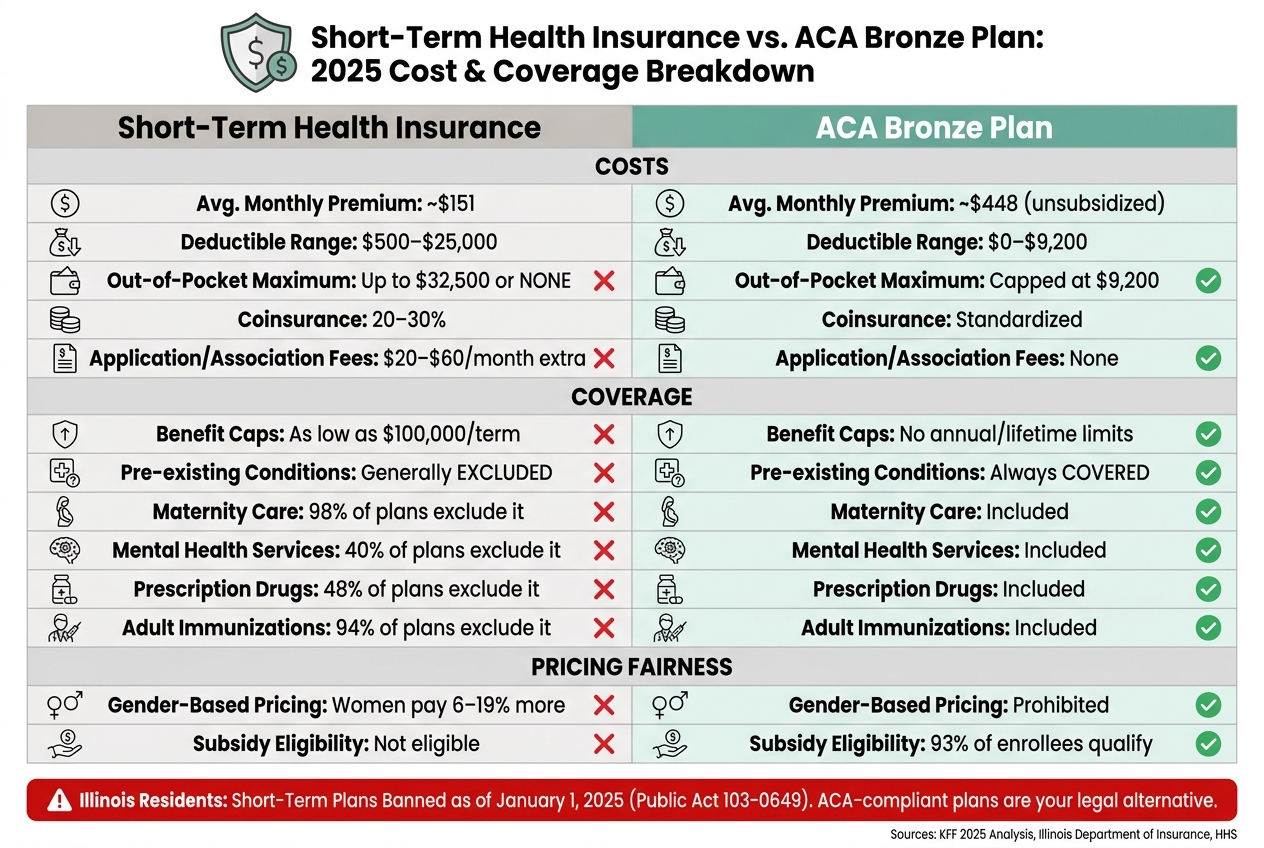
Short-Term Health Insurance vs. ACA Plans: Cost & Coverage Comparison 2025
After reviewing coverage details, it’s essential to weigh the financial risks and costs of short-term health plans.
Breakdown of Costs
Short-term plans often come with an attractive price tag. They typically start at around $100 per month, with an average cost of about $151 per month. This is a stark contrast to the average unsubsidized ACA Bronze plan premium of $448 per month. But don’t let the low premiums fool you – there’s more to consider when calculating the total cost.
Deductibles for these plans can vary significantly, and once you meet the deductible, you’ll generally pay 20%–30% coinsurance on covered services. Prescription drug coverage is another area to watch. Instead of flat copays, most short-term plans offer negotiated discounts, with the remaining costs counting toward your deductible and coinsurance. Additional fees include a one-time application fee of $20–$35 and a monthly association fee of $15–$25.
Out-of-Pocket Maximums and Benefit Caps
Short-term plans can carry significant financial risks. Unlike ACA plans, which cap individual out-of-pocket costs at $9,200 for 2025, short-term plans aren’t required to set a maximum. Some plans cap out-of-pocket exposure at $32,500, while others have no limit at all. In the event of a serious illness or accident, this could leave you with unlimited personal liability.
"Short-term health insurance plans often have lower premiums than ACA plans but can be more expensive when you need care." – Bob Haegele, Personal Finance Writer
Benefit caps are another potential pitfall. For example, a plan with a $100,000 total payout limit could be quickly exhausted during a major hospitalization. To understand the worst-case scenario, add up the total premiums, the full deductible, and applicable coinsurance. Keep in mind that some plans don’t offer any out-of-pocket limit, which could result in overwhelming medical bills. Knowing these limits is crucial before comparing short-term plans to ACA options.
Comparing Costs with ACA Plans
When evaluating value, it’s important to compare short-term plans directly with ACA options. While the low premiums of short-term plans appear competitive, especially against unsubsidized ACA plans, this comparison doesn’t apply to most people. Why? Because roughly 93% of ACA Marketplace enrollees qualify for premium tax credits, making ACA plans far more affordable and comprehensive than short-term alternatives.
A 2025 analysis by KFF highlights this difference. For a 40-year-old earning about $45,140 annually in Houston, TX, a subsidized ACA Bronze plan was 5% cheaper for a male and 23% cheaper for a female compared to the lowest-cost short-term plan available in that area. Gender-based pricing further complicates the comparison, as short-term plans often charge 6%–19% more for women than for men, a practice banned under ACA-compliant plans. Before assuming a short-term plan is a money-saver, it’s worth checking your eligibility for ACA subsidies.
| Feature | Short-Term Plan | ACA Bronze Plan (2025) |
|---|---|---|
| Avg. Monthly Premium | ~$151 | ~$448 (unsubsidized) |
| Deductible Range | $500–$25,000 | $0–$9,200 |
| Out-of-Pocket Max | Up to $32,500 or none | Capped at $9,200 |
| Benefit Caps | As low as $100,000/term | No annual/lifetime limits |
| Gender-Based Pricing | Yes (women pay more) | Prohibited |
| Pre-existing Conditions | Generally excluded | Covered |
sbb-itb-a729c26
Provider Networks and Access to Care
It’s essential to review your provider network carefully to avoid unexpected medical bills.
Network-Based Coverage
Most short-term health plans in the U.S. are PPO plans, which allow you to see any licensed provider. However, you’ll save a lot by sticking with in-network providers. One big advantage of PPO plans is that they don’t require referrals to see specialists, offering more flexibility compared to many managed-care plans.
Before enrolling, ask your insurer for the network name. For instance, National General’s short-term policies have used the Aetna Open Choice PPO network. This network includes prominent facilities like Northwestern Memorial Hospital, University of Chicago Medical Center, Rush University Medical Center, and Ann & Robert H. Lurie Children’s Hospital. Once you have the network name, use the insurer’s online directory to check if your preferred doctors and hospitals are included.
After using the directory, take an extra step: call the provider directly. Confirm they accept your specific short-term policy – not just the network in general. This ensures the online information is accurate and helps you avoid surprises.
Out-of-Network Coverage
Understanding out-of-network coverage is just as important. Costs for out-of-network care can add up quickly. For example, while in-network care might be covered at 80%, out-of-network care is often limited to 60%. Additionally, out-of-network deductibles are typically twice as high as in-network ones – for example, $1,000 in-network versus $2,000 out-of-network.
Keep in mind that short-term plans are not protected by the federal No Surprises Act. This means if you receive care from an out-of-network provider – even at an in-network facility – you could face balance billing. Essentially, you’ll be responsible for the difference between what the provider charges and what your insurer covers, which could lead to thousands of dollars in unexpected costs.
"If the plan doesn’t have a provider network, that means the doctors and hospitals… have not agreed to accept the insurer’s reimbursement rates as payment in full… they are free to send a bill to the patient for whatever amount the insurance plan doesn’t pay." – healthinsurance.org
| Coverage Detail | In-Network | Out-of-Network |
|---|---|---|
| Coinsurance (insurer pays) | ~80% | ~60% |
| Deductible | E.g., $1,000 | Often 2x in-network (e.g., $2,000) |
| Balance Billing Risk | Low (pre-negotiated rates apply) | High (no negotiated discounts) |
| No Surprises Act Protection | Not applicable | Not covered |
To avoid costly mistakes, confirm your providers are in-network before committing to a plan. Double-check all network details as part of your decision-making process.
Enrollment, Claims, and Policy Management
Medical Underwriting and Enrollment
Once you’ve evaluated costs and networks, understanding how enrollment, claims, and policy management work is crucial to avoid interruptions in coverage.
Short-term health insurance, unlike ACA plans, requires you to complete a health questionnaire to determine eligibility. Your medical history plays a big role here – it can affect your premium and even your ability to qualify. Insurers are allowed to deny applications based on pre-existing conditions, so approval isn’t guaranteed.
If you do qualify, the application process is simple and quick. Most online forms take less than 10 minutes to complete. You’ll need to provide basic details like names and birthdates for everyone covered, a summary of any diagnoses or medications, and a payment method. Before paying your first premium, double-check the effective date and the list of excluded conditions, as these are set from the start. One perk? Coverage can start as soon as the day after approval. Once you’re enrolled, staying on top of claims is the next step.
Claims and Documentation
When you visit a healthcare provider, present your member ID card so the office can bill the insurer directly. If you end up paying out of pocket, you’ll need to file a claim yourself. This involves submitting a claim form along with an itemized bill to request reimbursement.
It’s best to file claims promptly after receiving care. Deadlines vary by insurer – some require submission within 12 months from the service date, while others allow until the end of the following calendar year. Keep copies of all bills and forms you send, as insurers usually don’t return originals. Maintaining a thorough record of your claims and correspondence is a smart way to stay organized.
Your Explanation of Benefits (EOB) will break down what was covered, what wasn’t, and why. If a claim is denied, the EOB will also explain how to file an appeal.
Keep in mind that some insurers might review your medical history after a claim, which could lead to denial or even policy cancellation.
Renewals and Cancellations
Managing your policy doesn’t stop at claims. Short-term plans are not automatically renewable. If you develop a health issue during your coverage period, the insurer might choose not to renew your plan. Caitlin Donovan, Senior Director at the National Patient Advocate Foundation, explains:
"If a policyholder experiences an expensive health problem, his/her insurer might opt to not renew the coverage at the end of a coverage period."
For monthly plans, you’ll need to cancel manually to stop recurring charges. If you pay the full premium upfront, the policy will naturally expire at the end of its term – this option is often cheaper overall. However, refunds for unused coverage are typically not available once the policy starts.
It’s also worth noting that losing short-term coverage does not qualify you for a Special Enrollment Period (SEP) to switch to an ACA plan. To avoid a lapse in coverage, make sure you have your next plan ready before your current one ends.
Conclusion and Next Steps
Recap of Key Checklist Points
When selecting a short-term health plan, it’s essential to carefully consider the following:
- Eligibility and exclusions: Pre-existing conditions are usually not covered, and approval often depends on medical underwriting.
- Coverage details: Understand what the plan covers – and what it doesn’t – before signing up.
- Cost structure: Be aware of premiums, deductibles, coinsurance, and any benefit caps.
- Provider network: Ensure your preferred doctors and hospitals are included in the plan’s network.
For residents of Illinois, it’s important to note that short-term, limited-duration (STLD) plans have been prohibited since January 1, 2025, under Public Act 103-0649. If you come across any short-term policies being offered in Illinois today, it’s a warning sign. Report such instances to the Illinois Department of Insurance at 866-445-5364.
Instead, consider ACA-compliant plans or other permitted options like hospital indemnity policies. Additionally, keep an eye on SB2757, a bill introduced in 2026 that aims to repeal the ban on STLD plans, though its future remains uncertain.
"Short-term health insurance is not comprehensive health insurance and does not offer full coverage traditionally afforded under comprehensive health insurance." – Illinois Department of Insurance
If you need help navigating these choices, read on to learn how Illinois Health Agents can assist you.
How Illinois Health Agents Can Help

Using this checklist as a guide can simplify the decision-making process, but navigating the changing regulations surrounding health insurance can still be overwhelming. That’s where Illinois Health Agents can step in to provide expert assistance. Whether you’re looking into an ACA marketplace plan, applying for Medicaid, or exploring permitted benefit policies, their team offers tailored advice to help you stay covered and compliant.
Their agents can also help determine if you qualify for a Special Enrollment Period (SEP) due to a life event like a job change, marriage, or relocation. It’s important to note that losing a short-term or excepted benefit plan does not automatically make you eligible for an SEP, so having knowledgeable support can make all the difference.
FAQs
What can I use instead of short-term insurance in Illinois?
If short-term insurance doesn’t meet your needs, an Affordable Care Act (ACA) Marketplace plan might be a better fit. These plans follow ACA guidelines, offering coverage for pre-existing conditions and including essential health benefits. Plus, depending on your income, you could qualify for subsidies to help lower your costs. For personalized assistance, Illinois Health Agents can guide you in finding a plan that aligns with both your healthcare needs and budget.
How do I estimate my worst-case cost on a short-term plan?
To figure out your worst-case expenses, start by adding up your total premiums for the policy term, your plan’s deductible, and any coinsurance payments until you hit the out-of-pocket maximum. Make sure to check if the plan includes a lifetime or per-incident benefit cap – any costs beyond these limits will fall entirely on you. Carefully review the exclusions, as non-covered expenses will also come straight out of your pocket. If you need tailored assistance, reach out to Illinois Health Agents.
How can I avoid out-of-network surprise bills?
To steer clear of unexpected bills with short-term health insurance, make sure to stick to providers within your plan’s network. Going outside the network can result in higher deductibles, reduced coverage, and more out-of-pocket expenses. Take the time to thoroughly review your policy, as short-term plans often come with high deductibles or capped benefits. If you need guidance, Illinois Health Agents can assist in finding a plan that aligns with your budget and preferred providers.
Recent Comments