
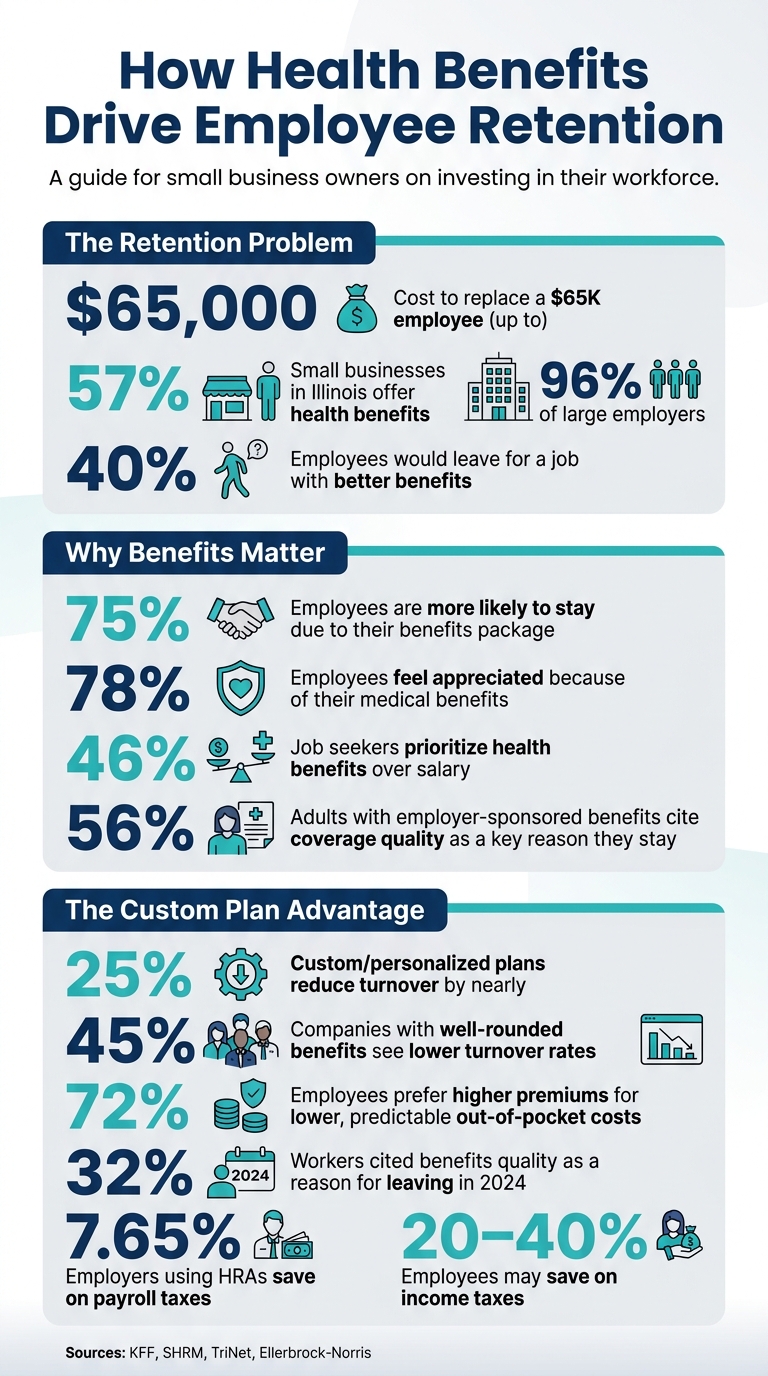
Employee turnover is expensive, especially for small businesses. Replacing a mid-level employee earning $65,000 can cost up to $65,000. Health benefits are a major factor in keeping employees, but only 57% of small businesses in Illinois offer them, compared to 96% of larger employers. Rising costs and generic plans often leave employees dissatisfied, making retention harder.
Custom health plans solve these issues by:
- Allowing employees to choose plans that fit their needs, like through Individual Coverage Health Reimbursement Arrangements (ICHRAs).
- Reducing turnover by nearly 25% and attracting job seekers, 46% of whom prioritize health benefits over salary.
- Addressing diverse needs across generations with tailored options like high-deductible plans for younger employees or robust family coverage for those with dependents.
Why it matters:
- 75% of employees are more likely to stay with a company because of its benefits.
- Strong health plans lower turnover rates by 45%, especially for small teams where losing one employee can disrupt operations.
Key takeaway: Offering personalized health benefits isn’t just about competing with larger companies – it’s about showing employees they’re valued while saving money in the long run.
How Health Benefits Drive Employee Retention: Key Stats for Small Businesses
How Health Benefits Affect Employee Retention
How Health Benefits Influence Employee Loyalty
Health benefits are more than just an added bonus – they’re a clear indicator of how much a company values its employees. In fact, 78% of employees say they feel appreciated by their employer because of the medical benefits they receive. This sense of value directly impacts their decision to stay.
A compelling 75% of employees report being more inclined to remain with a company because of its benefits package, making it the top factor influencing retention. On the flip side, 40% of employees would consider leaving their current job if they found an opportunity with better benefits.
"Benefits are among the most tangible expressions of employer support. Personalization shows employees that the company recognizes their individuality – strengthening engagement, loyalty, and retention." – TriNet Team
Customizing benefits to meet individual needs strengthens employee loyalty in ways that one-size-fits-all plans cannot. For small businesses, this personalization can serve as a competitive advantage against larger companies with less flexible offerings.
These findings underscore the importance of offering comprehensive, personalized health benefits to retain top talent, especially for small businesses.
Why Small Business Employees Prioritize Health Coverage
For many employees, health insurance isn’t just about covering doctor visits – it’s about financial security. With the average group family health insurance deductible at $3,722 and nearly 50% of U.S. households lacking $1,000 in emergency savings, employer-sponsored coverage becomes a necessity rather than a luxury.
The quality of health coverage also plays a major role in retention. 56% of U.S. adults with employer-sponsored benefits cite the quality of their coverage as a key reason they stay with their current employer. This is particularly true for employees with families. When a plan provides robust coverage for spouses and children, it becomes a powerful incentive to stay, even beyond salary considerations.
"Losing one vital member of a 20-person team can significantly slow operations… Fortunately, you have a few options that can help make your business more ‘sticky,’ the most important of which is employee benefits." – Andy Bassett, CIC, CPCU, Ellerbrock-Norris
Small businesses that prioritize strong health benefits see tangible results. Companies offering well-rounded benefits packages experience 45% lower turnover rates compared to those relying solely on competitive salaries. For small teams, this stability is invaluable – it ensures operational continuity and preserves institutional knowledge.
sbb-itb-a729c26
Retention Problems That Custom Health Plans Can Fix
Meeting the Needs of a Multigenerational Workforce
Today’s workforce spans multiple generations, each with its own health coverage priorities. A single, standard plan often falls short of meeting these diverse needs. Custom health plans, however, allow for multiple tiers of coverage, giving employees the flexibility to choose options that align with their life stage.
For example, younger employees might lean toward high-deductible health plans (HDHPs) with lower premiums, especially when paired with mental health resources. Workers with families often need plans with robust coverage for pediatric care and urgent visits. Meanwhile, older employees tend to prioritize pharmacy benefits and Health Savings Accounts (HSAs). These accounts are particularly appealing as the IRS will allow individual contributions of up to $4,300 and family contributions of up to $8,550 in 2026.
| Generation | What They Prioritize | Plan Features That Help |
|---|---|---|
| Gen Z | Mental health, low premiums | HDHPs, digital mental health platforms |
| Millennials | Family coverage, flexibility | Richer medical benefits, parental leave |
| Gen X | Caregiving, financial planning | Eldercare support, disability coverage |
| Boomers | Comprehensive medical, retirement | Pharmacy benefits, HSAs, chronic condition management |
By tailoring coverage to generational needs, employers can address specific financial and healthcare concerns while ensuring better plan alignment.
Lowering Financial Stress from Healthcare Costs
High-deductible plans without adequate employer support can leave employees feeling financially strained.
"A plan with a $6,000 individual deductible and no employer contribution to the deductible is technically offered coverage, but it functions as a pay cut for employees who actually use it." – Sam Newland, Founder, BENEFITRA
A majority – 72% of employees – prefer higher premiums in exchange for lower, predictable out-of-pocket costs. Custom plans can tackle this issue by incorporating smarter cost-sharing models. For instance, pairing high-deductible plans with employer HSA contributions of $1,000–$2,000 annually can ease financial stress. Employers can also implement salary-based contribution models to ensure lower-wage employees aren’t disproportionately burdened. Additionally, voluntary "gap" coverage, such as accident or critical illness insurance, can shield employees from major unexpected expenses without significantly increasing employer costs.
These strategies not only reduce financial stress but also improve overall satisfaction with healthcare benefits.
Improving Access to Local Healthcare Networks
A health plan loses its value if employees can’t access their preferred local providers, a common issue with standard regional plans. Individual Coverage Health Reimbursement Arrangements (ICHRAs) offer a practical solution. Employers provide a fixed, tax-free monthly allowance, allowing employees to purchase ACA-compliant plans through their local exchange. This ensures employees can choose plans that include trusted, local providers.
For small businesses in Illinois, especially those with remote or geographically dispersed teams, ICHRAs eliminate the mismatch between coverage and local care options.
"When health benefits are clear, supportive, and personalized, they send a powerful message: we care about you, and we’re invested in your well-being." – Gwendolyn Smith, Health & Benefits Partners
How to Design and Roll Out a Custom Health Plan
Custom health plans can be a game-changer for employee retention. Here’s how to design one that meets your team’s needs while staying within budget.
Identifying What Employees Need from Their Coverage
Start by understanding exactly what your employees value in their health benefits. Conduct an annual benefits survey to uncover gaps in your current plan. Pair this with a review of usage data to see which benefits are popular and which are underutilized. This combination helps identify where funds might be wasted and where employees feel underserved.
Exit interviews are another valuable tool. In 2024, 32% of workers cited the quality of benefits as a key reason for leaving their jobs. By asking departing employees whether the health plan influenced their decision, you can uncover honest feedback that might not surface elsewhere. Additionally, benchmark your plan’s deductibles and employer contributions against industry standards using resources like KFF or SHRM. This gives you a clear sense of how your offerings compare in the market.
Once you’ve gathered this data, you’ll be ready to tackle the challenge of balancing costs with coverage.
Balancing Plan Costs and Coverage Options
With employee needs in hand, the next step is designing a plan that fits your budget without sacrificing quality. A smart strategy is offering tiered plan options. This allows employees to choose from a range of plans, such as a basic high-deductible option or a more comprehensive PPO. This flexibility ensures employees can pick what works best for their financial and healthcare needs, avoiding the pitfalls of a one-size-fits-all approach.
For smaller businesses, level-funded plans are worth considering. These plans come with fixed monthly payments and the possibility of a refund if claims are lower than expected. If you offer a high-deductible plan, consider pairing it with an employer contribution to an HSA. This helps employees manage out-of-pocket costs without increasing your overall expenses.
You can also add voluntary benefits like dental, vision, or hospital indemnity coverage. These are typically employee-funded, keeping costs low for the employer. For example, employer-paid dental coverage costs approximately $30–$50 per employee per month, while vision coverage adds just $10–$15. Despite their modest cost, employees consistently rate these benefits as highly valuable.
Once your plan options are in place, the focus shifts to making enrollment simple and clear.
Making Enrollment and Plan Education Straightforward
Even the best health plan won’t succeed if employees don’t understand it. The stats are telling: 42% of employees re-enroll in their previous plan without reviewing their options, and only 15% take the time to analyze cost-effectiveness during enrollment. This isn’t due to indifference – it’s because benefits can be confusing.
"Most employees don’t disengage from benefits because they don’t care – they disengage because benefits are confusing." – TriNet
The solution? Clearer communication. Use side-by-side plan comparisons and cost calculators to help employees see how each option aligns with their expected healthcare needs. Tailor your communication methods to your workforce. For instance, mobile-friendly updates are ideal for younger employees, while those nearing retirement may need more detailed guidance on Medicare and HSAs.
Don’t limit education to the open enrollment period. Regular check-ins or benefit reminders throughout the year keep employees informed and reduce the chances they’ll stick with last year’s plan out of habit. Simplifying the enrollment process not only helps employees make better choices but also strengthens their connection to the company.
Conclusion: Using Custom Health Plans as a Retention Tool
The Long-Term Payoff of Tailored Health Benefits
Investing in custom health plans does more than just improve employee retention – it creates a ripple effect of benefits for both employees and employers. When employees have access to plans covering their preferred doctors and prescriptions, they’re more likely to take advantage of preventive care. This means fewer sick days and a healthier, more productive team overall. Plus, employers utilizing HRAs can save 7.65% on payroll taxes, while employees might enjoy 20–40% savings on their income taxes.
"To be an employer of choice today means offering a comprehensive compensation package including benefits that meet the needs and expectations of employees." – Deanna Rosenbaum, VP of Channel Sales, ADP
Custom health benefits don’t just reduce turnover – they build a sense of loyalty among employees. And with the right guidance, implementing these benefits becomes a straightforward process.
Working with Illinois Health Agents to Build Custom Plans
Custom health plans are easier to implement when you have the support of experienced local professionals. For small businesses in Illinois, Illinois Health Agents provides expert guidance on options like ICHRAs, QSEHRAs, group health plans, and voluntary benefits. They focus on aligning the plan structure with your budget and workforce needs, ensuring employee retention remains a priority.
But their support doesn’t stop at plan selection. Illinois Health Agents also offers services like employee education, contribution strategy advice, annual reviews, and tax-saving strategies. For small businesses with 10 or fewer employees, group health services are available for just $250 per year, and the fee is waived if 10 employees enroll. This makes expert assistance accessible even for the smallest teams.
Custom health plans aren’t just for large corporations. With the right partner, they’re a practical and impactful way for small businesses to build a dedicated, long-term workforce.
FAQs
Is an ICHRA a good fit for my small business?
An Individual Coverage Health Reimbursement Arrangement (ICHRA) is a smart choice for small businesses aiming to manage expenses while providing flexible benefits. Here’s how it works: you decide on a fixed, tax-deductible contribution amount, and your employees use those funds to select health plans that fit their personal needs. This approach ensures that everyone can find coverage tailored to their specific situation.
One of the standout features of ICHRA is its flexibility. There’s no minimum participation requirement, making it a scalable option for businesses of any size. Plus, it’s a cost-efficient way to offer health benefits without the complexity of traditional group plans.
If you’re unsure whether ICHRA aligns with your budget and team’s needs, consulting with an independent broker, such as Illinois Health Agents, can provide clarity and guidance. They can help you navigate the options and ensure you make the right decision for your business.
How much should an employer contribute to a custom health plan?
Employers should align their contributions with their budget and employee retention goals instead of sticking to a fixed amount. One approach is covering a larger portion of basic plan costs while offering buy-up options for employees seeking enhanced coverage. For high-deductible health plans (HDHPs), contributing between $500 and $1,000 to employees’ Health Savings Accounts (HSAs) can help ease the burden of high deductibles. Alternatively, Health Reimbursement Arrangements (HRAs) allow employers to set up tax-free allowances without mandatory caps, providing flexibility. For tailored advice on structuring contributions to meet your company’s specific needs, Illinois Health Agents can offer expert guidance.
How do I explain plan options so employees actually choose well?
Employees make better decisions when communication is clear and easy to understand. To achieve this, mix digital tools like online portals, mobile apps, and cost calculators with face-to-face options such as benefits fairs or small group discussions. Video tutorials and regular updates can break down complicated choices into manageable pieces. For more tailored support, Illinois Health Agents can assist your business, helping employees grasp their options and making the enrollment process smooth and straightforward.
Recent Comments