

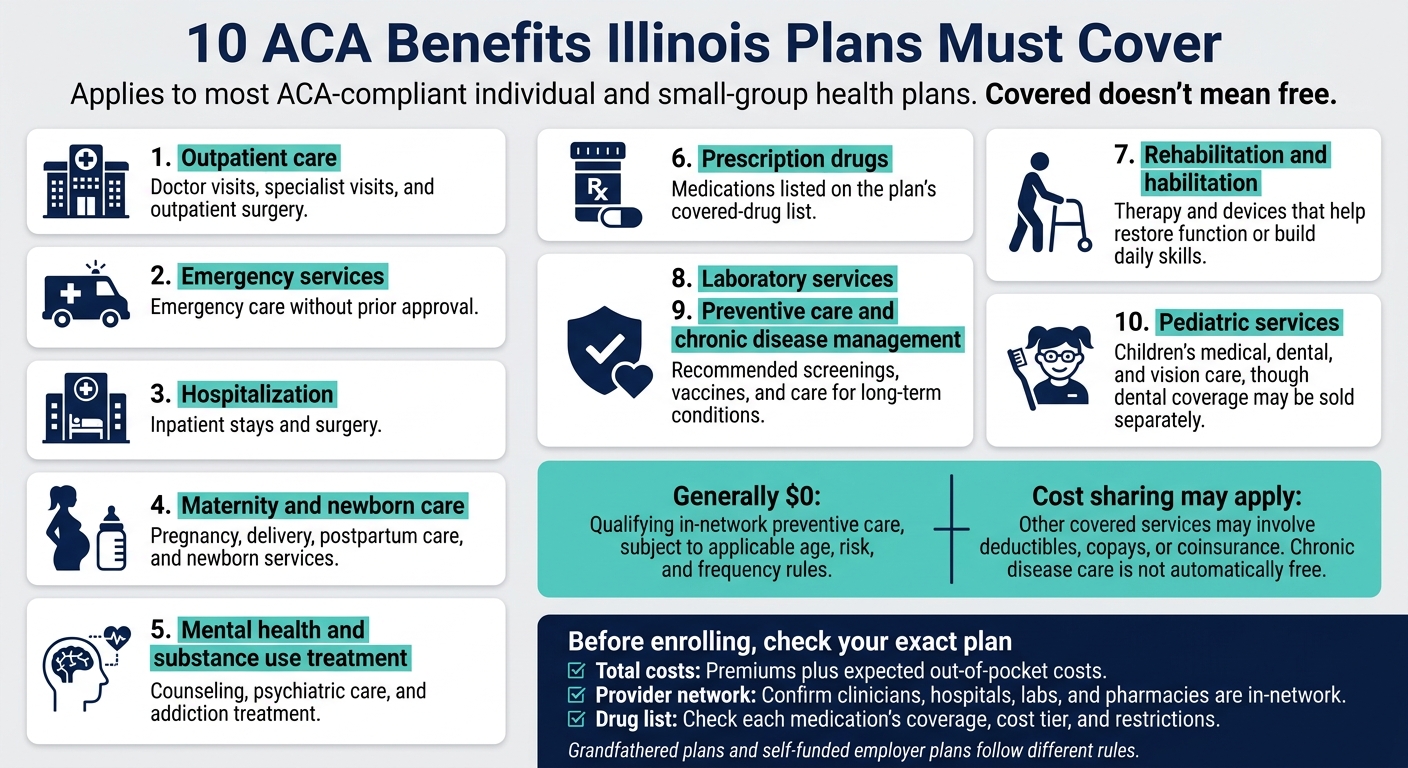
Most Illinois individual and small-group health plans must cover 10 ACA benefit categories - but covered doesn’t mean free. I’d check your plan’s costs, provider network, and drug list before enrolling.
Here’s what those plans must cover:
- Outpatient care: Doctor visits, specialist visits, and outpatient surgery.
- Emergency services: Emergency care without prior approval.
- Hospitalization: Inpatient stays and surgery.
- Maternity and newborn care: Pregnancy, delivery, postpartum care, and newborn services.
- Mental health and substance use treatment: Counseling, psychiatric care, and addiction treatment.
- Prescription drugs: Medications listed on the plan’s covered-drug list.
- Rehabilitation and habilitation: Therapy and devices that help restore function or build daily skills.
- Laboratory services: Blood work, pathology, and other covered tests.
- Preventive care and chronic disease management: Recommended screenings, vaccines, and care for long-term conditions.
- Pediatric services: Children’s medical, dental, and vision care, though dental coverage may be sold separately.
My takeaway: compare total costs, not just monthly premiums. Qualifying in-network preventive care generally costs $0, but other services may involve deductibles, copays, or coinsurance. <u>Check your exact plan before booking care.</u> Grandfathered plans and self-funded employer plans follow different rules.
10 ACA Benefits Illinois Plans Must Cover
[Health Insurance] 50, Essential Health Benefits Under the ACA
sbb-itb-a729c26
How ACA Benefit Requirements Work in Illinois
Federal law sets 10 essential health benefit categories. Illinois’s benchmark plan spells out the services covered within each category. State law adds requirements, including infertility treatment and certain autism therapies. The list below explains these 10 categories and what Illinois plans must cover.
Get Covered Illinois is the state Marketplace where you can shop for plans and apply for financial assistance. Self-funded employer plans usually follow federal rules rather than Illinois mandates. Medicare follows separate federal rules.
Your premium keeps your coverage active. Deductibles, copays, and coinsurance are your share of covered costs - which is why two plans covering the same benefits can still cost very different amounts.
Your out-of-pocket maximum limits what you pay for covered, in-network care each year.
Required benefits don’t mean every plan works the same way. Provider networks, covered drugs, and costs can vary. Before choosing a plan, check that your providers are in-network and your medications are on its formulary, or covered-drug list. The categories below explain what Illinois plans must cover and how plan design can affect your costs.
1. Ambulatory Services: Doctor Visits and Outpatient Care
Covered Services
Ambulatory care means outpatient care. Illinois ACA-compliant individual and small-group plans must cover primary care visits, specialist visits, clinic care, and outpatient surgery.
Network and Plan Details
A referral isn’t the same as prior authorization (prior approval). HMOs often require a primary care referral to see a specialist. Some outpatient services also need prior approval.
Before you schedule care, check that the provider is in-network for your plan to avoid higher costs.
Cost Sharing
Your Summary of Benefits and Coverage lists costs for primary care visits, specialist visits, and outpatient surgery. Office visits may have a copay before you meet your deductible. Surgery may require you to pay toward your deductible plus coinsurance. Specialist visits usually cost more than primary care visits.
Emergency care has different rules, covered in the next section.
2. Emergency Services: Care Without Prior Authorization
Covered Services
Emergency evaluation and stabilization don’t require prior authorization. Illinois ACA plans cover emergency care at any hospital, including out-of-network hospitals. HMO members don’t need a referral.
Cost Sharing
For out-of-network emergency care, your plan must use in-network cost-sharing. The No Surprises Act generally blocks balance billing, but you may still owe a deductible, copay, or coinsurance. Check your Explanation of Benefits to make sure your plan applied in-network cost-sharing.
Network and Plan Details
Urgent care isn’t emergency care. It follows the usual network and cost-sharing rules. Before getting non-emergency care, check whether the facility is in your plan’s network.
Ground ambulance bills usually fall outside federal surprise-billing protections, so you may still receive a separate balance bill.
If emergency care leads to an inpatient stay, the next section explains hospitalization coverage.
3. Hospitalization: Inpatient Stays and Surgery
Covered Services
When emergency care leads to a hospital admission, hospital coverage rules apply.
Illinois ACA plans cover inpatient hospitalization and surgery. Inpatient care requires formal admission to the hospital. Staying overnight doesn’t automatically make you an inpatient, so confirm whether your care will be billed as inpatient or outpatient.
Cost Sharing
Expect separate bills from the hospital facility, surgeon, and anesthesiologist. Your deductible and coinsurance may apply to each bill. Some plans also charge daily hospital copays.
Check your Summary of Benefits and Coverage to estimate these costs, including daily copays and any limits on those copays.
Network and Plan Details
Before a planned admission, ask your insurer to confirm that the hospital, surgeon, anesthesiologist, and other treating physicians are in-network. An in-network hospital may still have out-of-network physicians, which can increase your bill.
Ask whether your surgery and admission require prior authorization. If they do, make sure approval is in place before the scheduled date. A scheduled surgery isn’t the same as an approved authorization.
4. Maternity and Newborn Care: Pregnancy Through Postpartum
Covered Services
Delivery often involves a hospital stay, but maternity coverage has its own rules.
Illinois ACA-compliant plans must cover pregnancy, maternity, and newborn care, even if you’re already pregnant when coverage begins. This includes prenatal care, delivery, postpartum care, and newborn care. Plans must also cover breastfeeding support and contraception.
Cost Sharing
In-network preventive maternity care costs $0, including screenings, counseling, and breastfeeding support. Delivery and nonpreventive newborn care may still come with deductibles, copays, or coinsurance.
Network and Plan Details
Check that both your OB-GYN and your planned delivery hospital are in-network. Before ordering a breast pump, confirm which models and vendors your plan covers. Review the formulary for prescribed medications, and check coverage for prenatal vitamins, too.
Illinois Coverage Rules
Newborn enrollment is part of planning for maternity coverage. Don’t assume your baby is automatically enrolled.
Submit enrollment within the special enrollment window triggered by the birth - generally 60 days for Marketplace plans or 30 days for job-based plans - to avoid leaving your baby uninsured.
5. Mental Health and Substance Use Treatment
Covered Services
Mental health coverage follows the ACA framework, with added parity protections.
Illinois ACA plans must cover outpatient counseling, psychotherapy, psychiatric visits, inpatient mental health care, and substance use treatment. Plans cannot deny coverage because of a pre-existing mental health condition.
Illinois Coverage Rules
Parity rules prohibit stricter limits on mental health and substance use treatment than on medical or surgical care. Illinois also requires telepsychiatry coverage and protections for medications used to treat opioid use disorder.
Cost Sharing
Your Summary of Benefits and Coverage lists outpatient and inpatient costs. Once you reach your plan’s out-of-pocket maximum, the plan pays 100% of covered, in-network expenses for the rest of the plan year.
Network and Plan Details
Check the insurer’s provider directory to make sure your therapist, psychiatrist, or facility is in-network for your exact plan. Also check whether you need prior authorization. If a claim is denied, you can file an appeal.
Next: prescription coverage and pharmacy rules.
6. Prescription Drugs: Covered Medications and Pharmacy Rules
Covered Services
Illinois ACA plans must cover prescription drugs. Each plan’s formulary lists the drugs it covers and their cost tiers. Generics usually cost the least, while brand-name and specialty drugs usually cost more. Your cost at the counter depends on the drug’s tier, prior approval requirements, and whether your pharmacy is in-network.
Illinois Coverage Rules
Step therapy means you must try a plan-preferred drug first. If your medication isn’t covered or the required alternative doesn’t work, ask for a formulary exception, a one-time refill, or a health-need exception. None is automatic. These rules affect both coverage approval and what you pay out of pocket.
If your plan denies coverage, you can appeal. Illinois’ Office of Consumer Health Insurance (OCHI) can help with complaints or an external review.
Cost Sharing
Check whether your plan has a separate pharmacy deductible or applies the medical deductible first. A copay is a fixed dollar amount. Coinsurance is a percentage of the drug’s cost.
Network and Plan Details
Check each medication using its exact name, dosage, and quantity. Confirm its tier, refill cost, prior authorization rules, and step therapy requirements. Also verify that your pharmacy - and any required specialty pharmacy - is in-network. These checks help prevent surprise denials at the pharmacy.
Next: rehabilitation, habilitation, and devices used for recovery or daily function.
7. Rehabilitation and Habilitation: Therapy and Devices
These benefits cover care and equipment that help you regain function or build daily living skills.
Covered Services
Rehabilitation helps restore function lost after illness, injury, or disability. Habilitation helps you build or maintain daily living skills.
Illinois ACA plans cover physical therapy, occupational therapy, and speech therapy in inpatient and outpatient settings. Durable medical equipment (DME), such as wheelchairs, crutches, and oxygen equipment, may also be covered.
Illinois Coverage Rules
Plans cover only medically necessary services and equipment. Check prior authorization requirements before starting treatment or ordering equipment.
Plans cannot place annual or lifetime dollar limits on these services, but visit limits may apply.
Cost Sharing
You can expect deductible, copay, or coinsurance charges for therapy and equipment. These charges may vary by benefit. Covered in-network costs count toward your out-of-pocket maximum.
Network and Plan Details
Confirm that your therapist and equipment supplier are in-network. Check your Summary of Benefits and Coverage and plan documents for visit limits, prior authorization requirements, and DME rules.
Next, lab services cover tests that guide diagnosis and treatment.
8. Laboratory Services: Blood Work and Other Tests
Covered Services
Illinois ACA-compliant individual and small-group plans cover laboratory services, including blood work, pathology, and screening tests.
Illinois Coverage Rules
Only qualifying in-network preventive lab tests are free. Diagnostic tests used to check symptoms or monitor a condition usually aren’t.
Cost Sharing
For diagnostic tests, you may need to meet your plan’s deductible, then pay a copay or coinsurance, depending on your plan.
Network and Plan Details
Check which lab will process your sample, not just whether your doctor is in-network. An in-network doctor may send samples to another laboratory or pathology facility.
Before your blood draw, get the lab’s name and confirm its network status with your insurer. Ask whether separate laboratory or pathology charges will apply and whether each test will be billed as preventive or diagnostic.
Routine preventive screenings have different cost rules, which the next section covers.
9. Preventive Care, Wellness, and Chronic Disease Management
Covered Services
This category covers routine care to prevent illness and care to manage chronic conditions.
Illinois ACA plans cover preventive visits, recommended immunizations, wellness checks, counseling, and chronic disease care when you use an in-network provider. Chronic disease care includes screenings, checkups, monitoring, care coordination, and education to help you manage long-term conditions.
Illinois Coverage Rules
In-network preventive services generally cost $0, with no deductible, copay, or coinsurance. That coverage depends on age, risk, and frequency rules - not every screening is free for every member. Diagnostic follow-up generally involves cost sharing, so check your plan’s preventive care schedule before booking.
Cost Sharing
A preventive visit may lead to office-visit charges if your doctor treats a separate problem. Chronic disease visits, medications, and monitoring aren’t automatically free.
Network and Plan Details
If a screening becomes diagnostic, ask how that changes your costs. For medications you take regularly, search your plan’s formulary using the exact drug name, dose, and quantity. Then confirm the drug’s cost tier and any coverage restrictions.
Pediatric benefits follow the same ACA framework, but child-specific medical, dental, and vision rules apply.
10. Pediatric Services: Medical, Dental, and Vision Care
Covered Services
This final ACA benefit category covers children’s well-child visits, screenings, vaccinations, dental exams and cleanings, and vision care. In-network preventive pediatric care generally costs $0. Nonpreventive dental or vision care may still come with copays or coinsurance.
Illinois Coverage Rules
Pediatric dental and vision benefits usually cover children under 19. Coverage through age 26 does not extend these pediatric benefits, and federal ACA rules don’t require routine adult dental or vision coverage.
For Illinois Marketplace buyers, pediatric dental coverage may be part of the medical plan or sold separately. Check the Summary of Benefits and Coverage to see which setup applies. The plan’s structure and network rules determine how children receive these benefits.
Cost Sharing
A stand-alone dental plan has its own premium, deductible, and pediatric out-of-pocket limit. If dental coverage is part of the medical plan, check how dental expenses count toward that plan’s deductible and out-of-pocket maximum.
Network and Plan Details
Before booking, confirm that the dentist and eye doctor belong to the plan’s dental or vision network - not just its medical network. Review which vision services and eyeglass benefits the plan covers, too.
What to Check Before Choosing an Illinois ACA Plan
Knowing what ACA plans must cover is the starting point. Next, compare how each Illinois plan provides those benefits - and what that means for your access to care and costs.
Check the plan year first. Then confirm whether the plan is an HMO, PPO, or POS, including its referral requirements and out-of-network rules. Don’t assume last year’s terms still apply.
Use the SBC for costs and the EOC for exclusions, restrictions, and limits. Also check whether pediatric dental coverage is part of the medical plan or provided separately.
| Cost to compare | What to check for each plan |
|---|---|
| Premium | Monthly payment, plus any separate pediatric dental premium. |
| Deductible | Individual and family amounts. |
| Copayments | Charges for visits and prescriptions, and whether you must meet the deductible first. |
| Coinsurance | Your share of covered costs, expressed as a percentage, and when it applies. |
| Annual out-of-pocket limit | The most you pay for covered, in-network care; premiums don’t count toward this limit. |
After comparing costs, review the network and drug list for the exact plan you’re considering.
Before enrolling, confirm that your clinicians, hospitals, therapists, labs, and pharmacies are in-network for that specific plan. Check its formulary using each medication’s name, dosage, and frequency.
Illinois Health Agents can help Illinois residents review plan and enrollment details.
As you compare plans, use Get Covered Illinois to check whether you qualify for premium tax credits and cost-sharing reductions for the plan year. Eligibility isn’t automatic. Include any assistance in your total-cost comparison, along with how well the network meets your needs.
Conclusion: Compare Benefits, Providers, and Total Costs
The 10 essential health benefit categories set the minimum coverage standard for Illinois ACA plans.
Compare plans based on the care you expect to use, your medications, in-network providers, and total annual cost - premiums plus expected out-of-pocket costs.
Before enrolling or renewing, check the plan year’s benefits, provider network, and prescription coverage. Each can change annually.
FAQs
How can I tell if my Illinois plan is ACA-compliant?
Check that your Illinois plan covers all 10 essential health benefits and meets federal consumer protection standards. Plans purchased through the official health insurance marketplace are ACA-compliant.
Review your policy for exclusions related to maternity care, mental health services, or prescription drugs. Also check for annual or lifetime dollar limits on essential health benefits. Illinois Health Agents can help you review whether your plan complies.
What can I do if no in-network specialist is available?
Contact your insurance company to talk through your options. Marketplace health plans must maintain provider networks that let you access services without unreasonable delays.
If your plan requires referrals, as HMOs often do, your primary care physician can help coordinate your care. With a PPO, you can generally see out-of-network specialists, but you’ll usually pay more out of pocket than you would for in-network care.
How do I appeal a denied essential health benefit?
If your claim for an essential health benefit is denied, you have the right to appeal. Contact your insurance carrier to request a formal review of the denial.
Check your plan documents to see which benefits are covered, what’s excluded, why your claim was denied, and how to file an appeal. Federal and state regulations also provide protections for policyholders.
Recent Comments