

A U.S. ER visit can cost $2,000+, and a hospital stay can hit five figures. If I’m visiting the United States, I’d compare plans by medical limit, deductible, coinsurance, pre-existing condition rules, and evacuation coverage before I buy.
Here’s the short version:
- Visitor insurance helps pay for sudden illness or injury during a short U.S. stay.
- Fixed-benefit plans cost less, but they pay set amounts per service, so I may owe a big gap.
- Higher-coverage travel medical plans cost more, but they usually cover a larger share of big medical bills.
- Student and exchange plans must match visa or school rules.
- Senior plans need extra attention for age limits, acute-onset rules, and chronic condition limits.
- Pre-existing condition rules can change a plan from usable to useless fast.
- Medical evacuation can cost $20,000–$50,000, so I’d check that limit too.
If I wanted the safest way to compare, I’d start with three numbers:
- Deductible: what I pay first
- Medical maximum: the most the plan pays
- Coinsurance: my share after the deductible
A few facts stand out from the article:
- Deductibles can range from $0 to $5,000
- Medical limits can go up to $8,000,000
- Coinsurance is often 10%–20% after the deductible
- Some budget plans start around $19/month
- J-1 plans usually need at least $100,000 in medical coverage and a deductible of $500 or less
- Seniors often should look at $100,000+ in coverage, and many may want $250,000–$500,000+
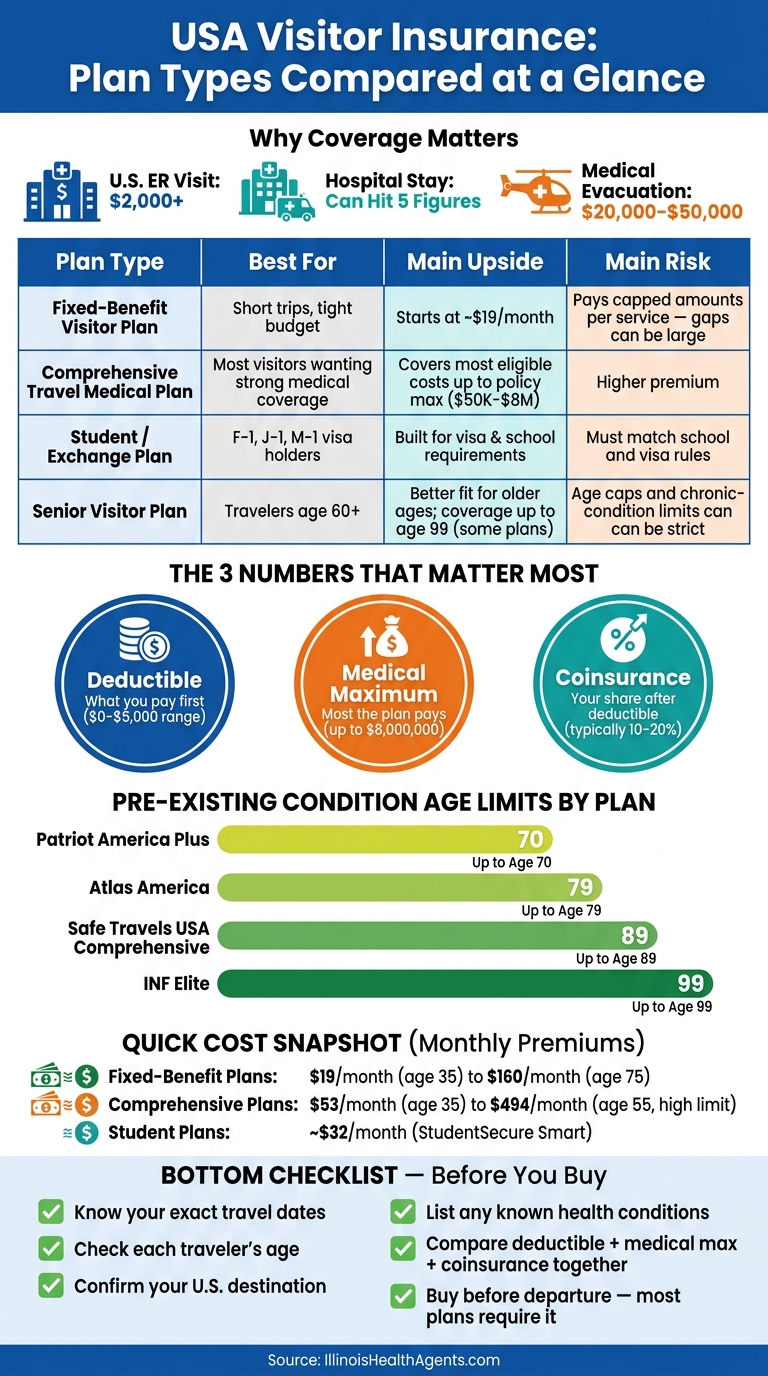
USA Visitor Insurance: Plan Types Compared at a Glance
5 Best Travel Insurance Options for Visitors to USA with Pre Existing Conditions
sbb-itb-a729c26
Quick Comparison
| Plan Type | Best For | Main Upside | Main Risk |
|---|---|---|---|
| Fixed-benefit visitor plan | Short trips, tight budget | Lower monthly cost | Pays capped amounts per service |
| Higher-coverage travel medical plan | Most visitors who want stronger medical help | Better help with large U.S. bills | Higher premium |
| Student/exchange plan | F-1, J-1, M-1, dependents | Built for visa/school needs | Must match school and visa rules |
| Senior visitor plan | Age 60+ travelers | Better fit for older ages | Age and condition rules can be strict |
I’d treat this as a filtering job, not a shopping job: first match the plan type to the traveler, then check age rules, then compare costs and coverage side by side.
1. Illinois Health Agents

Illinois Health Agents helps travelers compare visitor insurance plans side by side. The comparison tools let you look at deductibles, medical maximums, coinsurance, and network access in one place, which makes the process a lot easier.
A good place to start is with the core costs: the deductible, medical maximum, and coinsurance. Deductibles range from $0 to $5,000, medical maximums go as high as $8,000,000, and coinsurance is usually 10%–20% after the deductible.
After that, look at how each plan deals with pre-existing conditions. This part matters most for older travelers and for anyone who already has a known health issue. Age limits and acute-onset rules can change coverage in a big way. For example, some plans, like INF Elite, cover pre-existing conditions up to age 99, while others, like Patriot America Plus, limit acute-onset coverage to age 70.
Network access can also affect what you pay when you get care. You can check whether a plan includes access to a PPO network. Direct billing may lower upfront out-of-pocket costs. Some plans also include up to $1,000,000 in emergency medical evacuation coverage.
If you want help comparing plans, travelers can contact Illinois Health Agents at 312.800.0751 or info@ilhealthagents.com.
2. Comprehensive USA Visitor Insurance Plans
Comprehensive plans cover most eligible medical costs up to the policy maximum. That’s the big difference from fixed-benefit plans, which pay a set amount for each service. And in the U.S., medical bills can climb fast. So when you compare plans, deductible, coinsurance, and policy maximum are the numbers that matter most.
Most comprehensive plans follow the same basic setup: you pay the deductible first, then coinsurance applies, and after that the plan pays covered costs up to the policy maximum. Deductibles usually range from $0 to $5,000.
One area where these plans split apart is pre-existing condition coverage. Age cutoffs vary by plan. Safe Travels USA Comprehensive extends acute-onset benefits to age 89, Atlas America to age 79, and Patriot America Plus to age 70. If you’re traveling with a known medical history, that age limit may end up being one of the first things to check.
The table below shows monthly costs for popular comprehensive plans with a $250 deductible, which makes it easier to compare price against coverage limits:
| Plan Name | Policy Maximum | Monthly Cost (Age 35) | Monthly Cost (Age 55) |
|---|---|---|---|
| Atlas Essential America | $50k–$1M | $53–$98 | $117–$200 |
| Patriot America Plus | $50k–$1M | $57–$106 | $124–$235 |
| Safe Travels USA | $50k–$1M | $57–$103 | $123–$227 |
| Atlas America | $50k–$2M | $58–$114 | $127–$253 |
| Patriot America Platinum | $1M–$8M | $108–$226 | $240–$494 |
Pricing based on a $250 deductible.
After price and limits, look at the extra benefits too. Most comprehensive plans also include emergency medical evacuation, repatriation of remains, trip interruption, and accidental dental care. PPO access matters as well, since in-network care can cut what you have to pay upfront. And watch the "Lite" versions closely. Some leave out COVID-19 coverage or acute-onset benefits.
If a lower monthly cost matters more to you and you’re okay with payout caps, fixed-benefit plans are the next category to compare.
3. Fixed-Benefit Visitor Insurance Plans
If low monthly cost matters more than broad medical protection, fixed-benefit plans are usually the next type to look at. You may also see them called scheduled benefit plans. They pay a set amount for each covered service, no matter what the doctor or hospital actually charges. So if your plan allows $55 for a doctor visit and the provider bills $250, you pay the other $195 out of pocket.
That shortfall can get big fast in the U.S. Even a routine doctor visit often runs $250 to $350. That’s the trade-off: lower premiums, but less coverage when bills come in higher than the plan’s payout schedule. Because of that, the fine print matters a lot more here.
The main draw is cost. These plans can start at just $19/month, which makes them the lowest-cost choice for healthy travelers who mainly want help with small medical issues, not large hospital claims. Here’s a side-by-side look at a few options:
| Plan Name | Policy Maximum | Deductible | Monthly Cost (Age 35) | Monthly Cost (Age 55) | Monthly Cost (Age 75) |
|---|---|---|---|---|---|
| Safe Travels Advantage | $25,000–$150,000 | $0 | $19–$54 | $29–$82 | $59–$160 |
| Visitors Care | $25,000–$100,000 | $100 | $25–$44 | $30–$65 | $66–$152 |
| Safe Travels Elite | $25,000–$175,000 | $0 | $25–$71 | $36–$110 | $105–$150 |
| VisitorSecure | $50,000–$130,000 | $100 | $31–$55 | $46–$84 | $93–$135 |
| Travel Medical USA Visitor Basic | $50,000–$150,000 | $100 | $39–$47 | $56–$68 | $178–$196 |
Source: 2026 pricing estimates
One detail that’s easy to miss: the deductible may apply per injury, per illness, or per policy period, depending on the plan. That can change your costs more than you’d think, so it’s worth checking before you buy.
Pre-existing condition rules also tend to be tight. Many fixed-benefit plans cover only the acute onset of pre-existing conditions, meaning a sudden and unexpected flare-up. For example, Visitors Care caps acute-onset coverage at $2,500 for seniors, while Safe Travels Elite and some INF plans extend this coverage to travelers over age 70. Start by checking the payout schedule and the pre-existing condition terms. After that, look at the extras.
Some plans also include features like emergency medical evacuation and repatriation of remains. VisitorSecure, for instance, offers up to $1,000,000 for emergency medical evacuation and up to $50,000 for repatriation of remains. You may also get access to PPO networks such as First Health or UnitedHealthcare, which can reduce what you owe through negotiated rates.
4. Travel Medical Plans with Trip Interruption Benefits
Once you get beyond fixed-benefit plans, this is where coverage starts to feel a lot stronger. Travel medical plans with trip interruption benefits pair higher medical limits with trip interruption, cancellation, and delay coverage. That makes them a better match for travelers who have a lot of prepaid, non-refundable trip costs on the line.
The jump in medical limits is hard to miss. Fixed-benefit plans often top out between $25,000 and $100,000. By comparison, travel medical plans in this group usually range from $50,000 to $2,000,000. The medical side works in a similar way, but these plans also help protect the money you’ve already put into the trip. That can matter fast when a single ER visit in the U.S. can push hospital bills into the five figures.
Pre-existing condition coverage still depends on the plan, but some upgraded options expand that coverage if you buy the plan within 14 days of the initial trip deposit. Age matters too. Safe Travels USA covers acute onset up to age 89, while Atlas America stops at age 79.
Prices also tend to go up with age and with higher coverage limits.
| Feature | Safe Travels USA Comprehensive | Atlas America |
|---|---|---|
| Max Medical Limit | Up to $1,000,000 | Up to $2,000,000 |
| Acute Onset Age Limit | Up to Age 89 | Up to Age 79 |
| PPO Network | FirstHealth | UnitedHealthcare / FirstHealth |
| AM Best Rating | A (Excellent) | A++ (Superior) |
| Adventure Sports | Optional add-on | Included as standard |
| Best For | Seniors & Green Card holders | High limits & active travelers |
Plan feature comparison:.
Both plans include emergency medical evacuation, repatriation of remains, and 24/7 travel assistance. Atlas America also includes adventure sports as a standard feature, which helps if the trip involves more than basic sightseeing. And if you’re a new Green Card holder dealing with the 365-day waiting period, Safe Travels USA can be a good fit.
If the trip is tied to school or an exchange program, the next section looks at plans built for students.
5. Student and Exchange Visitor Medical Plans
Student and exchange visitor plans are built for F-1, J-1, and M-1 visa holders, along with F-2 and J-2 dependents in full-time study or approved research. If your trip is tied to a school or exchange program, these eligibility rules matter more than the usual visitor-plan extras.
For J-1 visa holders, the State Department sets minimum insurance rules. A plan must include at least $100,000 in medical coverage per accident or illness, $50,000 for emergency medical evacuation, $25,000 for repatriation of remains, and a deductible of no more than $500 per accident or illness.
Student plans may also cover areas that many visitor plans handle poorly or skip. That often includes mental health care, maternity after a waiting period, and sports injuries. Pre-existing conditions are usually covered only after a 6- to 12-month waiting period. In some cases, that waiting period can be skipped if you show proof of prior creditable coverage.
The table below shows the main differences in waiting periods, coverage caps, and mental health benefits.
| Feature | Study USA | Patriot Exchange | StudentSecure Budget | Navigator for Student |
|---|---|---|---|---|
| Pre-existing Waiting Period | 6–12 months | 12 months | 12 months | 12 months (can be waived) |
| Medical Maximum | Up to $500,000 | Up to $500,000 | Up to $500,000 | Unlimited |
| Mental Health | Covered | 80% coverage | Covered | Covered |
If price is a big factor, there are lower-cost choices. StudentSecure Smart starts at about $32/month, and Study USA starts at about $39/month for a 24-year-old with a $200,000 limit.
Before you buy anything, check whether your university lets you waive its school-sponsored plan. Schools often have their own rules, and missing one detail can turn a low-cost plan into the wrong plan fast.
Next, compare plans for older travelers, where age limits and acute-onset rules change again.
6. Senior Visitor Insurance Plans
For older travelers, age limits and chronic-condition rules matter more than trip extras. The stakes are higher here. Even a short hospital stay can cost five figures, so seniors should start with at least $100,000 in medical coverage.
Age is the first filter.
- Ages 60–69: look for plans with PPO access and acute-onset protection
- Ages 70–79: focus on senior plans with no upper-age cap
- Ages 80+: pick plans with no age cap and telehealth
From there, the key question is simple: how does the plan deal with chronic conditions and acute onset?
Most standard plans cover acute onset only. That means controlled hypertension, diabetes, and heart disease are often left out. If chronic conditions are not an issue, a standard plan may work. If they are, broader medical coverage matters more than saving a few dollars.
IMG Visitors Protect goes a step further. It offers broader chronic-condition coverage, including cardiac events, for travelers up to age 99. The catch: you need to buy at least 90 days of coverage.
The table below shows IMG Visitors Protect pricing for a 3-month period with a $500 deductible:
| Age Group | $50,000 Max | $100,000 Max | $250,000 Max |
|---|---|---|---|
| 60–69 | $954 | $1,195 | $1,434 |
| 70–79 | $2,295 | – | – |
| 80+ | $2,947 | – | – |
On deductibles, a $500 deductible gives you a middle ground between lower monthly cost and out-of-pocket exposure. A $5,000 deductible can cut the premium, but it also leaves you with much more risk if something goes wrong.
Buy before you fly. Most plans need to be purchased before departure.
After age and medical risk, the next step is checking exact coverage limits and exclusions.
Key Coverage Differences to Check Before You Buy
Before you buy, compare four things: medical maximum, deductible and coinsurance, pre-existing condition rules, and evacuation/trip benefits.
Medical maximum is the most the insurer will pay. That number matters more than many people think. A stroke that leads to ICU care can run past $150,000. For seniors or longer trips, it often makes sense to look at plans with $250,000–$500,000+ in coverage. Once you know the max, look at what you have to pay before the plan starts covering costs.
Deductible and coinsurance decide your share of the bill. You pay the deductible first. After that, coinsurance kicks in. Many plans come with deductibles in the $50–$2,000 range and use 80/20 cost-sharing until you hit the out-of-pocket cap. It sounds simple on paper, but this is where costs can add up fast.
Pre-existing condition rules are where many travelers get caught off guard. Most plans only cover acute onset, which means a sudden flare-up that needs immediate care. Routine treatment or ongoing care for chronic conditions is usually not covered. Age limits also differ by plan:
- Patriot America Plus covers acute onset up to age 70
- Atlas America covers acute onset up to age 79
- Safe Travels USA Comprehensive covers acute onset up to age 89
Check evacuation, repatriation, and trip interruption last. These can be easy to skim past, but they matter. Medical evacuation by itself can cost $20,000–$50,000, so make sure the policy includes all three. And if you ever need to file a claim, hold on to itemized bills, doctor’s notes, and medical reports. Missing paperwork is one of the most common reasons claims get denied.
From here, the right plan comes down to who is traveling and how much coverage they need. Next, match these coverage points to the traveler type that fits your trip.
Pros and Cons by Traveler Type
The best plan depends on who’s traveling and what could go wrong on the trip. Start with the traveler’s risk profile, then compare deductibles, coverage limits, and exclusions.
| Traveler Profile | Best Plan Fit | Affordability | Coverage Strength | Key Limitation |
|---|---|---|---|---|
| Short-term Tourist | Fixed-benefit or basic comprehensive | High | Low to moderate | Fixed plans cap payouts per service, so serious emergencies can leave large gaps |
| Visiting Parents | Comprehensive with a pre-existing condition waiver | Moderate | High | Pre-existing waiver required; buy within the short application window |
| International Student | Student/exchange plan (e.g., Patriot Exchange, StudentSecure) | Moderate | High | Must meet visa and school rules; routine care is usually excluded |
| Business Traveler | Premium comprehensive or annual multi-trip | Moderate | Very high | Business-trip cancellation usually needs an add-on |
| Family with Children | Comprehensive family plan | Moderate | High | Deductibles may apply per person; some plans cover children under 17 at no extra cost, while others do not |
| Senior (60+) | Senior-specific comprehensive | Lower | High | Age caps rise after 70 or 80, and chronic-condition coverage is limited |
A short-term tourist may lean toward a fixed-benefit plan because the price is easier on the wallet. The catch is simple: if a major medical event happens, those per-service payout caps can leave a big bill behind.
For parents visiting from abroad, a comprehensive plan with a pre-existing condition waiver is often the safer pick. But timing matters. Miss the short purchase window, and that waiver may not apply.
Students usually need plans built for school and visa rules, such as Patriot Exchange or StudentSecure. These plans can work well for major medical needs, but routine care is often left out.
Business travelers tend to need higher limits and fewer payout caps, which is why premium comprehensive or annual multi-trip plans often make more sense. One thing to watch: trip cancellation tied to work usually isn’t included unless you add it.
Families with children should look closely at how deductibles work. Some plans apply them per person, which can add up fast. Others include children under 17 at no extra cost, while some don’t.
For travelers age 60 and up, senior-focused comprehensive plans often give stronger medical protection than budget options. Still, age bands can push prices up after 70 or 80, and coverage for chronic conditions is often narrow.
Comprehensive plans usually cost more, but they’re often a better fit for travelers who want higher limits and fewer service caps.
Conclusion
After you compare plan types, the next step is simple: match the coverage to the riskiest part of your trip. In the U.S., medical care can cost a lot, so start by looking at the policy maximum.
Then line up the deductible and medical maximum with what you can afford. If your trip involves chronic conditions or older travelers, pre-existing-condition rules should move to the top of your checklist.
For older travelers, visiting parents, and anyone with known health needs, it makes sense to look closely at pre-existing-condition rules and buy before the purchase window for that benefit closes.
Before you buy, keep a few details handy:
- Exact travel dates
- Each traveler’s age
- Your U.S. destination
- Any known health needs
It also helps to read the policy’s claims steps and extension rules with care. Most visitor plans can be renewed if your stay lasts longer, but that usually only works if you take action before the original policy expires.
If the policy details feel like a lot, Illinois Health Agents can help compare plans and explain the terms so you can pick coverage that fits your trip.
FAQs
How much coverage do I need for a U.S. trip?
It comes down to your health, how long you’ll be in the U.S., and how much risk you’re okay taking on. A common rule of thumb is $50,000 to $100,000 in medical coverage. If you’re staying longer, you’re older, or there’s a higher chance you’ll need care, $250,000 or more is often a smarter pick.
Medical treatment in the U.S. can get expensive fast. That’s why travelers with pre-existing conditions or other health concerns may want higher coverage limits. It also helps to choose a plan that includes acute onset coverage for pre-existing conditions.
What’s the difference between fixed-benefit and comprehensive plans?
Fixed-benefit plans pay a set dollar amount for each covered service. If your medical bill is higher than that amount, you pay the difference. That means coverage is more limited, but these plans are often lower in cost and can make sense if you just want basic coverage.
Comprehensive plans cover a broader range of care and usually pay most covered costs up to the policy maximum. They often come with deductibles and co-insurance. That makes them a better fit for major medical issues, emergencies, or hospital stays.
Will a plan cover my pre-existing condition?
Yes, coverage for pre-existing conditions varies by plan.
Most standard visitor insurance plans don’t fully cover ongoing treatment for a pre-existing condition. But many plans do cover the acute onset of pre-existing conditions. That means a sudden, unexpected flare-up or medical emergency.
Coverage can differ a lot from one plan to another. Some plans only offer this type of coverage up to certain age limits. Others give more room in what they pay for.
Check each plan’s terms closely to see if it covers:
- emergency flare-ups
- ongoing treatment
- both
That small detail can make a big difference when you need care.
Recent Comments