

If you live in Illinois, the short answer is simple: you can’t buy a new short-term health insurance plan today. Since 01/01/2025, Illinois has barred new short-term plans, plus renewals, extensions, and replacements. And under federal rules, new short-term plans are capped at 3 months, with 4 months total including renewals or extensions.
If I strip this down to the parts that matter most, here’s what decides who can get short-term coverage in places where it’s still sold:
- Age: often for adults up to 64 or 65
- Residence: you must live in a state that still allows these plans
- Health history: insurers can review your medical past and may deny you
- Preexisting conditions: care tied to past health issues is often not covered
- Timing: short-term plans are meant for brief gaps, not long-term coverage
Just as important, these plans are not ACA-compliant. That means they don’t have to cover many types of care people expect, such as maternity, mental health care, and parts of prescription drug coverage.
For Illinois readers, the main takeaway is underlined here: <u>even if you meet the age and health rules, state law blocks new enrollment.</u> In most cases, your next step is to look at ACA Marketplace coverage, COBRA, or Medicaid instead.
| Topic | What you need to know |
|---|---|
| Illinois status | No new short-term plans allowed |
| Federal limit | 3-month initial term; 4 months total |
| Approval basis | Age, state of residence, health screening |
| Preexisting conditions | Often excluded or used as a reason to deny coverage |
| Best fit | Brief coverage gaps only |
| Illinois options now | ACA plans, COBRA, Medicaid |
So if you’re asking, “Who qualifies?” the plain answer is: in Illinois, new buyers do not qualify because the product is no longer for sale.
Short Term Medical Insurance Explained (2025 Update)
sbb-itb-a729c26
Who can generally qualify for short-term health insurance
Basic eligibility for short-term health insurance usually comes down to three things: age, where you live, and medical underwriting.
Age limits, dependent eligibility, and when coverage typically ends
Most short-term plans are sold to adults up to age 64 or 65, which means coverage often stops right before Medicare begins.
Dependents can often be added too. In many cases, that includes a lawful spouse and unmarried children under 26. That said, insurer rules differ. Some carriers let you apply under one family policy, while others want a separate application for each person.
Residency and citizenship requirements
You generally need to live in a state where the plan is legally sold. If your state does not allow short-term health plans, you won’t be able to enroll. State-level rules can also narrow who has access.
Many carriers also ask applicants to be U.S. citizens or lawful residents. If you’re a non-citizen on certain visas, your options may be more limited, or you may not qualify for a standard short-term plan at all.
Other basic screening factors insurers may use
Insurers usually want applicants to be without other major medical coverage, and they expect the application to be completed fully and honestly. In most cases, you can’t hold a short-term plan and major medical coverage at the same time.
That last part matters more than many people think. If an insurer later finds false or missing information, it can cancel the policy and may deny claims.
| Eligibility Factor | Typical Requirement |
|---|---|
| Age | Adults 18–64 or 65; coverage usually ends before Medicare starts |
| Dependents | Lawful spouse and unmarried children under 26; carrier rules vary |
| Residency | Must live in a state where short-term plans can be sold |
| Citizenship/Status | U.S. citizen or lawful resident |
| Existing coverage | Must lack other major medical coverage |
| Application accuracy | Full, truthful disclosure required |
Age and residency are only the first filters. After that, health history often plays a big part in whether an application gets approved.
How health status and preexisting conditions affect approval
After age and residency, health history is the next big approval screen. Short-term insurers can deny coverage or add exclusions based on how you answer the application.
Medical underwriting and common reasons an application may be declined
Most screening happens through simple yes-or-no health questions. That sounds easy enough, but those answers can make or break an application.
Common denial triggers include pregnancy, recent major surgery or hospitalization, or treatment that a doctor has recommended but that hasn’t been finished yet. Conditions like cancer, heart disease, diabetes, COPD, stroke, and HIV/AIDS often lead to stricter review.
Preexisting condition exclusions versus full denial
A denial means the insurer does not issue a policy at all. An exclusion means you can get the policy, but it won’t pay for care tied to a preexisting condition.
Illinois rules say insurers must clearly disclose that preexisting conditions are excluded under the policy. In plain English, the result can feel pretty similar either way: if you need care for a preexisting condition, you will usually have to pay those bills yourself.
Comparison table: health factors that may lead to approval limits, exclusions, or denial
| Health Factor | Typical Underwriting Impact | Likely Result |
|---|---|---|
| Chronic illness such as cancer, diabetes, heart disease, COPD, or stroke | Often leads to deeper underwriting review | Denial or exclusion of related care |
| Pregnancy | Often treated as high risk | Denial or maternity exclusion |
| Recent major surgery or hospitalization | May point to an active or recent condition | Denial or exclusion of follow-up care |
| Ongoing prescriptions or recent specialist care | Can point to an existing medical issue | Approval limits, exclusions, or denial |
| Well-controlled conditions | May still be approved | Coverage may be issued, but the condition can still be treated as preexisting |
For Illinois residents, availability depends on state law just as much as health history.
Why Illinois residents need to pay close attention to state law
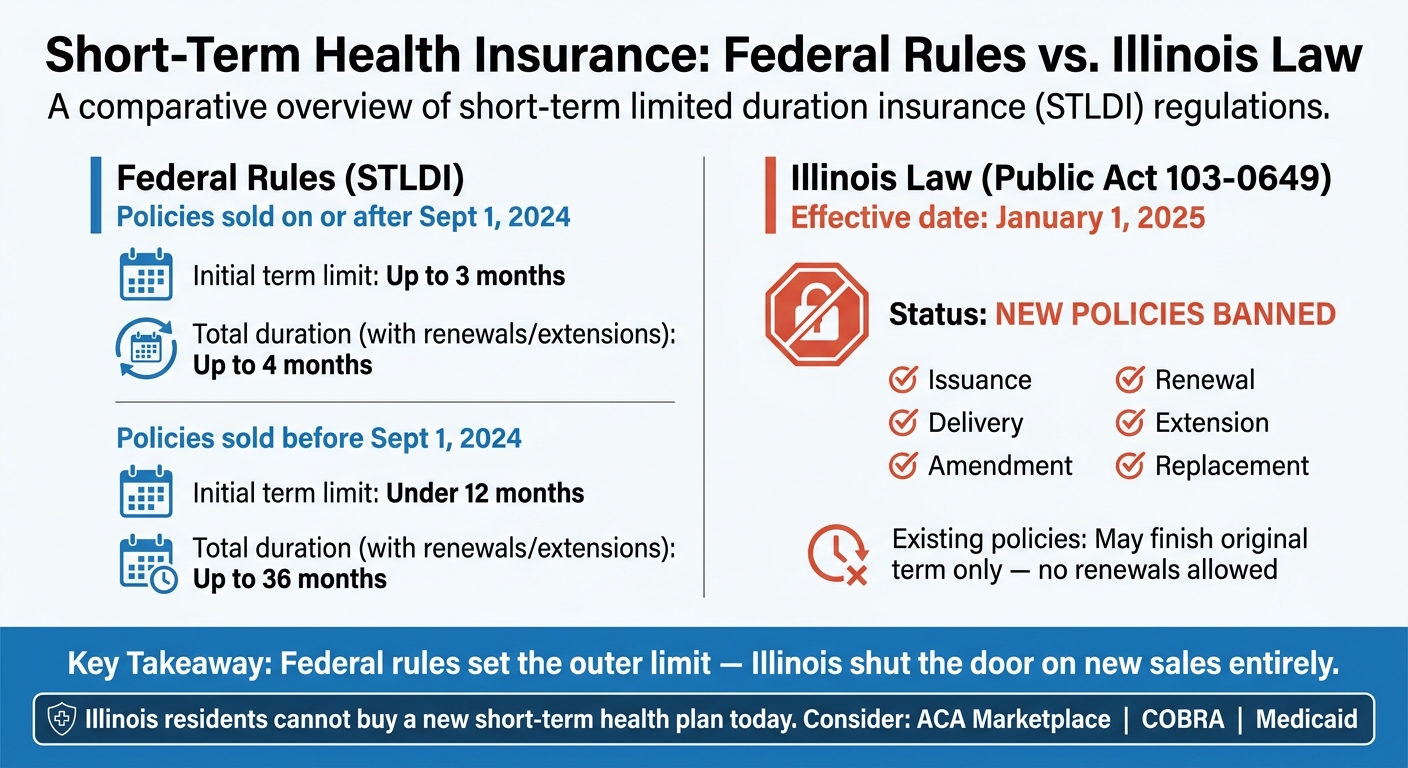
Short-Term Health Insurance: Federal Rules vs. Illinois Law
For Illinois residents, state law is the deciding factor in whether short-term health insurance is even on the table. An applicant might meet every normal requirement and still not be able to buy a plan, because Illinois law stops new short-term sales.
Federal duration limits for short-term plans
Federal STLDI rules cap new policies at a 3-month initial term and 4 months total, including renewals or extensions. Older policies sold before September 1, 2024, may have longer terms, but only if state law allows.
Illinois restrictions on new short-term health insurance policies
Illinois went a step further and banned new short-term policies outright. Public Act 103-0649, which took effect on January 1, 2025, bans the issuance, delivery, amendment, renewal, extension, or replacement of STLDI for Illinois residents and Illinois-domiciled entities. Existing policies could finish their original term, but no new or renewed STLDI can be sold in Illinois.
Put simply: federal rules set the outer limit, but Illinois shut the door on new sales.
Comparison table: federal rules versus Illinois rules
| Rule Source | Initial Term Limit | Total Duration Limit | Illinois Rule |
|---|---|---|---|
| Federal (policies sold on or after September 1, 2024) | Up to 3 months | Up to 4 months (including renewals or extensions) | Blocked by Illinois ban |
| Federal (policies sold before September 1, 2024) | Under 12 months | Up to 36 months (with renewals or extensions) | Existing policies only; no renewals |
| Illinois law (Public Act 103-0649) | N/A – prohibited | N/A – prohibited | Issuance, delivery, amendment, and renewal banned as of January 1, 2025 |
That leaves a very practical issue: which coverage options make sense for a gap in Illinois.
Who short-term coverage may fit, who it does not fit, and what Illinois readers should know
Situations where short-term coverage has historically been used
Short-term health insurance has mainly been used as temporary gap coverage during short breaks in major medical insurance. In the past, people often turned to these plans between jobs, after aging off a parent’s plan, before Medicare started, or while waiting for the next enrollment window.
That backstory matters in Illinois because new short-term policies are no longer allowed.
Who short-term coverage is generally not designed for
Even in states where short-term plans are still sold, they only work for a pretty small slice of people. Someone with a chronic condition like diabetes, heart disease, asthma, or cancer can run into preexisting-condition exclusions. And if you depend on regular prescriptions, out-of-pocket costs can add up fast.
These plans also tend to leave out services many people assume health coverage will handle, including:
- Maternity care
- Many preventive services
Pregnant individuals, and people planning a pregnancy, are generally not a fit for this kind of plan because maternity coverage is usually excluded.
A person may qualify on paper. But that doesn’t mean the coverage works in real life if it doesn’t line up with their medical needs.
Conclusion: the main eligibility answer for Illinois readers
For Illinois residents, the practical answer is simple: you cannot buy a new short-term health insurance policy today. Even if you meet the age, residency, and health standards insurers have used in the past, Illinois law bars new policies from being issued, delivered, renewed, or amended.
If you’re dealing with a coverage gap – after a job change, after aging off a parent’s plan, or during some other life shift – the path usually leads to ACA marketplace plans, COBRA, or Medicaid, depending on your income and situation. Illinois Health Agents helps Illinois residents sort through those options and find coverage that fits their needs.
FAQs
What if I had a short-term plan before 01/01/2025?
If you bought a short-term health insurance policy before January 1, 2025, it can stay active until the end of its current term.
After that, you can’t renew it, extend it, or buy another short-term plan in Illinois. And there’s one more thing to know: because short-term plans aren’t considered minimum essential coverage, the plan ending does not trigger a Special Enrollment Period.
If you need coverage after your policy ends, Illinois Health Agents can help you look at ACA-compliant major medical plans.
Can I buy a short-term plan in another state if I live in Illinois?
No. If you live in Illinois, you can’t buy a short-term, limited-duration health insurance plan.
Starting January 1, 2025, Illinois law bans the sale, issuance, and renewal of these policies for state residents.
That ban also applies to short-term plans sold through out-of-state groups or associations.
If you’re looking for coverage, Illinois Health Agents can help you look at other state-approved options.
How do I compare ACA, COBRA, and Medicaid for a coverage gap?
Compare ACA Marketplace plans, COBRA, and Medicaid based on your income, health needs, and eligibility.
Medicaid is often the lowest-cost option and may come with $0 premiums. COBRA lets you keep the same coverage you had through your former employer, but there’s a catch: you pay the full premium yourself, plus a 2.0% administrative fee. ACA Marketplace plans can be a cheaper option than COBRA, especially if you qualify for premium subsidies after losing coverage.
The right pick often comes down to three things:
- Income: This can affect whether you qualify for Medicaid or ACA subsidies.
- Health needs: If you want to keep the same doctors or ongoing treatment, COBRA may make more sense.
- Eligibility: Not everyone can get Medicaid, and COBRA is only available in certain job-based coverage situations.
If cost is your main concern, Medicaid is usually the first place to look. If keeping your exact old plan matters most, COBRA offers that. If you want a middle ground between price and coverage, an ACA Marketplace plan may be the better fit.
Recent Comments