

If I’m using Gusto for benefits, I should treat it as admin software, not as my broker. That’s the short answer. The article argues that Gusto can handle enrollment and payroll deductions, but it often falls short on the broker work that saves money and fixes hard problems.
Here’s the core point in plain English:
- Plan help can be thin. I may see plan prices, but not enough analysis on deductibles, networks, funding models, or Illinois carrier options.
- Renewals can stay too narrow. Instead of checking the whole market, the process may stay close to the current carrier.
- Claims and billing help can be limited. If a claim is denied or an invoice is wrong, I may be told to work with the carrier myself.
- Illinois rules add more risk. State continuation for 2–19 employees, rating rules, and state coverage mandates can be easy to miss without local broker support.
- The cost of getting this wrong can be high. The article says firms with 50–150 employees can overpay by 15% to 30%, and a 100-person company may face $180,000 to $360,000 in avoidable yearly costs.
If I want payroll in one place but still want broker help, the article’s answer is simple: keep Gusto for payroll and move benefits to a separate broker through a Broker of Record change.
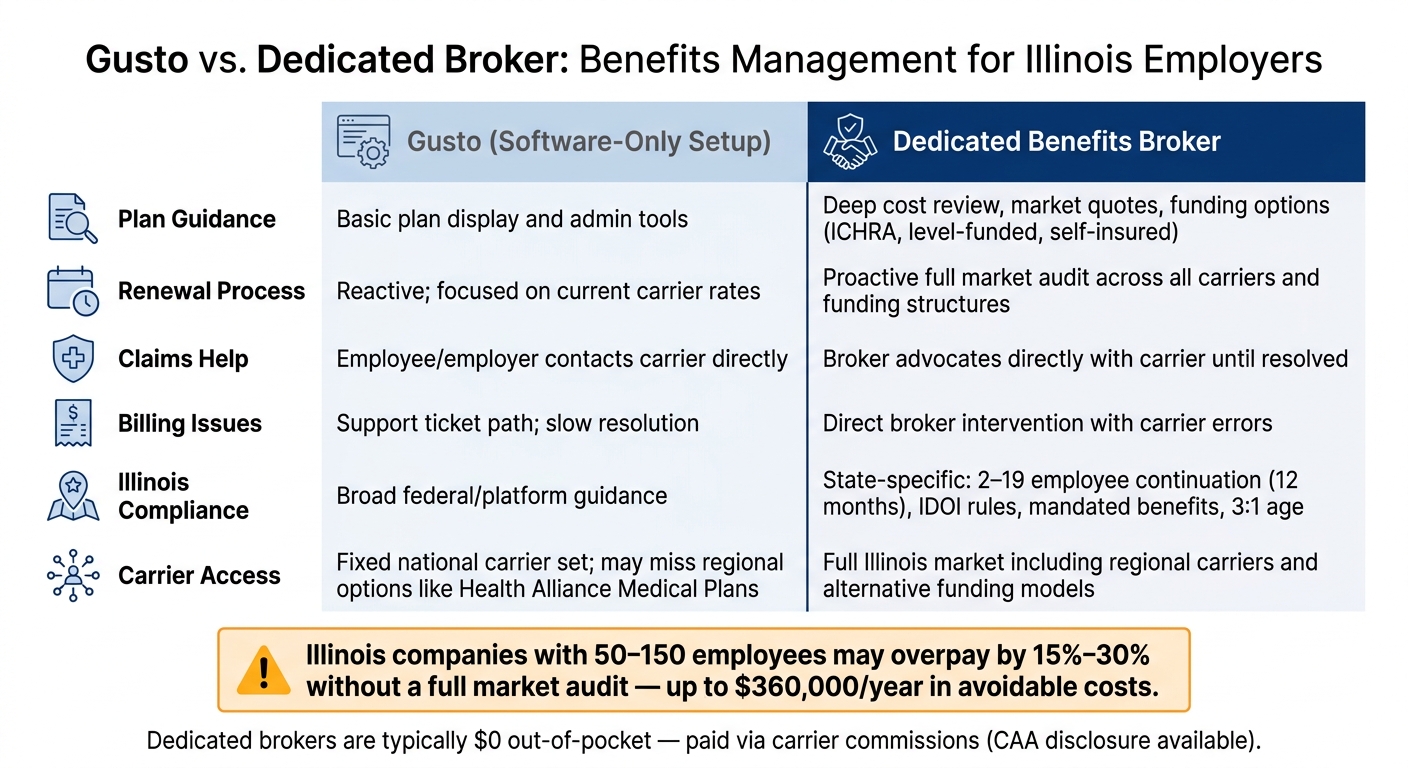
Gusto vs. Dedicated Broker: Benefits Management Comparison for Illinois Employers
Is Gusto a PEO? Payroll vs PEO Explained
sbb-itb-a729c26
Quick comparison
| Area | Gusto-style setup | Dedicated broker |
|---|---|---|
| Plan review | Basic plan display and admin | Deeper cost review, market quotes, funding options |
| Renewal work | Often centered on current carrier | Market check across carriers and plan types |
| Claims help | Employee/employer may need to call carrier | Broker steps in and follows up |
| Billing issues | Support ticket path | Direct broker help with carrier errors |
| Illinois support | Broad platform guidance | State-specific help on continuation, rating, and mandates |
So if I just need basic enrollment, Gusto may be enough. If I need cost control, claim help, renewal leverage, or Illinois-specific guidance, the article says it’s the wrong fit.
Problem 1: Shallow plan guidance and weak cost strategy
Gusto moves fast. But fast enrollment isn’t the same thing as plan analysis. It gives employers tools to get people signed up, not deep plan strategy. And that gap matters when the goal is cost control, not just checking the enrollment box.
Plan recommendations may be too generic
Gusto will usually show premiums and plan tiers. That’s useful, but it’s only part of the story. Employers also need to look at deductibles, out-of-pocket maximums, and how the provider network works for employees in Illinois.
Another blind spot: there often isn’t clear visibility into the carrier underwriting factors behind the premium. If you can’t see what is driving the price, it’s easy to miss lower-cost setups like ICHRA. For Illinois small businesses, ICHRA can cut costs by 20% to 30% compared with group plans.
The problem also shows up in budget planning. A lower premium can look good at first glance, but that often comes with a catch:
- Higher deductibles
- A narrower network
- Coverage that doesn’t match how employees use care
That kind of software-first setup usually doesn’t dig into the choices that shape total spend, like group pricing vs. age-based pricing, dependent coverage, and the tradeoff between premium, deductibles, and network access. Companies with 50 to 150 employees often overpay for benefits by 15% to 30%. So a surface-level plan pick isn’t a small issue. It can turn into a direct hit to the budget.
What a broker should do instead
A broker should do more than put plans on a screen. They should build the financial case for the right option. That includes annual plan modeling, side-by-side cost comparisons across carriers, and contribution strategy advice that fits both your budget and how your team uses care.
Those gaps tend to get more expensive at renewal, during claims disputes, and when billing errors show up.
Problem 2: Weak support during renewals, claims, and billing issues
These gaps tend to hit hardest at renewal time, during claims disputes, and when billing goes sideways.
Renewals can feel reactive, not strategic
In a software-first setup, renewal can boil down to a notice with new rates and a few updated plan choices from the current carrier. That’s reactive. It’s not a market check.
A real renewal process goes much further. It means sending census data to every relevant carrier, pulling quotes across funding models, and lining them up side by side so an employer can compare what’s out there. As Nick Taranto puts it:
"A real market audit means contacting every relevant carrier, submitting your census data, collecting and normalizing quotes across plan structures, and presenting a genuine comparison."
Employers are also often told that small-group rates can’t be negotiated under ACA rules. That’s not always the whole story. Level-funded or self-insured options can bring employee risk into pricing discussions, but that only happens if the broker actually goes after those paths.
When the renewal process stays inside the current carrier’s lane, employers miss the chance to test the broader market. That’s the line between software processing a renewal and a broker managing it with intent.
Claims and billing problems may not get direct broker help
The same issue gets harder to ignore when an employee has a claim denied or the monthly bill is off. Gusto’s Help Center says:
"For questions about claims and coverage, contact your carrier directly. We do not make invoice payments on your behalf."
That means when an employee runs into a denied claim or a provider network dispute, the employer or employee may have to deal with the carrier on their own. Without a dedicated broker in the mix, harder cases often get routed into carrier support and can take longer to fix. What employers usually need is someone who sticks with the issue until it’s settled, not someone who just opens a ticket.
Billing errors can play out the same way. Automated payroll deductions help. But if a carrier sends the wrong invoice, or an eligibility mistake creates a mismatch, the fix can still drag on for days through general support channels.
Admin help vs. broker advocacy
| Employer Need | Software-centric model | Dedicated broker advocacy |
|---|---|---|
| Renewal strategy | Reactive; focuses on current carrier rates and plan options | Proactive; runs full market audits and compares funding structures |
| Claims escalation | Limited; employers are often told to contact carriers directly | Strong; direct advocacy and carrier follow-up |
| Billing correction | Automated deductions help, but error resolution can be slow | Strong; human oversight helps correct discrepancies |
| Employee problem-solving | Relies on self-service tools and general support channels | Strong; dedicated help from someone who knows Illinois provider networks |
Even when admin support does its job, a narrow carrier view can still cut down the options available to Illinois employers.
Problem 3: Limited carrier access and weak Illinois-specific knowledge
Carrier access may not cover the full Illinois market
Support issues are one problem. A short carrier list is another.
If a broker uses a national platform with a fixed set of carriers, Illinois employers can miss part of the market. That can leave out regional carriers and other plan setups that may fit better. For example, regional carriers like Health Alliance Medical Plans may not appear in the quote process at all. The same goes for funding setups like level-funded or self-insured plans, which often get left out.
That matters because employers can’t compare the full cost picture if those options never make it into the quote set. And if they can’t compare them, they may miss a lower-cost plan or one that fits the team better.
For a healthier small-group workforce, a level-funded plan can lead to meaningful savings when compared with a standard fully insured plan. But that only happens if someone takes the time to look for it.
National compliance help is not the same as Illinois-specific support
Federal rules like ACA, ERISA, and COBRA are only the starting point. Illinois adds its own rules, and that’s where broad, one-size-fits-all guidance can miss the mark.
Illinois requires employers with 2–19 employees to offer state continuation coverage for up to 12 months after a qualifying event. That’s separate from federal COBRA, and it’s easy to overlook if a broker isn’t following Illinois rules closely. The state also requires coverage for services like infertility treatment, mammograms, and certain autism spectrum disorder therapies.
Then there’s the waiting period issue. The ACA sets a 90-day maximum waiting period for new hires, but using that rule the right way alongside Illinois payroll and group law often calls for local know-how.
Illinois small-group rating rules add another layer. They limit age-based premium variation to a 3:1 ratio, along with tobacco use, family tier, and geography. The usual minimum employer contribution is about 50% of the employee premium. These are not details you want handled with a generic federal checklist. They need Illinois-specific review.
What Illinois employers should look for in a broker
An Illinois employer should look for a broker who quotes all relevant regional carriers, not just the default national lineup. That broker should also run an annual compliance review against IDOI rules, not only federal rules. They should know how Illinois state continuation works, what participation rules apply, and how employer contribution setups connect to Illinois small-group requirements.
Local market knowledge also shapes plan decisions in a very practical way. Which carrier networks work across the parts of Illinois where your employees live? How does Blue Cross Blue Shield of Illinois stack up as the only carrier with statewide network reach across all 102 Illinois counties? When does an ICHRA make more sense than a group plan? When might a level-funded setup work better for a given workforce? Those calls depend on knowing the Illinois market, not just pulling data from a national report.
| What to Ask a Prospective Broker | Why It Matters |
|---|---|
| Do you quote regional Illinois carriers like Health Alliance? | Ensures you’re seeing the full market, not just national defaults |
| How do you track Illinois state continuation requirements? | Avoids compliance gaps for groups with 2–19 employees |
| Can you model level-funded or self-insured options? | Opens up potential savings for healthier workforces |
| Do you review plans against IDOI rules annually? | Keeps plan design aligned with Illinois-specific mandates |
| Are you independent, or tied to a limited carrier set? | Reveals whether your options are genuinely broad |
Conclusion: When Gusto is the wrong fit and what to do next
Gusto works well for payroll. But payroll software is not the same thing as a benefits broker, and that gap can hit Illinois employers hard when they need more than a self-serve portal.
Those weak spots get expensive fast. They tend to show up as limited plan guidance, reactive renewals, weak claims help, and thin Illinois compliance support. Companies with 50 to 150 employees often pay 15% to 30% more for benefits when no full market audit is done.
When that starts draining time and money, the move is pretty simple: keep payroll and brokerage separate. You can stay with Gusto for payroll and shift benefits to a dedicated broker through a Broker of Record letter. That can give you access to a full market audit, hands-on renewal help, and direct support when claims or billing problems pop up.
Key takeaways for Illinois business owners
For Illinois employers, the test is pretty straightforward:
Gusto can handle basic enrollment, but it starts to fall short as benefits needs grow. As headcount climbs, renewal costs go up, or your HR lead spends hours chasing carriers, the platform’s limits stop being a minor hassle and start becoming a liability.
A dedicated broker often costs employers $0 out of pocket because broker pay usually comes through carrier commissions, and employers can ask for written compensation disclosure under the CAA. That means you can get market access, direct advocacy, and Illinois-specific support without switching payroll.
FAQs
How do I know if I need a dedicated broker?
You may need a dedicated broker if you want hands-on support and personal guidance that goes beyond a self-service portal.
It can also make sense if you need help comparing a broader mix of plan options, fixing claim issues, handling state-specific compliance, keeping up with rule changes, and helping employees through private enrollment conversations.
What is a Broker of Record change?
A Broker of Record (BOR) change is the formal process of appointing a new insurance broker to represent your business with health insurance carriers.
When you submit a letter of authorization, you move policy management, renewals, and day-to-day support to the new broker. That change replaces your previous representative and gives the new broker access to plan data, along with the authority to help your business.
Can I keep payroll in Gusto and move benefits out?
Yes. You can keep payroll in Gusto while managing benefits outside the platform.
Gusto lets you keep your own broker and your current health plans. It can also automate payroll deductions and handle enrollments through its broker integration.
If your benefits are managed outside Gusto, you can still set up manual payroll deductions.
Recent Comments