

My starting point: choose an HSA for savings you can keep, or an employer health FSA for planned spending with funds available upfront - if you qualify. For 2026, HSA contribution limits are $4,400 for self-only coverage and $8,750 for family coverage; the health FSA salary-reduction limit is $3,400.
Neither account is health insurance. I’d compare eligibility, taxes, access to money, unused funds, and job-change rules before deciding.
Quick Comparison
| What I’d compare | HSA | Health FSA |
|---|---|---|
| Eligibility | Requires qualifying health coverage and no disqualifying coverage or status | Usually requires an employer that offers the account |
| Tax treatment | Federal tax breaks on contributions, growth, and qualified withdrawals | Federal tax breaks on contributions and qualified reimbursements |
| Access to funds | Only money already deposited | Full annual election generally available when coverage starts |
| Unused money | Stays yours year after year | Generally forfeited unless the plan allows a carryover or grace period |
| Changing jobs | Account stays yours | Coverage and claims deadlines depend on the plan |
| Using both | Can pair with a limited-purpose or qualifying post-deductible FSA | A general-purpose FSA - including a spouse’s - can block HSA contributions |
The account alone doesn’t decide which health plan costs less. I’d compare premiums, deductibles, prescriptions, provider networks, employer deposits, and early-year bills. Before enrolling, I’d also <u>confirm eligibility, Illinois tax treatment, and spending deadlines</u> - and check the limits for the coverage year.
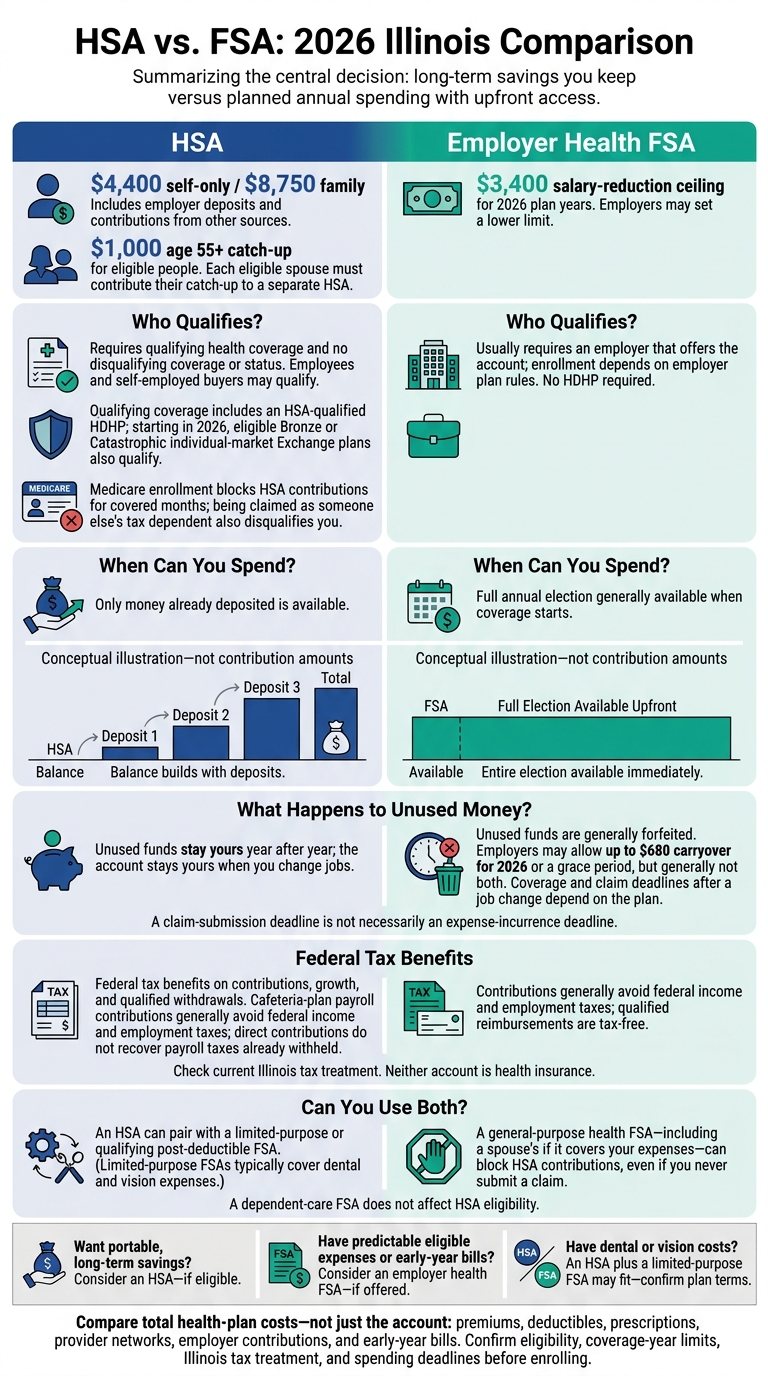
HSA vs. FSA: 2026 Illinois Comparison
FSA vs HSA: Which Tax-Advantaged Account Is Right for You in 2026?
sbb-itb-a729c26
Who Can Use an HSA or Health FSA?
| Eligibility factor | HSA | Health FSA |
|---|---|---|
| Eligible participants / sponsor | People who meet HSA rules, including employees and self-employed buyers | Usually employees whose employer offers the plan |
| Required coverage | HSA-qualified HDHP; starting in 2026, an eligible Bronze or Catastrophic individual-market Exchange plan also qualifies | No HDHP required; access depends on the employer’s plan |
| Disqualifying coverage or status | Medicare, other coverage that blocks contributions, or being claimed as a dependent on someone else’s tax return | Employer eligibility rules, waiting periods, enrollment requirements, and plan terms |
| Pairing with an HSA | - | Only a limited-purpose or post-deductible FSA can pair with an HSA; a general-purpose health FSA usually blocks HSA contributions |
Federal HSA rules apply to Illinois buyers whether they get coverage through work or buy it themselves. For a health FSA, the employer’s plan determines who can enroll. Once you qualify, contribution limits and spending rules determine how much you can set aside and when you can use it.
HSA Eligibility and Contribution Limits
For 2026, a standard HSA-qualified HDHP must have a deductible of at least $1,700 for self-only coverage or $3,400 for family coverage. Out-of-pocket limits, excluding premiums, cannot exceed $8,500 for self-only coverage or $17,000 for family coverage. Starting in 2026, Bronze or Catastrophic plans purchased through the individual Exchange also count as HSA-compatible, even if they don’t meet the usual HDHP thresholds. Don’t assume a Bronze or Catastrophic plan sold outside the Exchange qualifies - check that specific plan before contributing.
The 2026 HSA contribution limits are $4,400 for self-only coverage and $8,750 for family coverage. Those totals include employer deposits and contributions from other sources, so subtract those amounts before deciding how much to contribute yourself. Eligible people who are 55 or older by year-end can add $1,000. Each eligible spouse must put their catch-up contribution into a separate HSA.
Eligibility generally depends on your coverage on the first day of each month. If you qualify for only part of the year, your contribution limit may be lower. Medicare enrollment blocks contributions for covered months, and being claimed as a dependent on someone else’s tax return also disqualifies you. Self-employed buyers have no HSA income ceiling or earned-income requirement, but should still consider whether they could afford the deductible in a year with high medical bills.
Health FSA Eligibility and Rules for HSA Use
Employees usually choose their health FSA salary reductions during employer enrollment. For 2026 plan years, the federal salary-reduction ceiling is $3,400, but employers can set a lower limit. Follow your plan’s claim procedures, submit the required expense records, and check both reimbursement and claim-submission deadlines. Self-employed buyers usually can’t open a health FSA unless they qualify through an employer-sponsored plan. Check with the plan administrator to confirm eligibility.
A spouse’s general-purpose FSA can block your HSA contributions if it covers your medical expenses - even if you never submit a claim. A limited-purpose FSA, which typically covers dental and vision expenses, can generally work alongside an HSA. A qualifying post-deductible FSA can also work, provided medical reimbursements start only after the required deductible is met. Ask for written confirmation of the FSA’s reimbursement terms and effective date. A dependent-care FSA does not affect HSA eligibility.
HSA vs. FSA: Taxes, Access to Funds, and Rollover
Once you qualify, the main differences come down to taxes, when you can spend the money, and what happens to unused funds.
| Feature | HSA | Health FSA |
|---|---|---|
| Federal taxes | Qualified withdrawals are tax-free. | Qualified reimbursements are tax-free. |
| Access to funds | You can spend only the available account balance. | The full annual election is generally available at the start of the plan year. |
| Unused funds and ownership | You own the account and can take it with you. Unused funds stay available indefinitely, and rollovers do not count toward the annual contribution limit. | Your employer controls the account, and unused funds are generally forfeited. Employers may allow a carryover of up to $680 for 2026 or a grace period, but generally not both. |
Tax Rules and Eligible Expenses
HSA contributions made through an employer’s cafeteria plan generally avoid federal income, Social Security, and Medicare taxes. Contributing directly to an HSA can still reduce your federal income tax, but it won’t recover payroll taxes already withheld. HSA earnings can also grow tax-free.
Health FSA salary reductions and employer contributions generally avoid federal income and employment taxes. Check current Illinois tax treatment rather than assuming it follows federal rules.
Both accounts can reimburse qualified medical expenses for you, your spouse, and eligible dependents, as long as the expenses meet the account’s timing rules. Keep supporting records. You cannot reimburse the same expense twice or claim a reimbursed expense as an itemized medical deduction.
When You Can Access Your Funds
A health FSA usually gives you access to your full annual election at the start of the plan year. With an HSA, you can spend only what has been deposited.
You can also pay out of pocket and reimburse yourself from your HSA later - even years later. The qualified expense must have occurred after you established the account, and it cannot have been reimbursed or deducted before. There is generally no federal same-year reimbursement deadline. Keep supporting records until you reimburse yourself.
Unused Funds, Account Ownership, and Job Changes
Your HSA stays yours when you change jobs. You can generally keep it where it is or transfer it to another HSA custodian, but you must remain eligible to make future contributions.
Nonqualified HSA withdrawals generally trigger income tax plus an additional 20% tax before age 65. After age 65, the additional tax generally ends, but income tax still applies.
With an FSA, extra time to submit claims does not necessarily mean extra time to incur expenses. Before leaving a job, ask when coverage ends, which claims remain payable, and whether COBRA continuation is available. Continuing coverage typically requires after-tax payments plus any applicable administrative fee.
Which Account Fits Your Illinois Health Coverage?
Once you understand the rules, use your cash flow and expected medical expenses to narrow your options. Compare total annual cost, when funds become available, and the risk of losing unused money.
| Your situation | Best fit | Eligibility and cash-flow impact |
|---|---|---|
| Self-employed buyer | HSA with an HSA-qualified HDHP | You don’t need an employer plan, but you must meet HSA rules and cover early expenses before deposits build up. |
| Household with predictable expenses | Employer health FSA | Base your election on expected eligible costs. Weigh tax savings against the risk of forfeiting unused funds. |
| Employee needing early-year bills covered | Health FSA, if offered | Its funding structure can help pay early-year bills. Confirm coverage dates and claim rules. |
| Job changer | HSA with qualifying coverage | Your HSA stays with you, but check that your next plan keeps you HSA-eligible. Confirm any remaining FSA claims before coverage ends. |
| Employee with dental or vision costs | HSA plus a limited-purpose FSA | This pairing can preserve HSA eligibility. Check exactly what the FSA covers. |
Compare Health Plan Costs and Household Needs
Use the table as a starting point, then check the fit against your expected medical use. Compare low-, expected-, and high-use years, ranging from little care to routine needs to major medical expenses. Add premiums, expected deductible spending, copayments, coinsurance, prescription costs, and account fees. Then subtract employer contributions and estimated tax savings.
Check provider networks and out-of-network rules separately. For a high-use year, consider annual premiums plus the in-network out-of-pocket maximum. Premiums and services your plan doesn’t cover do not count toward that maximum.
For family coverage, review pediatric, maternity, specialist, prescription, and out-of-network benefits. Check both spouses’ coverage, too: a spouse’s general-purpose FSA can block HSA contributions. Anyone approaching Medicare should coordinate HSA contribution timing with enrollment to avoid excess contributions.
Small employers should set their contribution amounts before enrollment and explain what employees may need to pay early in the year. Budget for administrative fees, confirm applicable nondiscrimination requirements, and explain account limits, eligible expenses, and forfeiture rules in plain language.
Check the Coverage Year and Plan Rules
Before enrolling, verify the plan year and contribution limits. Match the plan year to the correct IRS limits and claim deadlines. For 2026, HSA contribution limits are $4,400 for self-only coverage and $8,750 for family coverage. HDHP minimum deductibles are $1,700 and $3,400, respectively, and maximum HDHP out-of-pocket limits are $8,500 and $17,000.
Ask for the Summary of Benefits and Coverage and account plan documents. For an FSA, check the applicable carryover amount or grace period, along with claim deadlines. Illinois Health Agents can help Illinois buyers compare coverage and identify HSA-compatible options. Confirm the final arrangement in writing, including account eligibility and how it fits your expected spending and ability to cover early bills.
Conclusion: Match Your Account to Your Coverage and Budget
Your choice depends on how you’ll pay for care now and later. An HSA offers portable, long-term savings with rollover. A health FSA suits planned annual spending and gives you front-loaded access to funds, but you risk losing unused money.
Compare expected expenses, eligibility, employer contributions, and cash flow. Check your plan documents for deadlines, then match the coverage rules, tax treatment, and rollover or forfeiture risk to your spending needs and ability to cover early bills.
FAQs
How does Illinois tax my HSA or FSA contributions?
Illinois follows federal tax rules for HSA and FSA contributions. The state has no separate tax penalty or incentive program.
HSA contributions are fully deductible from Illinois taxable income. Investment growth and withdrawals used for qualified medical expenses also remain tax-free.
For both HSAs and FSAs, pre-tax payroll contributions made through an employer’s Section 125 cafeteria plan generally reduce the wages reported for Illinois income tax purposes.
What if I accidentally overcontribute to my HSA?
Contact your HSA custodian to request a withdrawal of the excess contribution and any earnings on it before your tax filing deadline. This can help you avoid potential tax consequences. If you find the error after the deadline, talk with a tax professional about your options.
Illinois Health Agents can help you coordinate payroll and contributions so your deposits stay within IRS limits throughout the year.
Can I switch from an FSA to an HSA midyear?
Yes, but you must meet HSA eligibility requirements to contribute. You generally can’t contribute to both a general-purpose health FSA and an HSA at the same time. Your FSA must be used up or converted to a limited-purpose FSA that covers only dental and vision expenses.
HSA eligibility is determined on the first day of each month. Your annual contribution limit is prorated based on the number of months you have an HSA-compatible high-deductible health plan.
Recent Comments