

Lost your job? I’d check when your health coverage ends first. Losing qualifying coverage - not the job itself - usually gives you 60 days before and 60 days after coverage ends to choose an ACA plan.
Here’s what I’d check before enrolling through Get Covered Illinois:
- Eligibility and dates: Confirm that your coverage loss qualifies, gather proof, and check your new plan’s start date.
- ACA versus COBRA: Compare premiums, doctors, prescriptions, and out-of-pocket costs. Ending COBRA early usually won’t create another enrollment window.
- Help with costs: Estimate your household income for the coverage year, then check tax credits, Illinois Medicaid, and All Kids.
- Final enrollment steps: Submit requested documents and pay the first premium. <u>An application receipt is not proof of coverage.</u>
My bottom line: check the dates before you switch. Confirm your new coverage with the insurer before ending COBRA.
ACA Coverage After Retirement: Special Enrollment & Tax Credits #shorts
sbb-itb-a729c26
Qualifying Coverage Losses and Enrollment Deadlines
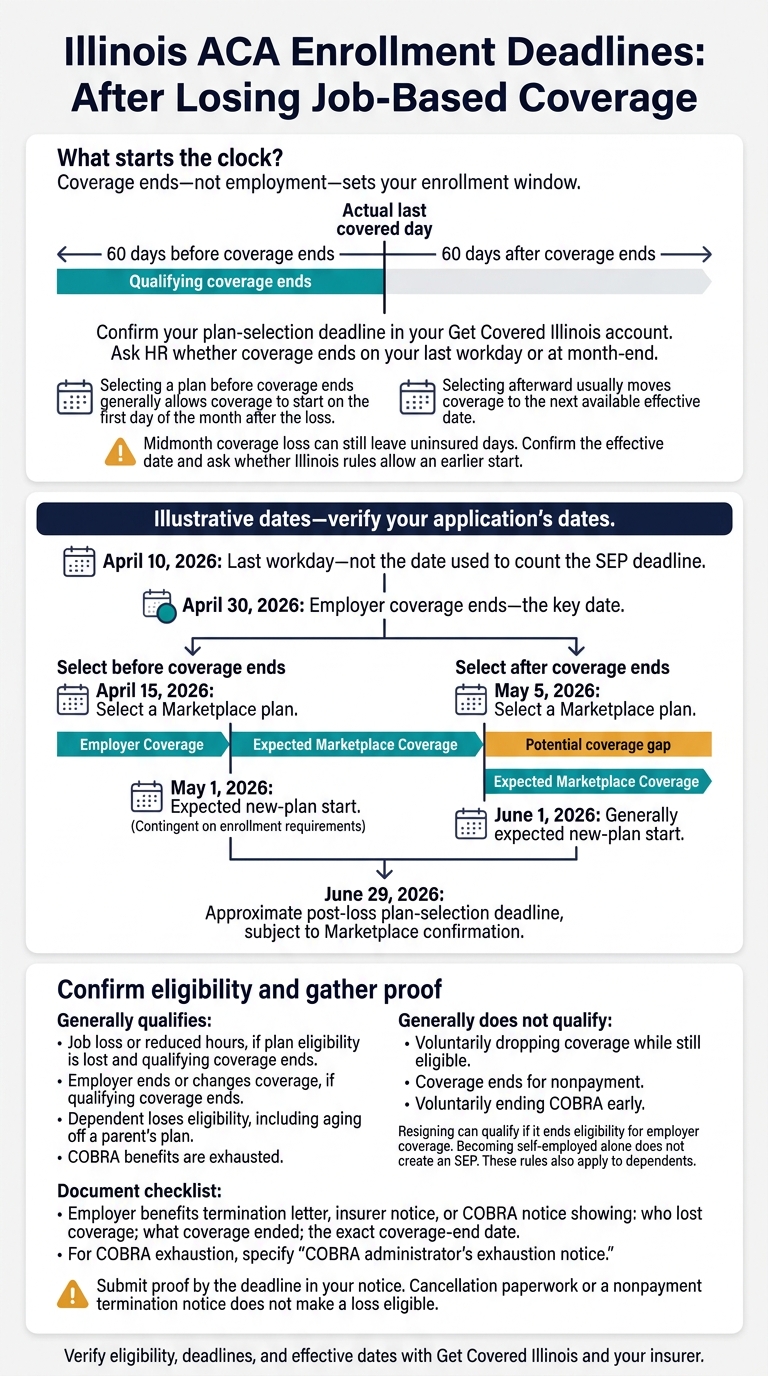
Illinois ACA Enrollment After Job Loss: Key Dates
Which Coverage Losses Qualify?
Resigning can qualify you for a special enrollment period (SEP) if it ends your eligibility for employer coverage. The SEP is tied to when qualifying coverage ends - not when your job ends. Dropping coverage while you’re still eligible usually doesn’t qualify. These rules also apply to dependents. Becoming self-employed, by itself, does not create an SEP.
| Event | Generally qualifies? | Useful supporting documents |
|---|---|---|
| Job loss or reduced hours | Yes, if you lose eligibility for that plan and qualifying coverage ends | Employer benefits letter or insurer notice showing the last covered day |
| Employer ends or changes qualifying coverage | Yes, if qualifying coverage ends | Employer or insurer notice describing the change |
| Dependent loses eligibility, including aging off a parent’s plan | Yes, for the affected dependent | Notice identifying the dependent and coverage-end date |
| Voluntarily dropping coverage while still eligible | Generally no | Cancellation paperwork does not make the loss eligible |
| Coverage ends for nonpayment | Generally no | A termination notice does not create eligibility |
| COBRA benefits are exhausted | Generally yes; voluntarily ending COBRA early generally does not qualify | COBRA administrator’s exhaustion notice |
The 60-Day Window and Plan Start Dates
Once you confirm that your coverage loss qualifies, check your enrollment dates. Use your actual last covered day - not your last workday - to count your SEP deadline. Ask HR whether coverage ends on your last workday or at month-end. Then confirm your plan-selection deadline in your Get Covered Illinois account.
If you enroll before coverage ends, your Marketplace plan generally starts on the first day of the month after the loss. If you enroll after coverage ends, the start date usually moves to the next available effective date. Losing coverage midmonth can still leave you with uninsured days. Confirm your effective date and ask whether Illinois rules allow an earlier start.
Sample Timeline and Required Documents
With your coverage-end date confirmed, mark your plan-selection deadline and gather your documents.
Hypothetical Illinois timeline: Your last workday is April 10, 2026, but your employer confirms coverage through April 30. You select a plan through Get Covered Illinois on April 15, with an expected May 1 start. The approximate post-loss enrollment deadline is June 29, subject to Marketplace confirmation. Waiting until May 5 to select a plan would generally mean a June 1 start, potentially leaving all of May uncovered. All dates are illustrative; verify your application’s dates.
Gather a benefits termination letter, insurer notice, or COBRA notice that shows who lost coverage, what coverage ended, and the exact end date. Submit that proof by the deadline listed in your notice.
COBRA, ACA Costs, and Financial Assistance
Compare COBRA and ACA Coverage
Once you know your SEP deadline, compare total costs - not just monthly premiums. Use each plan’s Summary of Benefits and Coverage to check networks, prescriptions, deductibles, copays, coinsurance, and out-of-pocket maximums.
| What to compare | COBRA | ACA Marketplace coverage |
|---|---|---|
| Networks and benefits | Usually keeps your employer plan, including its provider network and prescription formulary | Networks and benefits differ; check your doctors, hospitals, and prescriptions before enrolling |
| Premium responsibility | Usually the full employer-and-employee premium, plus up to a 2% administrative fee | Plan premium minus any premium tax credit you qualify for |
| Financial assistance | Marketplace premium tax credits do not apply | Eligible households may get premium tax credits; Silver-plan cost-sharing reductions can lower deductibles, copayments, coinsurance, and out-of-pocket maximums |
| Deductible and out-of-pocket progress | Usually maintains current treatment and progress toward deductibles and out-of-pocket maximums within the plan year | Switching plans usually resets deductible and out-of-pocket spending |
| Coverage timing | Can cover the gap retroactively if you elect coverage and pay on time | Coverage starts on the effective date |
Federal COBRA usually applies to private employers with 20 or more employees. Coverage often lasts 18 months after job loss or reduced hours. You usually have 60 days from the later of coverage loss or the election notice to elect COBRA, then 45 days after election to make your first payment. Later payments have a grace period of at least 30 days.
Illinois continuation rights may apply when federal COBRA does not. Check with your plan administrator or Illinois insurance regulators to confirm which rules apply.
When You Can Switch From COBRA to ACA Coverage
Choosing COBRA keeps your original enrollment window open, but it does not extend that window. Once it closes, canceling COBRA or missing payments usually won’t create a new SEP. You generally need COBRA exhaustion, another qualifying event, or Open Enrollment to enroll in Marketplace coverage.
Estimate Household Income for Premium Tax Credits
If ACA coverage looks less expensive, check whether your projected income qualifies you for premium tax credits.
Use your projected annual household income for the coverage year, including wages, taxable unemployment, taxable severance, and net self-employment income. Pay stubs, unemployment records, and severance letters can help you build that estimate.
Access to affordable employer coverage - including a spouse’s plan - can affect subsidy eligibility. Report income and coverage changes promptly. Advance credits are reconciled on your federal tax return, so don’t assume last year’s subsidy amount or an earlier eligibility decision still applies.
Check Illinois Medicaid and All Kids Eligibility
If your income is low after losing coverage, check public coverage options before choosing a Marketplace plan.
Illinois Medicaid uses current monthly income under its program rules. Children through age 18 may qualify for All Kids even when their parents use Marketplace coverage. Family members don’t all have to use the same coverage.
Complete Enrollment and Avoid Coverage Gaps
Apply Through Get Covered Illinois
Once you confirm your coverage loss and deadline, complete your Marketplace application before the 60-day window closes.
Apply through Get Covered Illinois to check whether you qualify for subsidies and submit the required proof. Open Enrollment for 2027 runs November 1, 2026, through January 15, 2027. Losing job-based coverage may also qualify you for a 60-day Special Enrollment Period outside those dates. You’re not covered until you complete enrollment, choose a plan, and pay the first month’s premium by the insurer’s deadline.
Check your account for “Documents Required” alerts. Upload the employer or insurer letter showing when your coverage ends. If your income or citizenship information doesn’t match, you usually have 90 days to submit proof.
Check Benefits, Coverage Dates, and Your First Payment
After submitting your application, review the plan details that affect your care and costs. Before choosing a plan, confirm its provider network, covered drugs, deductible, and out-of-pocket maximum.
Keep your coverage-end date, COBRA dates, ACA effective date, and first-payment deadline in one calendar. An application confirmation is not proof of coverage. Check your effective date, enrollment status, and payment status directly with the insurer.
Get Help With Illinois ACA Enrollment
Illinois Health Agents can help you finish the application, choose a plan, and estimate your income. To have a broker assist with your application, authorize them through your Get Covered Illinois account. The broker cannot add themselves to your account.
Conclusion: Confirm Your Coverage Loss, Deadline, and Start Date
Your coverage-end date - not your last workday - starts the enrollment clock. Make sure your coverage loss qualifies, then confirm your enrollment deadline.
Estimate your household income for the coverage year to check subsidy eligibility. Include wages, severance, unemployment, and expected future earnings. Check whether each family member qualifies for Medicaid or All Kids.
Compare ACA and COBRA based on total cost and how well the coverage meets your needs, not premiums alone.
Don’t end COBRA until your new plan’s start date is confirmed, the required documents are approved, and your first premium is paid. Keep the insurer’s coverage confirmation - not just the application receipt - to help avoid a coverage gap.
FAQs
What if my employer delays proof of coverage loss?
Contact your employer’s HR department right away to request a letter confirming your coverage type and official end date. You can also use an insurer’s notice as proof. If your employer doesn’t provide the letter, contact the Department of Labor for help.
Submitting proof and choosing a plan are separate steps. Complete your plan enrollment within your 60-day Special Enrollment Period (SEP), even if you’re still gathering documents.
How does a lump-sum severance payment affect my subsidies?
Marketplace subsidies depend on your projected annual household income. A lump-sum severance payment counts as taxable income, adding to your yearly total and potentially reducing the financial assistance you qualify for.
Include severance in the annual household income estimate on your application so your subsidy reflects your financial situation.
What if I get a new job after enrolling?
If you start a new job after enrolling, check when your new benefits begin. Waiting periods often run 30-90 days. Knowing the exact start date helps you avoid coverage gaps or overlaps.
Losing job-based coverage typically gives you a 60-day Special Enrollment Period. Your coverage start date usually depends on when you apply and when your previous coverage ends. Keep your termination or coverage end notice as proof.
Recent Comments