
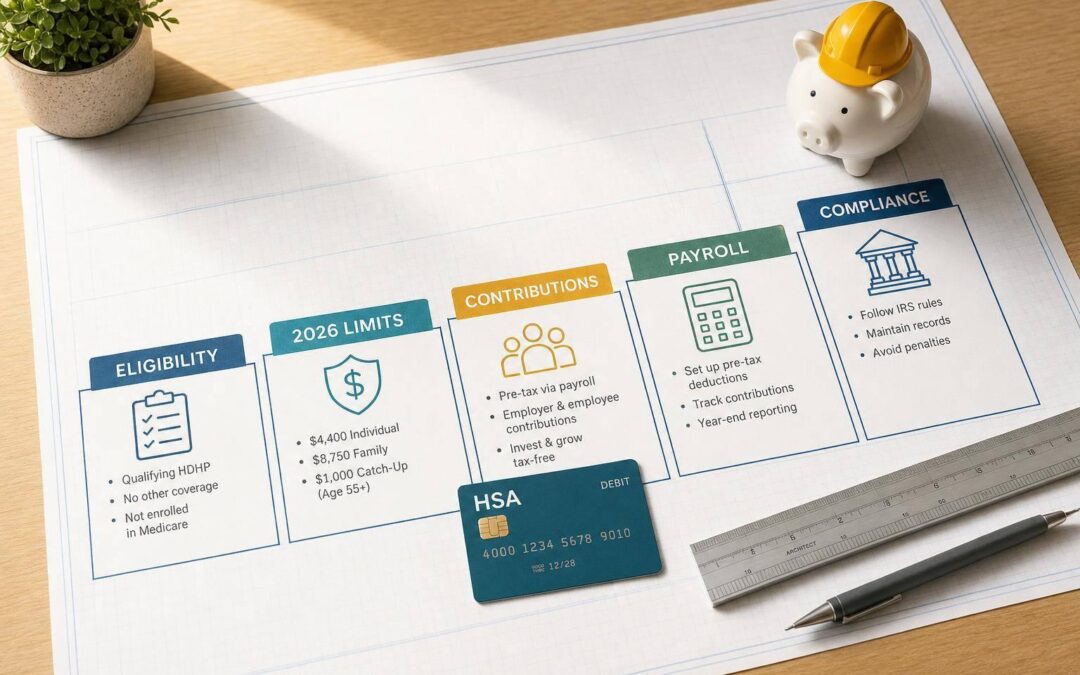
If you run a small business, an HSA can cut tax costs, lower premium pressure, and help employees pay medical bills with pre-tax money. To use one, you need an HSA-eligible high-deductible health plan (HDHP), you need to stay within IRS contribution limits, and you need payroll and plan rules set up the right way.
Here’s the short version:
- HSAs work only with HSA-eligible HDHPs
- 2027 HSA limits are $4,500 for self-only and $9,000 for family coverage
- People age 55+ can add $1,000
- Employer and employee contributions count toward the same annual limit
- Employer contributions can lower payroll tax costs
- Plan setup matters if you also offer an FSA or use pre-tax payroll deductions
- Unused HSA money rolls over and stays with the employee
Small firms face steep health costs. In 2023, average family premiums at small firms hit $23,621, and workers paid about $8,334, or 38%, of that cost. That’s why many owners look at HSAs as a simpler way to pair lower premiums with tax-favored medical savings.
If I were sizing up HSAs for a small business, I’d focus on four things first: plan eligibility, contribution rules, payroll setup, and employee education. Get those right, and the rest gets much easier.
| Key point | What to know |
|---|---|
| Plan requirement | Must be an HSA-eligible HDHP |
| 2027 limits | $4,500 self-only / $9,000 family |
| Catch-up | +$1,000 at age 55+ |
| Tax treatment | Contributions can be tax-free; qualified withdrawals are tax-free |
| Account ownership | The employee keeps the HSA if they leave |
| Main risk areas | Overcontributions, Medicare enrollment, FSA conflicts, payroll reporting |
In plain English: an HSA can be a smart fit for a small business, but only if the plan is eligible and the rules are handled with care.
HSA Contribution Models for Small Businesses: Which Strategy Fits You?
1. HSA Basics and Eligibility Rules for Small Businesses
What an HSA Is and How It Works With an HSA-Eligible HDHP
An HSA is a tax-advantaged account used for qualified medical expenses. But there’s an important catch: it only works if the person is covered by an HSA-eligible HDHP that meets IRS rules.
HSAs come with a triple tax advantage. Contributions are pre-tax or tax-deductible, account growth is tax-free, and withdrawals for qualified medical expenses are tax-free. For 2027, an HSA-eligible HDHP must have a deductible of at least $1,750 for self-only coverage or $3,500 for family coverage. Its out-of-pocket maximum can’t be more than $8,700 for self-only coverage or $17,400 for family coverage. Preventive care can still be covered before the deductible kicks in.
In Illinois, these plans should be clearly marked as HSA-eligible. Even so, it’s smart to confirm IRS eligibility with your insurer or broker. Illinois Health Agents can help Illinois small business owners check that a group plan is actually HSA-compatible before enrollment.
Who Can Open and Use an HSA
HSA eligibility is tied to the individual, not the employer. So even if a company offers an HSA-eligible plan, each person still has to meet the account rules on their own.
A person can contribute to an HSA only if they are covered by an HSA-eligible HDHP on the first day of the month, have no other disqualifying coverage, are not enrolled in Medicare, and cannot be claimed as a dependent. Sole proprietors can open an HSA directly and deduct eligible contributions on Form 1040. W-2 employees open their own HSAs, and the account always stays with the individual.
If an owner or employee has family HDHP coverage, contributions can go up to the family limit. Spouses can also split contributions across separate HSAs, as long as they stay within that combined family cap.
Some of the most common disqualifiers are:
- Coverage under a spouse’s PPO
- Medicare enrollment
- A general-purpose health FSA
These rules matter in a small business setting because they affect who can take part and how much an employer may want to set aside.
Contribution Limits, Qualified Expenses, and Withdrawal Rules
For 2027, HSA contribution limits are $4,500 for self-only coverage and $9,000 for family coverage. Those limits include all deposits combined. That means employee contributions, employer contributions, and any other funding all count toward the same annual cap.
| Coverage Type | 2026 Limit | 2027 Limit |
|---|---|---|
| Self-only HDHP | $4,400 | $4,500 |
| Family HDHP | $8,750 | $9,000 |
| Catch-up (age 55+) | +$1,000 | +$1,000 |
People who are age 55 or older by year-end can add another $1,000 above the standard limit. If both spouses are 55 or older and each one is HSA-eligible, those catch-up amounts must go into separate HSAs. In plain English, each spouse needs their own account to make their own $1,000 catch-up contribution.
Qualified expenses are defined under IRS Section 213(d). They usually include deductibles, copays, prescriptions, dental care, vision care, and some long-term care costs. Health insurance premiums usually don’t count, except in limited cases such as COBRA coverage or coverage tied to unemployment.
If someone takes money out for a nonqualified expense before age 65, the amount is taxable and also hit with a 20% penalty. After age 65, that penalty goes away, but regular income tax still applies to nonqualified withdrawals.
With those rules in place, the next piece is how employer contributions are handled, how the tax treatment works, and what small businesses need to do to stay compliant.
Compare group health plans for your Illinois business. Our local, licensed agents shop the top carriers and send you side by side quotes at no cost.
Get Group Quotes
2. Employer Contribution Rules, Tax Treatment, and Compliance
How Employer and Employee Contributions Are Taxed
When an employer puts money into an employee’s HSA, that money is not treated as taxable wages. It is not subject to federal income tax withholding, Social Security, Medicare, or FUTA taxes. The employer can also deduct those HSA contributions and avoid payroll taxes on them.
Employee contributions follow a different set of tax rules, so payroll setup matters.
If employees contribute through payroll under a Section 125 cafeteria plan, those contributions are pre-tax and usually avoid FICA taxes too. If employees contribute directly instead, they use after-tax dollars first and then claim the deduction on their personal tax return, as long as they are HSA-eligible and stay within the annual limit.
Employer contributions and employee pre-tax payroll deductions must be reported in Box 12 of Form W-2 with code W. That detail matters more than it might seem at first. Payroll records and HSA custodian records need to line up. Employees then use the code W amount when they fill out Form 8889, which checks total contributions against the IRS annual cap.
Business structure also affects who gets the tax deduction. C corporation owner-employees who receive a W-2 can get employer HSA contributions the same way other employees do. More-than-2% S corporation shareholders, partners, and sole proprietors do not use that route. They generally fund their own HSAs directly and take the deduction on their personal tax returns.
How the HSA is funded then decides which compliance rules apply: comparability rules or Section 125 cafeteria plan rules.
Comparability Rules and Section 125 Plan Exceptions
If HSA contributions are made outside a Section 125 cafeteria plan, the IRS comparability rules apply. That means the employer must make comparable contributions for all comparable participating employees. In plain terms, that usually means the same dollar amount or the same percentage of the deductible.
Employers can still vary contributions by coverage tier, like self-only versus family coverage, and by employee class. But they cannot vary them based on personal factors such as health status. If the comparability rules are broken, the penalty is steep: an excise tax equal to 35% of all HSA contributions the employer made for that calendar year.
When employer HSA contributions are made through a Section 125 cafeteria plan, the comparability rules do not apply. Instead, the plan has to pass Section 125 nondiscrimination tests. Those tests look at eligibility, contributions, and benefits to make sure highly compensated or key employees are not getting favored treatment.
This setup gives employers more room in plan design. For example, a company can offer a matching contribution tied to employee salary reductions, as long as the cafeteria plan passes nondiscrimination testing.
| Contribution Route | Governing Rule | Flexibility |
|---|---|---|
| Outside Section 125 plan | HSA comparability rules (Section 4980G) | Limited, same amount or % for all comparable employees |
| Through Section 125 cafeteria plan | Section 125 nondiscrimination rules | More flexible, matching and tiered designs allowed |
Records, Reporting, and Common Compliance Mistakes
Good recordkeeping is part of staying out of trouble. Employers should track HDHP enrollment dates, contribution amounts, salary reductions, and coverage changes.
Some mistakes show up again and again:
- Going over the IRS annual contribution limit because employer and employee contributions were not coordinated
- Missing mid-year eligibility changes, such as an employee dropping HDHP coverage or enrolling in Medicare
- Allowing HSA contributions while an employee is covered by a disqualifying general-purpose FSA
That last issue is easy to miss. If your company offers both an HSA and a general-purpose health FSA, an employee enrolled in both is not eligible for HSA contributions. One fix is to set up the FSA as limited-purpose so it covers only dental and vision expenses.
A year-end reconciliation can catch problems before W-2s go out. Match payroll records against HSA custodian deposit reports for each employee, confirm that combined contributions did not go over the IRS limit, and fix any contributions made after an employee lost eligibility. Illinois Health Agents can help Illinois small business owners line up their group plan structure, FSA setup, and Section 125 plan so these issues do not snowball.
With the tax rules in place, the next move is choosing a contribution approach that fits your team and budget. These rules shape the model you pick next.
HSA Strategy Every Business Owner Needs
3. Choosing an HSA Contribution Strategy for Your Small Business
Once the compliance rules are set, the next move is simple: decide how much to contribute and when to fund it.
That choice still needs to fit the plan rules from the prior section. In practice, most small businesses weigh three things:
- compliance
- cash flow
- workforce mix
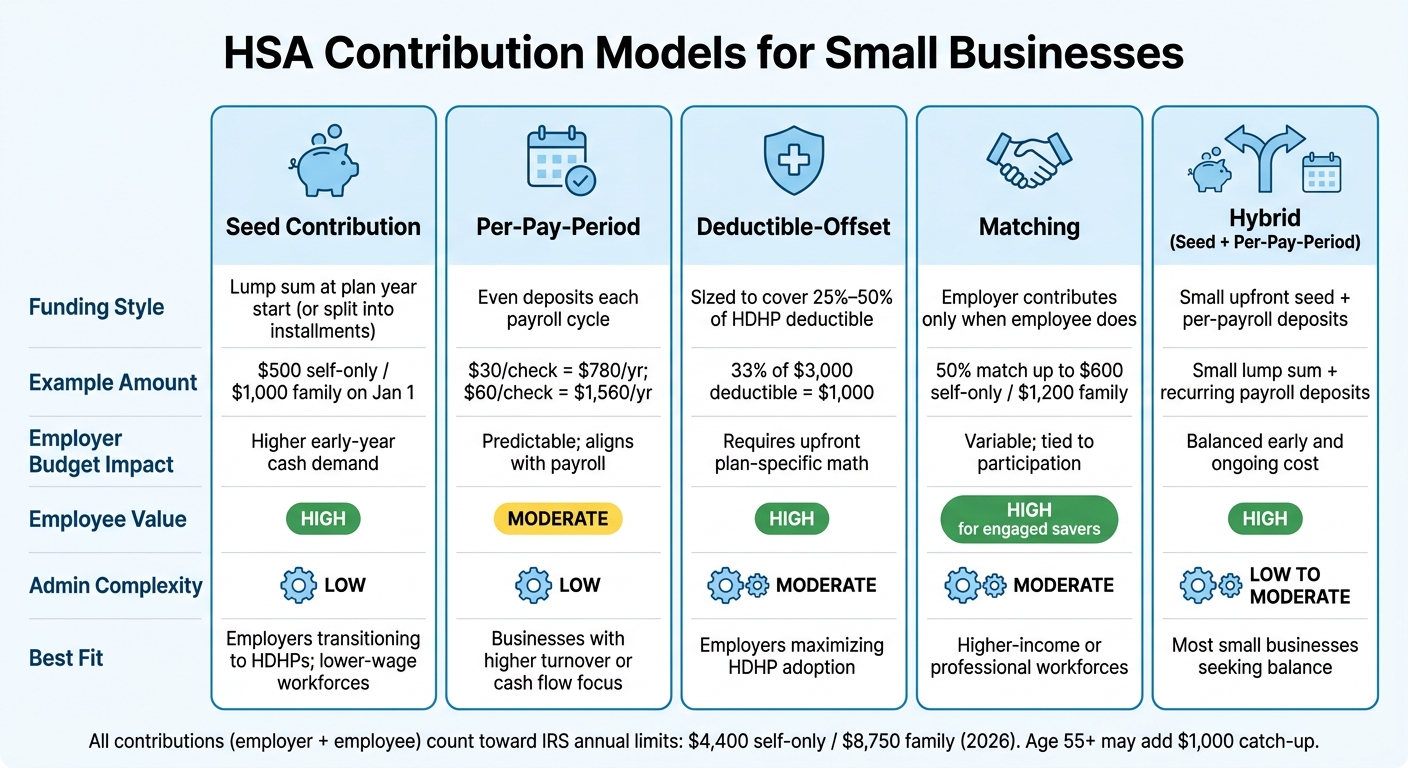
Most employers land on one of four main models. Some combine two of them into a hybrid setup.
Common Contribution Models and When to Use Each
Seed contributions are a lump sum added near the start of the plan year. For example, an employer might deposit $500 for self-only coverage and $1,000 for family coverage on January 1. That gives employees money to use right away, which can help a lot during a move to an HDHP. Some businesses break that seed into smaller deposits during the year to ease cash pressure while still giving early help.
Per-pay-period contributions spread deposits across payroll cycles. On a biweekly schedule, $30 per check adds up to $780 a year, and $60 per check adds up to $1,560. This model tracks neatly with payroll costs. It also cuts down the risk of putting in money for workers who leave mid-year, because deposits stop when payroll stops. That can be a smart fit for seasonal teams or businesses with more turnover.
Deductible-offset contributions are based on a share of the HDHP deductible. Employer guidance often points to 25% to 50% of the in-network deductible. So if the self-only deductible is $3,000, a 33% contribution comes to $1,000. It’s a direct way to soften the sting of a high deductible without covering the whole thing.
Matching contributions work a lot like a 401(k) match. The employer contributes only if the employee does. One simple formula is matching 50% of employee contributions up to $600 per year for self-only coverage and $1,200 for family coverage. This keeps employer cost tied to employee participation. It often works best with a professional or higher-income workforce that can put money in on a steady basis.
Hybrid means combining a small upfront seed with per-pay-period deposits. That gives employees some help early in the year without putting the full cost on the business all at once.
How to Budget by Coverage Tier, Workforce Needs, and Plan Costs
It helps to budget self-only and family coverage on separate tracks. Family tiers usually call for bigger contributions because both the deductible and out-of-pocket max are higher.
A good starting point is to compare your HDHP premium savings with your old plan and shift part of those savings into HSA funding. Say moving to an HDHP saves your business $900 per year per self-only enrollee and $2,200 per family enrollee. If you put 60% of those savings into HSA contributions, that works out to about $540 for self-only and $1,320 for family coverage.
That move can keep your total health benefit spend close to neutral while still giving employees money in their accounts.
To estimate your yearly cost, multiply each tier contribution by expected enrollment. For instance, 12 self-only enrollees at $540 and 8 family enrollees at $1,320 gives a total annual HSA budget of about $17,040. Add a small cushion, around 5% to 10%: for mid-year hires or coverage changes. Illinois employers can use Illinois Health Agents to model tiers using local plan quotes and use patterns.
Workforce makeup matters too. Lower-wage employees often get more from seed or deductible-offset designs because they may not be able to build their HSA balance on their own. Higher-income employees often respond better to matching setups, where the employer contribution depends on their own saving habits.
Contribution Model Comparison Table
| Model | Funding Style | Employer Budgeting Impact | Employee Value | Admin Complexity | Best Fit |
|---|---|---|---|---|---|
| Seed | Lump sum at plan year start, or split into installments | Higher early-year cash demand | High, funds available immediately | Low | Employers transitioning to HDHPs; lower-wage workforces |
| Per-pay-period | Even deposits each payroll cycle | Predictable; aligns with payroll | Moderate, balance builds gradually | Low | Businesses prioritizing cash flow control or with higher turnover |
| Deductible-offset | Sized to cover 25% to 50% of the deductible | Requires upfront plan-specific math | High, directly reduces deductible exposure | Moderate | Employers wanting to maximize HDHP adoption without full deductible coverage |
| Matching | Employer contributes only when employee does | Variable; cost tied to participation | High for engaged savers | Moderate | Higher-income or professional workforces; employers managing total cost |
| Hybrid (seed + per-pay-period) | Small upfront amount plus payroll deposits | Balanced early and ongoing cost | High, combines immediate and steady support | Low to moderate | Most small businesses seeking balance between protection and predictability |
After you choose a funding model, the next step is setting payroll timing, employer deposits, and new-hire rules.
4. How to Set Up and Administer HSAs Step by Step
Once you’ve picked your contribution model, it’s time to put the setup in place. That includes checking that the health plan qualifies, choosing an HSA custodian, linking payroll, and making sure employees know how the account works.
Confirm the Group Plan Is HSA-Eligible and Choose an HSA Custodian
Start by confirming that your group health plan is an HSA-eligible HDHP. For 2027, make sure the plan meets IRS HDHP deductible and out-of-pocket limits. In Illinois, qualifying plans are often labeled HSA-eligible in the plan materials. If that label isn’t clear, ask your carrier or broker for written confirmation before you lock in the plan.
Your first stop should be the Summary of Benefits and Coverage (SBC). After that, choose an HSA custodian: the bank or specialty provider that holds employee accounts. A few points matter most:
| Criteria | What to Look For |
|---|---|
| Account fees | Low or no monthly fees |
| Payroll integration | Batch file uploads or other payroll connectivity |
| Online/mobile access | Easy access to balances, receipts, and tax forms |
| Investment options | Mutual funds or ETFs after a cash threshold is met |
| Employee support | Responsive customer service and educational resources |
Many custodians charge no employer or employee account fees and also offer brokerage-style investment access. It helps to compare two or three providers using the table above before you choose one. A little homework here can save a lot of cleanup later.
Once you’ve chosen the custodian, the next step is payroll setup and funding timing.
Set Payroll Deductions, Employer Funding, and New-Hire Rules
With the custodian in place, payroll becomes the main admin checkpoint. Use a Section 125 cafeteria plan for pre-tax employee salary reductions. You also need written plan documents that spell out eligibility, elections, and change rules.
Set up separate payroll codes for employee salary reductions and employer contributions. For 2027, annual HSA limits are $4,500 for self-only coverage and $9,000 for family coverage, plus a $1,000 catch-up contribution for employees age 55 and older. Send funds to the custodian soon after each payroll run so year-end reconciliation doesn’t turn into a mess.
It’s also smart to set written proration rules for new hires and stop contributions with the last month of active HDHP coverage after termination. Track new hires, coverage changes, and terminations in one contribution calendar.
Employee Education and Illinois Support Options
After setup, give employees a simple walk-through so they can use the account the right way from day one. They should understand qualified expenses, rollover rules, and the account’s investment upside. A short enrollment meeting usually does the job well. Cover the HDHP deductible, qualified expenses, and tax savings.
Illinois employers can use Illinois Health Agents for HSA-eligible plan selection, contribution design, custodian coordination, and employee education.
5. Long-Term HSA Management and Key Takeaways for Small Business Owners
Once your plan is up and running, the job changes a bit. Now the goal is to keep it eligible, funded, and easy for employees to use.
HSAs work best as a long-term medical savings tool. Unused money rolls over from year to year, and the account stays with the employee even if they leave the company. That makes an HSA a benefit with staying power, which can help with retention.
But that long-term upside only pays off when employees know how the account works.
One big piece is investing. When employees invest part of their HSA balance, the account can do a lot more over time. HSA accounts with invested dollars have an average total balance of about $20,677: around eight times larger than cash-only accounts. At the same time, only about 9% of HSAs have invested dollars. So a lot of employees are leaving that growth opportunity on the table. If you explain the investment side clearly, you give people another path to build long-term savings.
On the employer side, the main habit to build is a simple annual review. Each year, make sure your health plan still qualifies for HSA use, your contribution amounts still fit both your budget and IRS limits, and your payroll setup is correct. It also helps to look at participation. Are enough employees opening accounts, using payroll deductions, and putting the benefit to work? If participation is low, take a close look at employee education, contribution design, and the custodian.
That yearly check can help you spot eligibility problems, overcontributions, and payroll mistakes before they turn into a bigger mess.
Use this checklist once a year to keep the program clean and cost-effective.
| Annual Review Checklist | Check |
|---|---|
| Plan eligibility | The health plan still qualifies as an HSA-eligible HDHP, and no coverage changes have made employees ineligible |
| Contribution amounts | Total contributions remain within the 2027 limits ($4,500 self-only / $9,000 family), and employer funding still fits the business budget |
| Payroll setup | Employee and employer contributions are being handled correctly |
| Employee participation | Account openings, payroll deduction uptake, and active use |
| Custodian fit | Fees, investment options, and support still meet your team’s needs |
Review the program each year, refresh employee education, and adjust funding as your business changes.
FAQs
Can I offer an HSA if some employees have other coverage?
Yes, but each employee’s eligibility depends on their coverage.
Employees with a non-HSA-qualified health plan, a full-purpose FSA, Medicare, or dependent status on someone else’s tax return usually can’t contribute to an HSA.
That said, your business can still offer an HSA-compatible high-deductible health plan. Only eligible employees can take part in the HSA and receive contributions.
What happens to HSA contributions if an employee leaves mid-year?
Any money already put into the employee’s HSA stays 100% theirs. An HSA is employee-owned and portable, which means they keep the full balance, including both employee and employer contributions.
You don’t take that money back. Just update your payroll records right away so the employee’s final contribution status is documented and your records stay in line with compliance rules.
How do I avoid HSA overcontributions through payroll?
Track each employee’s HSA eligibility and prorated limit, especially if they become eligible partway through the year. That matters because the IRS annual limit doesn’t just depend on the plan year. It also depends on when the employee became HSA-eligible.
You’ll also want to watch total HSA contributions across the year, including employer contributions, so the combined amount stays within IRS limits.
If an employee tells you they’ve hit the limit, stop payroll deductions as soon as possible. A delay of even one payroll run can create a mess that someone has to fix later.
It also helps to be clear about when deposits will be made. Employees want to know when money leaves their paycheck and when it will show up in the account. On top of that, work closely with the HSA custodian so each contribution is credited the right way and on time.
Recent Comments