
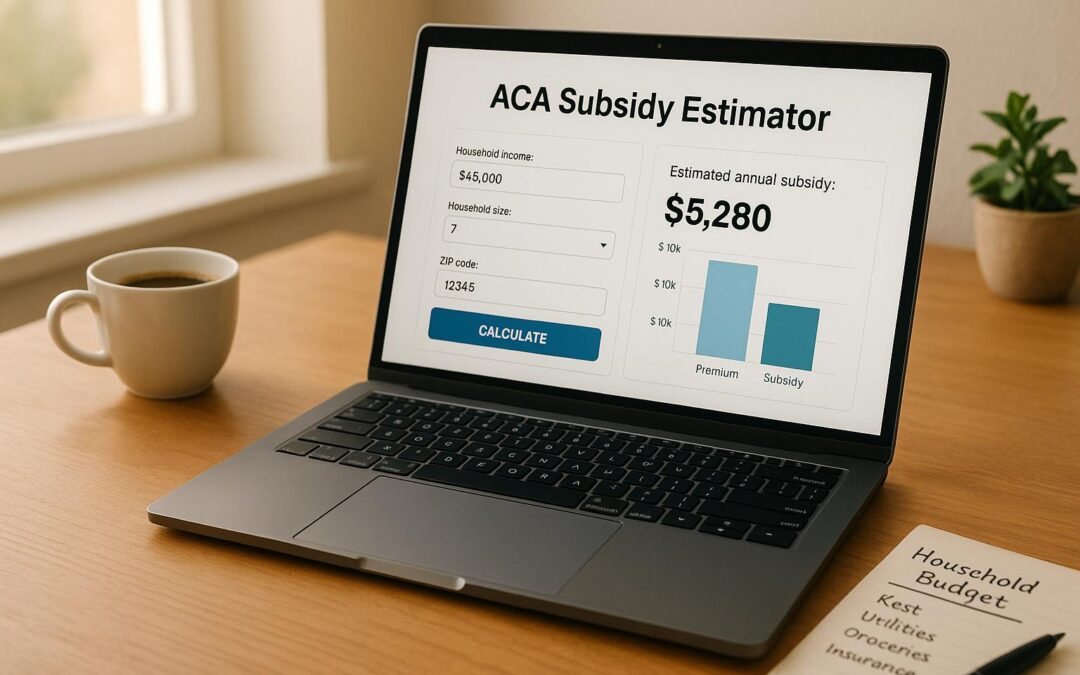
How ACA subsidies work in Illinois for 2027
The premium tax credit lowers what you pay each month for a plan bought through Get Covered Illinois, the state’s health insurance marketplace. It caps how much of your income you are expected to pay for a benchmark plan: the second-lowest-cost Silver plan in your county. If that plan costs more than your share, the credit covers the difference.
The rules for 2027
The larger credits available from 2021 through 2025 expired at the end of 2025 and were not restored. For 2027 you are expected to pay between 2.15% and 10.22% of household income, depending on where your income falls, and the credit stops at 400% of the federal poverty line. That limit is a cliff, so a household just over it gets no credit at all.
Why your county and ages matter
Benchmark premiums vary a great deal across Illinois. For a 21-year-old in 2027 the benchmark runs from about $445 a month in Cook County to about $1,136 in parts of southern Illinois. Premiums also rise with age, so the estimator prices each person in your household separately. Children who qualify for All Kids and adults who qualify for Medicaid are left out of the marketplace price, because those programs would cover them instead.
Example: a 25-year-old in Chicago earning $24,000
Here is how the 2027 math works for one person, age 25, living in ZIP 60657 (Lakeview, Cook County) with $24,000 of expected income.
- Income vs. the poverty line: $24,000 is about 150% of the $15,960 poverty guideline used for 2027 coverage. That is above the 138% Medicaid limit, so this person shops on Get Covered Illinois.
- Expected contribution: At 150%, the 2027 IRS table sets the share at about 4.32% of income: $1,036.80 a year, or $86.40 a month.
- Benchmark premium: The second-lowest-cost Silver plan in Cook County is about $446 a month at age 25.
- Premium tax credit: $446.48 minus $86.40 leaves a credit of about $360 a month, roughly $4,320 for the year.
With that credit, the benchmark Silver plan costs about $86 a month, lower-priced Silver plans cost less, and many Bronze plans come out close to $0.
One detail matters at this income. 150% of the poverty line for one person is $23,940, only $60 below this example. Under 150%, Silver plans carry the strongest cost-sharing reduction (94% actuarial value, with much lower deductibles). Just over it, the reduction drops to 87%. A small pre-tax contribution, such as to a traditional IRA, lowers MAGI and can move someone under that line. Run your own numbers in the estimator above, or call us at 312.726.6565.
FAQs
Who qualifies for an ACA subsidy in Illinois?
Most people buying their own coverage qualify if household income is between 100% and 400% of the federal poverty line: about $15,960 to $63,840 for one person for 2027 coverage, and more for larger households. Adults under 138% of the poverty line usually qualify for Illinois Medicaid instead, and children under 19 can qualify for All Kids up to 318%. You generally cannot get a credit if you have an affordable offer of coverage through a job.
How accurate is this estimate?
It uses the 2027 IRS contribution table, the federal poverty guidelines, and 2027 benchmark premiums for every Illinois county from Get Covered Illinois plan data, which can still change before open enrollment begins. You can switch the estimator to plan year 2026 if you need coverage before January. It does not include tobacco surcharges. Your official amount is set when you apply through Get Covered Illinois, and it is settled on your tax return based on your actual income for the year.
Do I apply on HealthCare.gov?
No. Starting with 2026 coverage, Illinois runs its own marketplace, Get Covered Illinois. Apply there to have the credit applied to your monthly premium. You can name Ryan Kennelly as your agent at no cost to you.
Recent Comments