

I start with one rule: organize Illinois health plan records by plan year, assign an owner and backup, and save each required notice with proof of delivery. A blank form won’t show what you sent - or when.
My checklist covers five file groups:
- Plan documents: Policies, summaries, amendments, and prior versions.
- Illinois disclosures: Benefit comparisons, employee requests, and delivery records.
- Enrollment and payroll: Elections, waivers, deductions, contributions, and premium payments.
- Continuation coverage: Separate federal COBRA and Illinois files, with deadline calculations, notices, elections, and payments.
- Renewals: Rates, approvals, coverage changes, and employee communications.
I also check retention dates, restrict access, and review files each year. Illinois disclosure records generally need at least one year of retention; other records may require four or six years, depending on the rule.
<u>Check which laws apply before setting deadlines.</u> Employer size and plan type matter, and broker support does not transfer the employer’s compliance duties.
Plan Documents and Illinois Disclosures
Policies, Plan Documents, and Benefit Summaries
Keep the executed group policy or master contract, employer application, certificate/evidence of coverage, plan or wrap document, amendments, riders, and carrier benefit materials. File everything by plan year, including all prior versions and their coverage dates. Don’t overwrite older versions.
For ERISA plans, keep the current SPD, all prior SPDs, proof of delivery, and employee acknowledgments or access logs.
For every medical option, retain each SBC version, its source template or data, and the plan-year effective date. Also keep proof that you distributed the SBC at application, renewal, special enrollment, and on request.
Track disclosure deadlines:
- SPDs: Generally due within 90 days after participation begins and within 120 days after a plan first becomes subject to ERISA reporting and disclosure requirements.
- SMMs: Generally due within 210 days after the end of the plan year in which a change was adopted.
- Material benefit reductions: Generally require disclosure within 60 days after adoption.
Illinois Consumer Coverage Disclosure Forms
If the Illinois Consumer Coverage Disclosure Act applies, keep the completed written comparison of your plan’s benefits with Illinois’s essential health insurance benefits. Retain the underlying benefit materials, agency notices, and correspondence, and identify the preparer and applicable benefit year.
Keep employee requests and proof of each disclosure sent at hire, annually, and on request. Record the recipient, date, delivery method, and version. For email or website disclosures, retain delivery records or access logs - not just the posted form. Keep these records for at least one year, or longer if another rule requires it.
File these disclosures with enrollment, payroll, and renewal records by plan year.
Compare group health plans for your Illinois business. Our local, licensed agents shop the top carriers and send you side by side quotes at no cost.
Get Group Quotes
Enrollment, Payroll, and Renewal Files
Along with plan documents and disclosures, keep records that show enrollment, payroll deductions, premium payments, and renewal changes.
Enrollment Forms and Payroll Deductions
Keep each employee’s completed enrollment form, waiver or declination form, and dependent documentation when applicable. Include the coverage tier, elected plan, effective date, employee premium share, and signed authorization for payroll deductions. For electronic elections, save the timestamp, system confirmation, and proof of access.
Retain payroll registers, deduction reports, employer contribution schedules, the applicable Section 125 cafeteria-plan document, and salary-reduction elections that show whether deductions are pre-tax or after-tax. Match each election to its payroll record by employee, plan, coverage tier, deduction amount, pay frequency, and coverage effective date. Flag missing authorizations, deductions for waived coverage, and incorrect start dates.
For special-enrollment requests and permitted midyear election changes, keep the triggering event, supporting documents, approval or denial, effective date, and payroll instruction. Log missed, refunded, retroactive, and corrected deductions without overwriting the original entry.
For HSAs, retain election forms, payroll deductions, employer contributions, custodian confirmations, and correction records. Reconcile contributions by tax year, then check year-end totals against Form W-2, Box 12, Code W.
Premium Bills and Payment Records
Save carrier invoices, enrollment rosters, payment confirmations, EFT records, credits, refunds, and billing correspondence. Each billing cycle, check elections and eligibility against the carrier roster, invoice, and payment.
Record the amounts billed and paid, payment date, any discrepancy, the person assigned to resolve it, and confirmation of the correction. Keep both the original bill and any corrected invoice or credit memo. Date and approve every billing review, even when you find no discrepancy.
Renewal Paperwork and Coverage Changes
Keep renewal rates, open-enrollment materials, SBCs, contribution schedules, enrollment and waiver forms, carrier correspondence, amendments, employee notices, and the final issued policy together. Record who approved the renewal and the employee and employer premium shares. Before the first deduction for the new coverage period, compare the approved rates and contributions with the payroll setup.
Maintain a change log with the affected benefits and employees, old and new coverage, effective dates, notice dates, delivery evidence, and payroll and carrier implementation dates. Require supporting approval or carrier confirmation for every change. Track notice deadlines before renewal, including 90 days’ notice when a coverage type is discontinued at renewal.
Use the same plan-year file structure for COBRA and Illinois continuation records.
COBRA and Illinois Continuation Records
When coverage ends or hours drop, move the file from renewal records to the continuation file.
Start with a written applicability check. Federal COBRA generally applies to private-sector group health plans with 20 or more employees on more than half of the prior calendar year’s working days. Illinois continuation can also apply to insured plans and smaller groups.
The file must document the qualifying event and deadline calculation. Save the prior-year employee count and calculation, funding arrangement, insurer, plan administrator, and governing Illinois statute or policy language. Before applying federal COBRA procedures to an Illinois insured plan, confirm which rule governs. Keep federal COBRA and Illinois continuation separate from the start - their deadlines and notices differ.
Federal COBRA Notices and Elections
Keep the exact COBRA general notice sent, plus the plan name, recipient names, coverage start date, preparation date, mailing or transmission date, delivery method, address or email used, tracking or certificate number, and electronic transmission record. Save returned-mail materials and follow-up attempts, too.
Federal guidance generally requires the general notice by the earlier of 90 days after coverage begins or the date an election notice must be provided.
For each potential qualifying event, keep the event report or termination documentation, reason for the event, coverage end date, qualified beneficiaries, date the plan administrator received notice, and all communications. Save the completed election form, written waiver or declination, date received, selected coverage level, effective date, premium rate, recurring payment ledger, invoices, receipts, returned payments, grace-period notices, and termination decision.
Record the event date, notice date, election deadline, payment deadline, and any applicable 30-, 14-, or 44-day deadline. If the employer is also the plan administrator, a 44-day outside deadline may apply after coverage loss. Save the actual deadline calculation - not just a blank template. Match elections and payments against insurer or administrator enrollment confirmations to document whether retroactive coverage was established.
Retain coverage confirmations and termination dates alongside the premium and payment records. For disability extensions, keep the determination, notice date, revised coverage end date, and administrator’s decision. Also save any unavailability or early-termination notice, the reason for it, and proof of delivery.
File Illinois-specific continuation records in a separate subfolder linked to the governing statute or policy.
Illinois Continuation Notices and Coverage Dates
Keep the governing statute or policy language, eligibility evidence, insurer instructions, state notice and election dates, proof of delivery, and carrier confirmation. Illinois continuation is separate from federal COBRA. Label the exact rule used and check state deadlines independently.
One Illinois provision requires mailing notice to the employee’s last known address within 10 days after termination or a qualifying reduction in hours. That provision generally requires a written continuation request within 30 days after the later of the event or notice, subject to an absolute 60-day limit. Do not use federal COBRA election periods to calculate the Illinois request deadline.
File Retention and Final Review
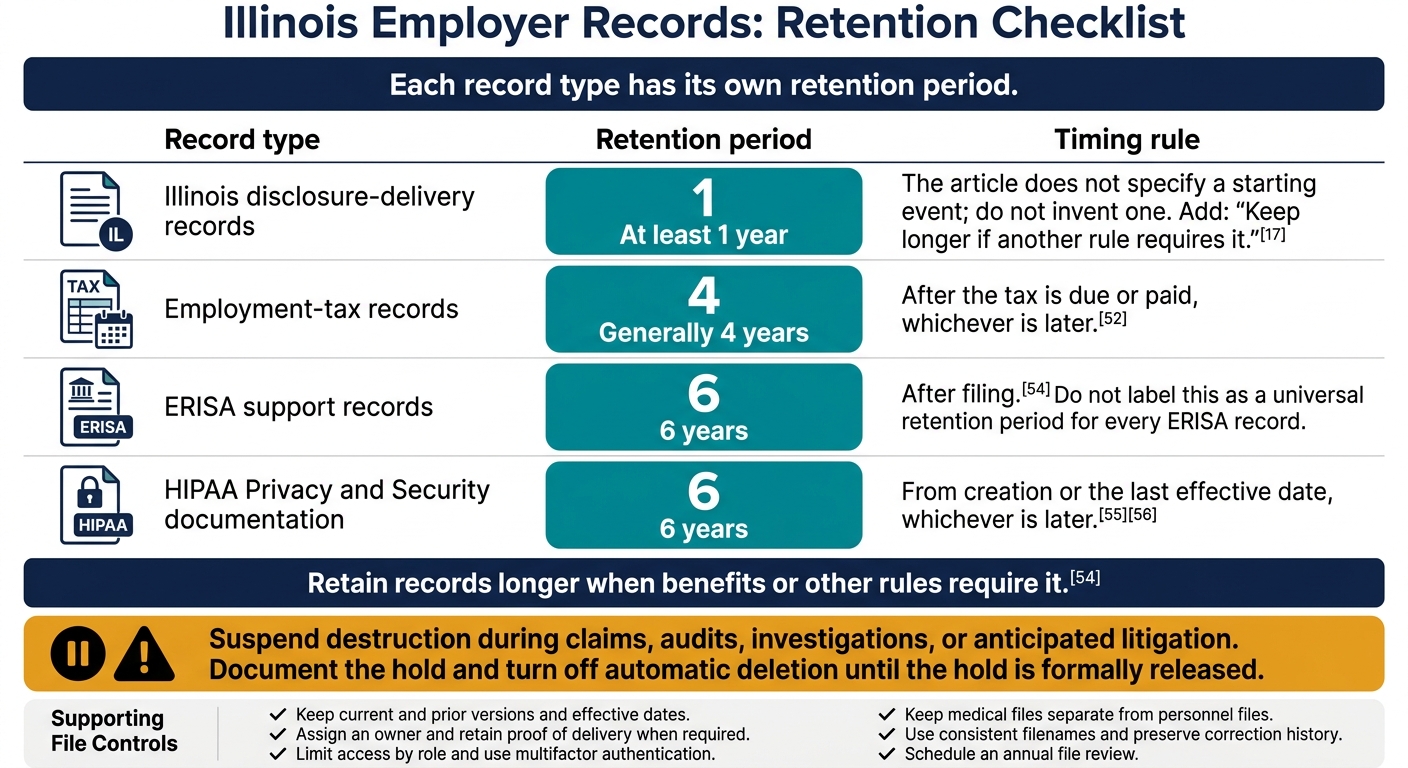
Illinois Employer Records: Retention Checklist
For each file category below, keep current and prior versions, effective dates, an assigned owner, and proof of delivery when required. Blank forms alone don’t show compliance.
Once the plan-year folders are complete, set retention dates, restrict access, and schedule the annual review.
Retention Deadlines and Secure Access
Each record type has its own retention period. Keep Illinois disclosure-delivery records for at least one year. Keep employment-tax records generally for four years after the tax is due or paid, whichever is later. Retain ERISA support records for six years after filing. Keep HIPAA Privacy and Security documentation for six years from creation or the last effective date, whichever is later. Retain records longer when benefits or other rules require it.
Limit access by role and use multifactor authentication. Keep medical files separate from personnel files, use consistent filenames, and preserve correction history.
Suspend destruction during claims, audits, investigations, or anticipated litigation. Document the hold and turn off automatic deletion until the hold is formally released.
Annual File Check and Brokerage Support
Use this checklist to confirm that each folder is complete, current, and ready for review.
| File category | Required records | Responsible person | Review status |
|---|---|---|---|
| Plan documents | Current and prior plan documents, summaries, amendments, effective dates, delivery proof | Benefits/HR lead | ☐ Current version verified ☐ Prior versions preserved ☐ Delivery evidence complete |
| Illinois disclosures | Coverage-comparison disclosures, recipient list, delivery proof, resend follow-up | HR or benefits administrator | ☐ Delivery dates verified ☐ Missing disclosures resolved |
| Payroll and enrollment | Elections, waivers, eligibility, deduction reports, reconciliations, corrections | Payroll and benefits teams | ☐ Deductions reconciled ☐ Corrections documented |
| Continuation coverage | COBRA and Illinois continuation notices and elections, qualifying-event records, coverage dates, premiums, delivery proof | Benefits administrator/TPA | ☐ Notices and delivery verified |
| Renewals | Renewal proposal, rates, carrier confirmation, employee communications, contribution decisions, plan changes, approvals | Benefits lead and finance | ☐ Renewal confirmed ☐ Coverage changes verified |
For each pay period, reconcile the carrier bill with the enrollment roster and payroll deductions. Record the review date, each exception, the person responsible for corrective action, the due date, and the resolution.
Illinois Health Agents can help with group health brokerage, employee education, contribution planning, and annual benefits reviews. Compliance remains the employer’s responsibility.
FAQs
Which Illinois disclosure rules apply to my health plan?
Illinois’s Consumer Coverage Disclosure Act (CCDA) requires all Illinois employers offering group health plans to provide a written comparison of their plan’s benefits with the state’s Essential Health Benefits (EHB) benchmark. This applies to fully insured, self-funded, and ERISA plans - even if the employer is headquartered outside Illinois.
Use the Illinois Department of Labor model disclosure form to mark each EHB category as covered, not covered, or partially covered, and explain any coverage gaps.
What if I’m missing proof of notice delivery?
Act right away. If the Illinois Department of Labor sends a non-compliance notice, you have 30 days to show compliance or correct the violation before penalties apply.
Keep records of each notice’s date, recipient, and delivery method for at least one year. For future notices, use email read receipts, benefits portal timestamps, or signed paper acknowledgments to create a verifiable audit trail.
How do I handle overlapping record-retention requirements?
Use a compliance matrix to track duties, responsible departments, and document types. Group files by reporting year and plan year to make audit preparation easier. If requirements conflict or overlap, keep both original and updated records to maintain a complete audit trail.
Use digital systems to automate record-keeping and track disclosure dates and employee acknowledgments. Retain documentation for the longest applicable retention period to meet all regulatory obligations.
Recent Comments