

Illinois’ average ACA rate increase fell from 28.8% for 2026 to 14.1% for 2027 - but premiums aren’t falling overall. I’d start with your renewal notice, not the statewide average: compare your monthly price before and after tax credits, then check benefits, doctors, and prescriptions.
I compare final individual-market rates as of October 22, 2026, including coverage for self-employed people - not small-group plans. Here’s the carrier snapshot.
Quick Comparison
| Carrier | 2026 average increase | 2027 final average increase |
|---|---|---|
| Blue Cross Blue Shield of Illinois | 28.2% | 14.9% |
| Celtic | 42.1% | 9.2% |
| Cigna | 19.5%* | Not listed |
| MercyCare | 11.1% | 12.2% |
| Molina | 23.8% | 1.8% |
| Oscar | 10.4% | 13.0% |
| UnitedHealthcare | 21.9%* | 12.4% |
Sources: IDOI filing tables. *Cigna’s and UnitedHealthcare’s 2026 figures come from rate-justification filings, not the final table. A filing alone does not confirm Marketplace participation.
<u>A smaller increase is not a premium cut.</u> I’ll explain proposed versus final rates, plan-level ranges, and why county, age, household details, and tax credits can change your renewal cost. My focus: helping you compare your actual 2027 options - not apply a carrier average to your bill.
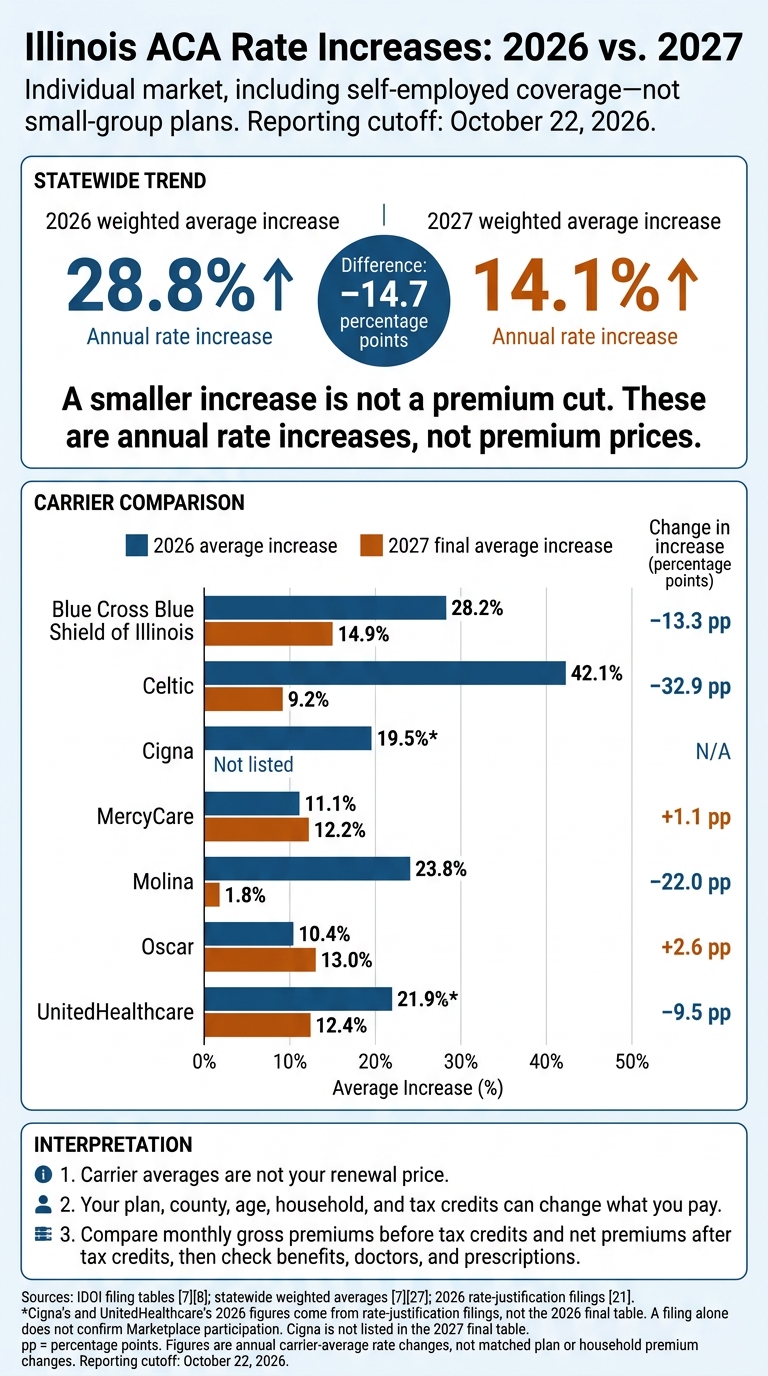
Illinois ACA Rate Increases: 2026 vs. 2027
Blue Cross Blue Shield of Illinois: 2026 vs 2027
BCBSIL accounts for much of Illinois’ slower premium growth in 2027, making its filing worth a closer look. The 2026 figures come from IDOI’s final filing ILCP-134670264. The 2027 filing, ILCP-134960138, is listed as final in the IDOI table.
Average Rate Changes, Plan Ranges, and Local Prices
| Effective year | Filing status | Carrier-wide average increase | Minimum plan change | Maximum plan change | Range spread | Average increase vs. prior year |
|---|---|---|---|---|---|---|
| 2026 | Final approved | 28.2% | −8.1% | 60.3% | 68.4 pp | - |
| 2027 | Final in IDOI table | 14.9% | −5.3% | 33.9% | 39.2 pp | −13.3 pp |
| 2027 minus 2026 | Comparison, not a separate filing | −13.3 pp | +2.8 pp | −26.4 pp | −29.2 pp | - |
Sources: IDOI final-filing tables. “pp” means percentage points. A negative minimum means at least one plan’s filed rate decreased - not that the carrier average fell.
Changes also varied by plan family:
Blue Choice Preferred PPO moved from 29.3% in 2026 to 14.7% in 2027, Blue Precision HMO from 24.4% to 17.7%, and MyBlue Plus from 31.0% to 7.4%, changes of −14.6, −6.7, and −23.6 percentage points, respectively. MyBlue Plus shows the largest year-over-year drop among the three products.
These averages don’t translate into monthly dollar changes. The filings don’t provide matched 2026 and 2027 monthly premiums for the same plan. Compare only identical plan IDs with the same rating inputs, including county. Treat replaced or discontinued plans as unmatched.
Reasons for Rate Changes and Approval Revisions
| Filing item | 2026 | 2027 |
|---|---|---|
| Average: initial → final | 27.0% → 28.2%; +1.2 pp | 14.9% → 14.9%; unchanged |
| Plan range: initial → final | −5.6%-60.4% → −8.1%-60.3% | −5.3%-33.9% → −5.3%-33.9%; unchanged |
Sources: IDOI filing tables and decision summary.
IDOI approved a 1.2-percentage-point upward revision in 2026. The 2027 figures showed no numeric revision. The filings don’t quantify how much of the rate change came from claims, utilization, drug costs, or risk adjustment.
BCBSIL’s affected membership grew from 238,363 in 2026 to 294,534 in 2027, but the filing does not attribute the rate change to enrollment.
sbb-itb-a729c26
Other Illinois Carriers: 2026 vs 2027
IDOI’s individual-market tables list each carrier’s legal entity and 2027 filing status. Cigna does not appear in the 2027 final table. Beyond BCBSIL, Celtic and Molina helped slow average increases, while MercyCare and Oscar posted larger increases than in 2026.
Celtic, Cigna, and UnitedHealthcare
| Legal entity | 2026 average | 2026 plan range | 2027 average | 2027 plan range | Average difference | Filing status |
|---|---|---|---|---|---|---|
| Celtic Insurance Company | 42.1% | 17.2% to 45.5% | 9.2% | 3.7% to 11.5% | −32.9 pp | 2026 final; 2027 final |
| Cigna HealthCare of Illinois, Inc. | 19.5% | −12.1% to 35.0% | Not available | Not available | Not available | 2026 rate-justification filing; 2027 unavailable |
| UnitedHealthcare of Illinois, Inc. | 21.9% | −1.4% to 36.4% | 12.4% | 7.0% to 15.5% | −9.5 pp | 2026 rate-justification filing; 2027 final |
Sources: IDOI filing tables and 2026 rate-justification filings.
Cigna’s and UnitedHealthcare’s 2026 figures come from rate-justification filings, not the 2026 final table. UnitedHealthcare’s figure fills in the earlier summary’s unavailable entry. “pp” means percentage points.
Carrier averages differ sharply, but the plan ranges show how a renewal could depart from the statewide trend. Check each carrier’s actuarial memorandum for the reasons behind its rate changes.
MercyCare, Molina, and Oscar
These carriers have narrower plan ranges for 2027, with Molina listing the same increase across all its plans.
| Legal entity | 2026 average | 2026 plan range | 2027 average | 2027 plan range | Average difference | Filing status |
|---|---|---|---|---|---|---|
| MercyCare HMO, Inc. | 11.1% | −8.5% to 20.7% | 12.2% | 8.7% to 13.1% | +1.1 pp | 2026 final; 2027 final |
| Molina Healthcare of Illinois, Inc. | 23.8% | −2.5% to 25.9% | 1.8% | 1.8% to 1.8% | −22.0 pp | 2026 final; 2027 final |
| Oscar Health Plan, Inc. | 10.4% | −6.0% to 29.4% | 13.0% | 8.8% to 16.5% | +2.6 pp | 2026 final; 2027 final |
Sources: IDOI final 2026 and 2027 filing tables.
MercyCare’s average edged up, while Oscar’s rose by a larger amount. Molina’s listed plans all show a 1.8% increase for 2027, well below its 2026 average.
For renewals, plan ranges matter more than carrier averages. None of the five carriers with listed 2027 final ranges shows a decrease. In contrast, the 2026 ranges for Cigna, UnitedHealthcare, MercyCare, Molina, and Oscar all included decreases.
Regional prices also differ, so compare plans individually when checking renewal premiums by county and rating area.
Regional Premiums and Household Renewal Costs
Illinois has 13 ACA rating areas, so premiums can differ by county - even with the same carrier. County-level comparisons tell you more than carrier averages, but the supplied filings don’t include matched local dollar premiums. Any explanation of county-level differences should rest on filing evidence, not just the premium amount.
The supplied materials don’t include matched regional dollar premiums for 2026 and 2027, so local dollar changes can’t be verified here. A valid comparison must match the carrier, plan ID, metal level, county or rating area, covered members, and age assumptions.
Filing Averages vs Your Premium
What you pay depends on your age, covered household members, projected income, tax-household size, and eligibility for financial assistance. The supplied materials don’t confirm the assistance rules that apply to both plan years. Recalculate eligibility separately for 2026 and 2027 rather than carrying one year’s tax credit into the next.
| Distinction | What to check |
|---|---|
| Proposed vs. approved | A proposal is a request under review; the final determination may change it. |
| Carrier average vs. plan change | An average covers multiple plans; your specific plan needs its own rate record. |
| Gross vs. net premium | Gross is the price before assistance; net is what you pay after applicable premium tax credits. |
| Individual vs. small-group rates | These are separate markets with separate filings and enrollment assumptions. |
| Filing increase vs. renewal price | A filing percentage doesn’t account for every change in age, coverage, or assistance. |
Treat the filing average as a guide - not your renewal price.
Compare Your 2026 Plan With 2027 Coverage
Use your 2026 coverage documents, 2027 renewal notice, and current quotes to compare costs. Keep the county, covered members, metal level, and plan the same where possible.
For a rate-only comparison, hold ages constant. For your actual renewal budget, use each person’s applicable age and note the difference. No household quotes or matched benefit documents were supplied, so the table lists the records needed rather than estimated amounts.
| Item | 2026 current coverage | 2027 renewal | Other available 2027 plan |
|---|---|---|---|
| County, members, ages | Confirm current profile | Identify changes | Use renewal profile |
| Carrier, plan ID, metal level | Coverage documents required | Renewal notice required | Plan documents required |
| Monthly gross premium ($) | Premium statement required | Quote required | Quote required |
| Monthly tax credit and net premium ($) | Eligibility record required | New calculation required | New calculation required |
Self-employed applicants and small-group employers need separate eligibility and quote reviews.
Conclusion: Confirmed Rate Changes and Next Steps
IDOI’s final tables show Illinois’s individual-market weighted average increase dropping from 28.8% in 2026 to 14.1% in 2027. Among the carriers reviewed, BCBSIL, Celtic, and Molina moved lower year over year, while MercyCare and Oscar moved higher. These are filing averages - not your renewal price.
The statewide figures also hide large local differences. Before treating a filing average as a renewal estimate, check the exact county, household, plan, network, and subsidy status.
Start with your own renewal notice. Illinois Health Agents helps individuals, families, self-employed people, and businesses review renewal notices and compare Illinois coverage. Open enrollment runs from November 1, 2026, through January 15, 2027. Before renewing, compare gross and net premiums, deductibles, copays, coinsurance, out-of-pocket maximums, networks, drug coverage, and county availability.
Reporting Cutoff and Filing Updates
Reporting cutoff: October 22, 2026. Later corrections or marketplace updates may change these figures.
FAQs
Could my 2027 premium rise even if my plan’s rate falls?
Yes. Your 2027 premium can go up even if your plan’s base rate drops. Your monthly bill also depends on your age and rating area.
If you receive federal premium tax credits through Get Covered Illinois, your out-of-pocket premium also depends on your household income and size. Smaller subsidies or changes in your eligibility can mean you pay more - even when your plan’s base rate drops.
How can I tell if switching plans will save me money overall?
Look beyond the monthly premium. Use a plan finder to compare costs based on your age, location, income, and household size. Check deductibles, copays, and out-of-pocket maximums, too.
If you qualify, premium tax credits and cost-sharing reductions through Get Covered Illinois can lower your premiums and out-of-pocket costs. Illinois Health Agents can help you weigh these trade-offs and work through carrier changes for 2027.
What happens if my current plan isn’t offered in 2027?
All 2026 Blue Cross and Blue Shield of Illinois individual plan IDs have assigned renewal paths for 2027. Many lead to different plans within the same product line. Check your renewal notice for your plan and premium details.
Cigna and Molina Healthcare are leaving Illinois’s individual market on January 1, 2027. If either is your carrier, you must choose a new plan during open enrollment to keep your coverage.
Recent Comments