

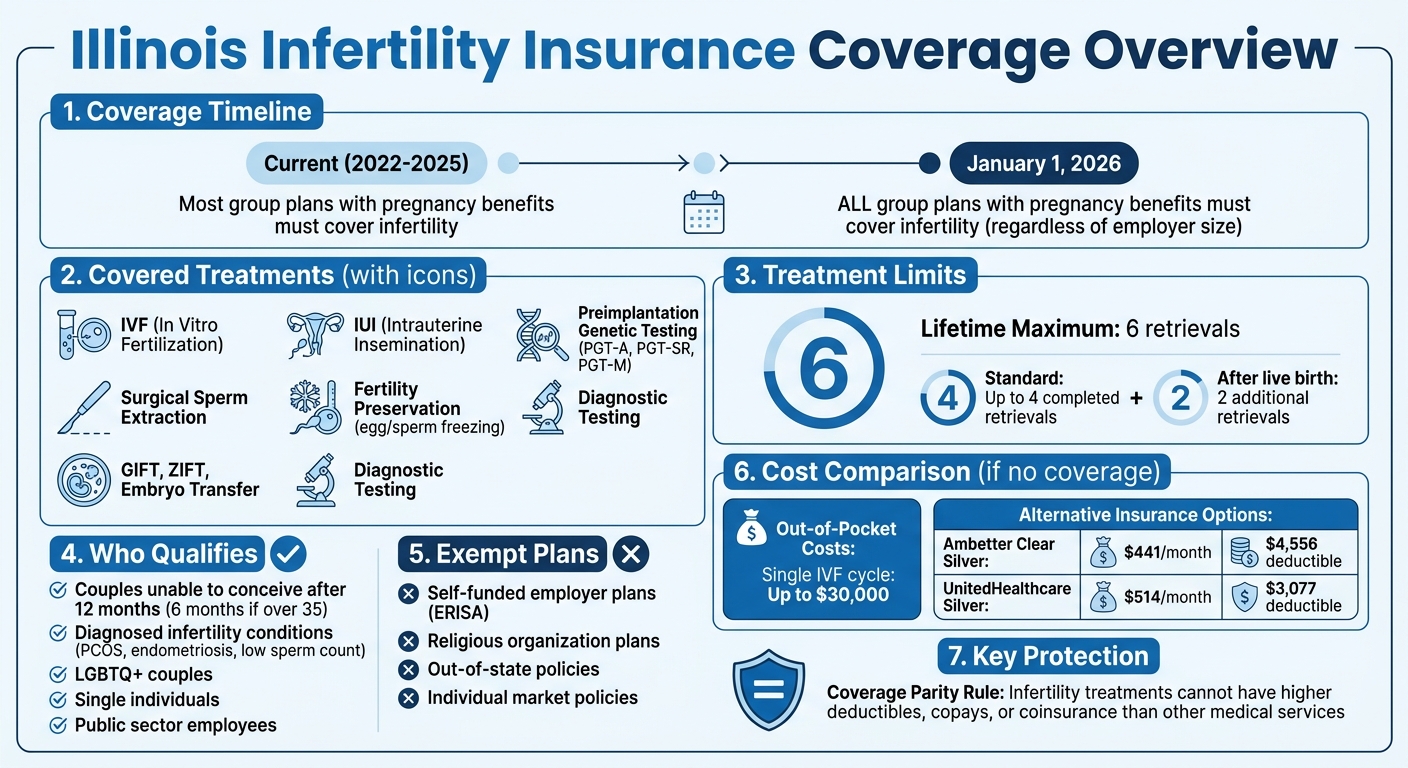
Navigating infertility insurance in Illinois just got easier. Starting January 1, 2026, all group health insurance plans that include pregnancy benefits must cover infertility treatments, regardless of employer size. Illinois is one of the few states with a fertility coverage mandate, offering access to treatments like IVF, IUI, and preimplantation genetic testing. However, not all plans are required to comply, self-funded employer plans, out-of-state policies, and religious organizations may be exempt.
Key Points:
- Mandate Expansion (2026): All group plans with pregnancy benefits must include infertility coverage.
- Covered Treatments: IVF, IUI, genetic testing, and more. Up to 4 oocyte retrievals are covered, with 2 additional if a live birth occurs.
- Exemptions: Self-funded employer plans, religious organizations, and out-of-state policies.
- Eligibility: Includes individuals unable to conceive naturally, LGBTQ+ couples, and single parents.
If your plan doesn’t cover infertility, options include ACA marketplace plans, grants, or financial aid programs. Always check your policy details and speak with your insurer or HR department to confirm coverage specifics.
Illinois Infertility Insurance Coverage Guide: Requirements, Exemptions, and Treatment Limits
How much does #IVFinsurance cover in Illinois? #fertilitytreatment Part 2 of 3
sbb-itb-a729c26
Illinois Infertility Insurance Laws
Illinois law requires most group health insurance policies that include pregnancy-related benefits to also cover infertility diagnosis and treatment. This is outlined under Section 356m of the Illinois Insurance Code.
Insurance providers cannot impose higher deductibles, copayments, or coinsurance for infertility treatments than they do for other medical services. In simpler terms, your fertility care must be treated like any other medical condition under your plan. Additionally, covered procedures must be performed at facilities affiliated with the Society for Assisted Reproductive Technology (SART) or those meeting standards set by the American College of Obstetricians and Gynecologists (ACOG) and the American Society for Reproductive Medicine (ASRM). These requirements set the groundwork for infertility coverage in Illinois.
Required Coverage for Fertility Treatments
Illinois law mandates coverage for a wide range of fertility treatments. These include IVF (in vitro fertilization), IUI (intrauterine insemination), GIFT (gamete intrafallopian transfer), ZIFT (zygote intrafallopian transfer), diagnostic testing, surgical sperm extraction, embryo transfer, uterine embryo lavage, low tubal ovum transfer, preimplantation genetic testing (PGT-A, PGT-SR, PGT-M), and standard fertility preservation.
Preimplantation genetic testing allows embryos to be screened for chromosomal or genetic disorders before implantation. Standard fertility preservation, such as egg or sperm freezing for patients undergoing treatments like chemotherapy, is also included. Illinois law requires insurers to cover up to four completed oocyte retrievals. If a live birth results from one of these retrievals, the plan must cover two additional retrievals, bringing the lifetime maximum to six.
2022 Coverage Expansion Changes
As of January 1, 2022, Public Act 102-0170 made significant updates to infertility coverage. The definition of infertility now includes the inability to reproduce without medical intervention. This change removed the previous requirement to prove infertility through 6-12 months of unprotected intercourse with an opposite-sex partner. The update has been especially beneficial for LGBTQ+ individuals and single parents, who previously faced challenges in accessing coverage.
Now, a diagnosis of infertility can be based on a licensed physician’s evaluation, considering factors like medical, sexual, and reproductive history, age, or physical findings. Additionally, the law clarifies that experiencing a miscarriage does not reset the waiting period required to meet the clinical definition of infertility.
Plans Exempt from Coverage Requirements
Not all plans are required to comply with these mandates. Self-insured employer plans, which are regulated by federal ERISA law, are exempt, as are policies issued by religious organizations and plans based in other states. Self-insured plans are often used by larger employers who handle claims directly instead of purchasing insurance from a provider.
Religious organizations also have the option to opt out if infertility treatments conflict with their moral or religious beliefs. Furthermore, the Illinois mandate applies only to policies issued within the state. If your employer is based in another state and the policy originates there, it is not required to adhere to Illinois infertility laws, even if you live and work in Illinois.
Eligibility for Infertility Coverage in Illinois
Who Qualifies for Coverage
Starting January 1, 2026, all group health insurance policies in Illinois that include pregnancy benefits must also cover infertility treatments, regardless of the employer’s size. To qualify for coverage, you generally need to meet one of these conditions:
- You’ve been unable to conceive after 12 months of unprotected intercourse (or 6 months if you’re over 35).
- A physician has diagnosed a condition that causes infertility, such as PCOS, endometriosis, or low sperm count.
- A licensed physician determines infertility based on your full medical history.
"The infertility definition includes inability to reproduce ‘as a single individual or with a partner without medical intervention,’ which supports inclusive access under qualifying plans.", Reproductive Medicine Institute
This law ensures coverage for single individuals and LGBTQ+ couples who require medical assistance to reproduce, eliminating the need to demonstrate infertility through attempts with an opposite-sex partner. Public sector employees, including those covered under the State Employees Group Insurance Program, as well as employees of counties, municipalities, and school districts, are also eligible.
For procedures like IVF, insurers may require you to first try less expensive treatments, such as IUI, unless a doctor determines those are not appropriate for your situation. Importantly, experiencing a miscarriage does not reset the waiting period needed to meet the definition of infertility. Knowing these details can help you navigate your options for affordable infertility care in Illinois.
Plans Not Required to Cover Infertility
Not every health plan falls under this mandate. While many group health policies comply, some are exempt. These include:
- Self-funded employer plans regulated by federal ERISA laws.
- Individual market policies.
- Plans offered by religious organizations that object to infertility treatments based on religious or moral grounds.
Additionally, the law applies only to insurance policies issued in Illinois. If your employer’s policy is based out of state, it doesn’t have to follow Illinois infertility coverage requirements, even if you live in Illinois. To find out if your plan is covered, ask your HR department whether the plan is "fully insured in Illinois" or "self-funded (ERISA)." Only fully insured plans issued within the state are required to comply.
How to Check Your Infertility Coverage
Reading Your Insurance Policy
Start by requesting your policy’s Summary of Benefits and Coverage (SBC) or Evidence of Coverage. Look for sections labeled "Infertility", "ART" (Assisted Reproductive Technology), or "Fertility Services" to identify what your plan includes for diagnosis and treatment options.
Pay close attention to the details about coverage parity. For example, Illinois law requires that insurers cannot impose higher deductibles, copayments, or coinsurance for infertility services compared to other medical services. If you notice different cost-sharing terms for fertility treatments, it could mean your plan is exempt from state mandates: this is often the case for self-funded plans or those issued outside Illinois. If you’re unsure about the wording in your policy, reach out to your insurer or HR representative for clarification.
Talking to Your Insurer or HR Department
Once you’ve reviewed your policy, contact your insurer or HR department to address any lingering questions. If you’re unsure about your plan type, ask your HR benefits coordinator whether your plan is "fully insured in Illinois" or "self-funded (ERISA)". Fully insured plans issued in Illinois must comply with the state mandate, while self-funded plans, governed by federal law, are exempt. However, some self-funded plans may still offer fertility benefits. Also, confirm where your policy was issued, as this can affect coverage.
For direct answers, call the customer service number on the back of your insurance card. Speak with a representative about your specific coverage, and always request written confirmation of any details they provide.
Additionally, many fertility clinics in Illinois, like the Advanced Fertility Center of Chicago (AFCC), have financial counselors who specialize in navigating insurance benefits. These professionals can help you understand your plan and guide you through the pre-authorization process.
Questions to Ask About Coverage
To fully understand your infertility coverage, ask your insurer or HR department the following questions:
- Which fertility procedures are covered? Examples include IVF, IUI, or surgical sperm extraction.
- Are there any waiting periods, age restrictions, or specific "medical necessity" requirements you must meet to qualify for benefits?
- Is pre-authorization required for treatments, and what steps are involved?
- Does the plan cover pre-implantation genetic testing (PGT)?
- Are fertility medications covered under the same terms as other prescription drugs? Do you need to use a specific specialty pharmacy to avoid claim issues?
- What are the exact costs for deductibles, copays, and coinsurance?
- If you need a surrogate or egg donor, does the plan include coverage for these services as part of your infertility treatment?
Getting clear answers to these questions will help you navigate your benefits and avoid surprises during treatment. Always take detailed notes and keep documentation of your conversations for future reference.
Options When Coverage Is Limited or Unavailable
Typical Costs for Infertility Treatments
Fertility care can be a hefty expense if you’re paying out of pocket. For instance, a single IVF cycle might run you as much as $30,000, and that doesn’t even include costs for monitoring or medications. Knowing these numbers in advance can help you prepare and explore options for financial support. With such high costs, finding alternative insurance plans or assistance programs becomes essential.
Other Insurance Options
If your employer’s insurance plan doesn’t offer adequate fertility coverage, you might have other options to consider. For example, if your employer provides a self-funded plan that’s exempt from Illinois mandates, you could purchase an individual plan through the ACA Marketplace at HealthCare.gov during open enrollment. This could be a game-changer, especially since Illinois considers infertility an essential health benefit for marketplace plans. These plans must comply with state coverage requirements.
Here’s a snapshot of what you might find:
- Ambetter’s Clear Silver Plan: Covers 100% of in-network infertility costs after meeting your deductible. Average monthly premium: $441; annual deductible: $4,556.
- UnitedHealthcare’s Silver Plan: Offers access to a broad network of 1.7 million providers. Average monthly premium: $514; deductible: $3,077.
Additionally, some employers offer supplemental fertility benefits through third-party administrators like Progyny, Carrot, or Maven. It’s worth checking with your HR department to see if these options are available.
Financial Help and Payment Programs
There are programs and resources designed to help ease the financial burden of fertility treatments:
- Grants and Nonprofits:
- The Chicago Coalition for Family Building offers fully funded IVF cycles and grants specifically for Illinois residents.
- The Cade Foundation Family Building Grant provides up to $10,000 for treatment or adoption costs.
- Medication Discounts:
- EMD Serono’s Compassionate Care program offers up to 50% off on medications based on income.
- Merck’s ReUnite Assist program helps uninsured patients access discounted fertility drugs.
- Veterans’ Benefits: Veterans and their spouses may qualify for a 25% discount at certain Illinois clinics and receive free medications through the Compassionate Corp Program if the infertility is related to a service injury.
- Lenders and Clinics: Fertility-specific lenders like PatientFi and Future Family provide loans up to $50,000, including some 0% interest plans without hard credit checks. Many fertility clinics in Illinois, including Fertility Centers of Illinois (FCI) and Advanced Fertility Center of Chicago (AFCC), have financial counselors to guide you through grants and specialized loans.
If you’re planning treatment, consider applying for medication discount programs before your cycle starts to save significantly. Some clinics also offer bundled or refund programs, like Fertility Access, where you pay a flat fee for multiple cycles and get a refund if the treatment doesn’t work. These options can provide both financial relief and peace of mind.
Choosing Infertility Insurance in Illinois
When selecting infertility insurance in Illinois, it’s crucial to understand how state mandates apply to your specific plan. Start by determining whether your plan is fully insured (and follows Illinois state mandates) or self-funded under ERISA, which exempts it from these requirements. Keep in mind that policies issued outside Illinois are not bound by the state’s infertility coverage rules.
Starting January 1, 2026, all group health plans that include pregnancy coverage, regardless of the employer’s size, must provide infertility treatments such as IVF, pre-implantation genetic testing, and surgical sperm extraction.
To ensure your plan meets your needs, carefully review your Summary of Benefits and Coverage (SBC) for infertility-related provisions. Confirm with your HR department or insurer that your plan is fully insured in Illinois and that cost-sharing for infertility treatments aligns with other medical services. This step helps ensure your coverage complies with Illinois mandates and supports your treatment goals.
If your current plan doesn’t meet state requirements, you have the option to purchase an individual policy through HealthCare.gov during open enrollment. These ACA-compliant plans are required to adhere to Illinois’ infertility coverage mandates.
Illinois law provides coverage for up to four completed egg retrievals, with the possibility of two additional retrievals if a live birth occurs, resulting in a lifetime maximum of six cycles. Verify that your plan includes essential services like fertility medications, intrauterine insemination (IUI), and pre-implantation genetic testing to ensure it aligns with both your treatment needs and budget.
FAQs
How do I know if my plan is fully insured in Illinois or self-funded (ERISA)?
If you’re trying to figure out whether your Illinois health plan is fully insured or self-funded (ERISA), start by checking your insurance documents or reaching out to your HR department or insurer for clarification.
- Fully insured plans: These are purchased directly from insurance carriers and must comply with Illinois state laws. For example, they include mandates like infertility coverage.
- Self-funded (ERISA) plans: These are managed by employers and operate under federal law, which means they are not bound by state-specific requirements like those in Illinois.
To identify your plan type, look for terms such as "fully insured" or "self-funded" in your plan documentation.
What counts as a “completed” egg retrieval under Illinois infertility coverage limits?
In Illinois, infertility coverage defines a "completed" egg retrieval as the successful collection of eggs from the ovaries. If this process leads to a live birth, the insurance will cover up to two more retrievals, with a lifetime cap of six retrievals. This policy ensures that coverage complies with the state’s infertility treatment regulations.
If my employer plan is exempt, what’s the fastest way to get infertility coverage through the ACA Marketplace?
If your employer’s plan doesn’t provide infertility coverage, one option is to apply for an ACA Marketplace plan that includes fertility benefits. Starting January 1, 2026, Illinois law will mandate that all health insurance plans cover infertility treatments, no matter the size of the employer. Make sure to thoroughly review plan details to ensure the coverage aligns with your specific needs.
Recent Comments