
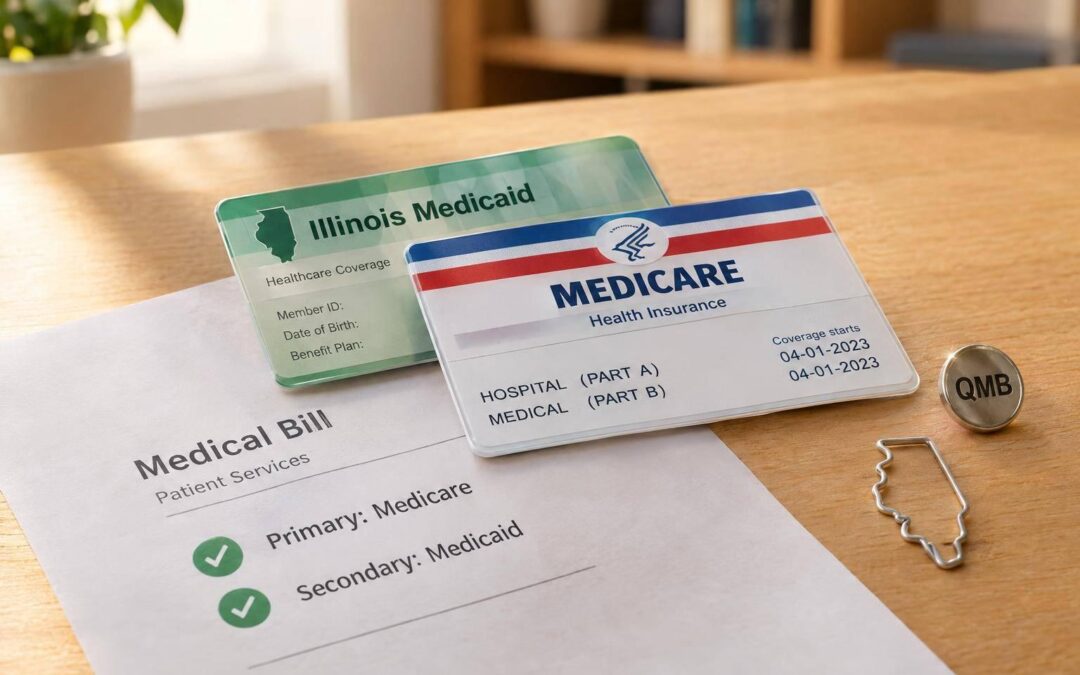
Medicare usually pays before Illinois Medicaid - but Medicaid does not pay every leftover bill. Before care or payment, confirm which insurer pays first and whether the provider accepts both forms of coverage.
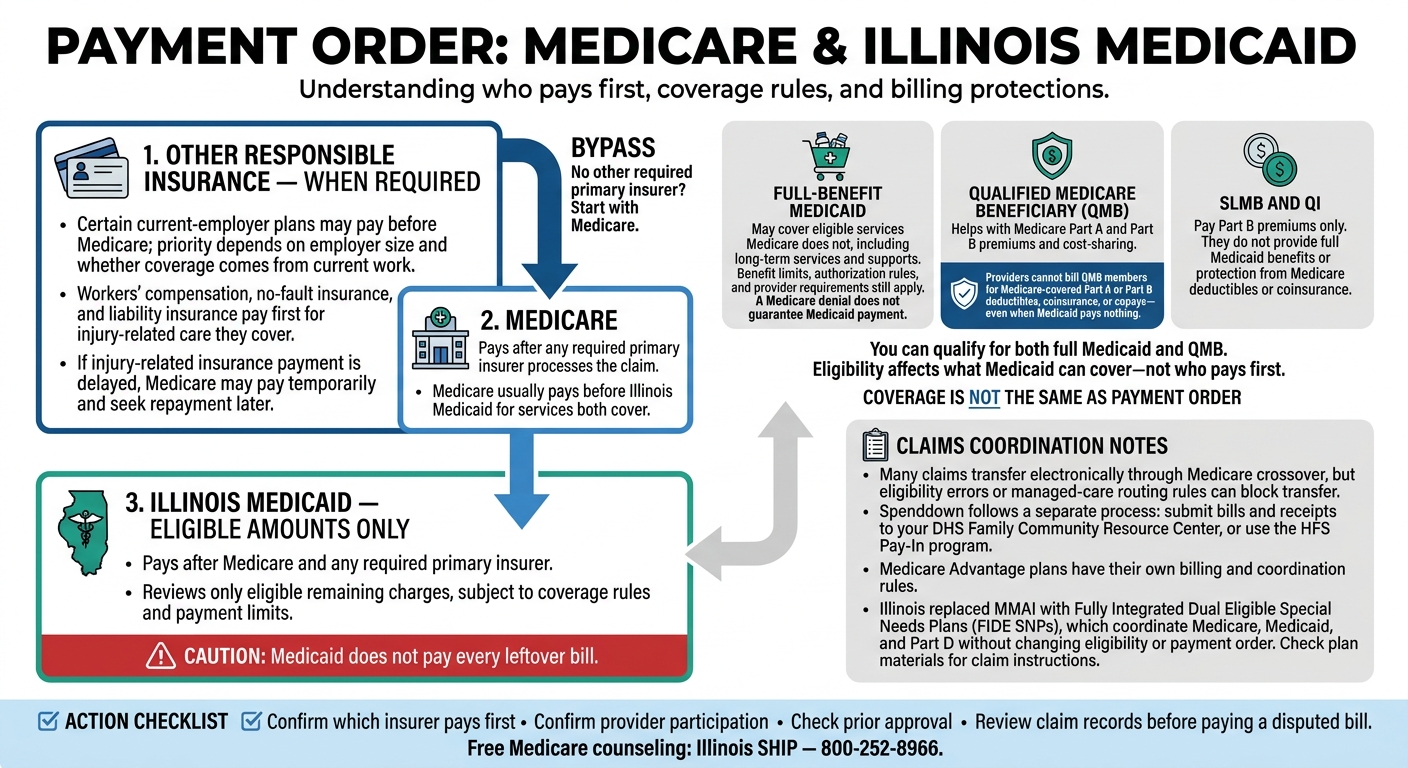
- Other insurance may pay first: Certain employer plans, workers’ compensation, and injury-related insurance take priority over Medicare.
- Medicaid coverage varies: Full Medicaid may cover services Medicare does not. Some Medicare Savings Programs help only with premiums.
- QMB protects against Medicare cost-sharing bills: Providers cannot charge QMB members for Medicare-covered Part A or Part B deductibles, coinsurance, or copays - even when Medicaid pays nothing.
- Claims may need follow-up: Crossover claims, spenddown, and integrated plan rules can affect how bills are handled.
For free help checking coverage or a disputed bill, Illinois SHIP can be reached at 800-252-8966.
Medicare and Illinois Medicaid: Who Pays First?
When Does Other Insurance Pay Before Medicare?
Even if you have both Medicare and Medicaid, another insurer may need to pay first. Medicare Secondary Payer rules set that payment order based on your coverage, employer size, and whether your coverage comes from current work.
When Does Employer Coverage Pay First?
A plan through a current employer may pay before Medicare, depending on employer size. Before you get care, ask the benefits administrator whether your plan is primary or secondary.
When Do Workers’ Compensation or Liability Insurers Pay First?
Workers’ compensation, no-fault insurance, and liability insurance pay first for injury-related care they cover. If payment takes time, Medicare may pay temporarily and seek repayment later.
How Does Payment Order Work Across Insurers?
| Coverage type | Who pays first? | When it applies |
|---|---|---|
| Other responsible insurance | Pays first when required | Qualifying employer coverage or insurance responsible for injury-related treatment |
| Medicare | Pays after any required primary insurer | After other responsible coverage has processed the claim |
| Illinois Medicaid | Pays after Medicare and any required primary insurer | Only for eligible remaining charges |
Medicare Advantage plans have their own billing and coordination rules.
sbb-itb-a729c26
How Does Illinois Medicaid Handle Claims After Medicare?
After Medicare processes a covered service, Illinois Medicaid may review any eligible balance. That handoff isn’t always automatic.
Do Medicare Claims Transfer Automatically?
Many claims transfer electronically through Medicare crossover. But eligibility errors or managed-care routing rules can block the transfer. Providers need both your Medicare and Medicaid information to bill correctly.
Medicaid Spenddown uses a separate process. Submit bills and receipts to your DHS Family Community Resource Center to meet spenddown, or use the HFS Pay-In program.
Does Medicaid Pay the Full Remaining Balance?
No. Illinois Medicaid pays only eligible amounts within its rules and payment limits. Some balances may remain unpaid.
However, providers cannot bill Qualified Medicare Beneficiaries (QMBs) for Medicare-covered Part A or Part B deductibles, coinsurance, or copays - even if Medicaid pays nothing.
Can Medicaid Cover Services Medicare Does Not?
Full-benefit Medicaid may cover eligible long-term services, supports, and other services Medicare doesn’t cover. But a Medicare denial doesn’t mean Medicaid will pay. The service must still meet Medicaid’s benefit limits, authorization rules, and provider requirements.
Confirm Medicaid coverage and prior authorization before getting care. Enrollment in a Medicare Savings Program alone doesn’t provide full Medicaid benefits or coverage for services Medicare denies.
Your Medicaid category and plan determine what Medicaid may pay after Medicare.
How Do Medicaid Eligibility and Illinois Plans Affect Coverage?
After Medicare pays, your Medicaid category and plan type determine what else is covered. Eligibility affects what Medicaid can cover - not who pays first.
How Do Full Medicaid Benefits and Medicare Savings Programs Differ?
Full-benefit Medicaid and Medicare Savings Programs offer different types of help.
| Eligibility category | Assistance and limits |
|---|---|
| Full-benefit Medicaid | Covers Medicaid services, including some that Medicare does not cover, such as long-term care. Providers cannot bill members beyond Medicaid’s allowed amount. |
| Qualified Medicare Beneficiary (QMB) | Pays Medicare Part A and Part B premiums, deductibles, and coinsurance. Providers cannot bill members for Medicare cost-sharing. |
| SLMB and QI | Pay Part B premiums only. They do not provide full Medicaid benefits or protection from Medicare deductibles or coinsurance. |
You can qualify for both full Medicaid and QMB. Premium-only programs like SLMB and QI do not add full Medicaid coverage.
What Replaced Illinois’ Medicare-Medicaid Alignment Initiative?
Your plan type also affects how claims and benefits are coordinated.
Illinois replaced MMAI with Fully Integrated Dual Eligible Special Needs Plans (FIDE SNPs). These plans coordinate Medicare, Medicaid, and Part D without changing eligibility or payment order. Check your plan materials for instructions on submitting claims.
Conclusion: Check Coverage Before Paying a Bill
Check the coverage order above before paying a bill. Medicare usually pays first for shared services, unless another insurer is primary. Illinois Medicaid pays only eligible remaining amounts.
What Should You Check Before Care or Paying a Bill?
- Insurance records: Give providers your current coverage details and confirm which insurer pays first.
- Provider participation: Make sure the provider accepts Medicare and your Illinois Medicaid plan.
- Prior approval: Ask whether any insurer requires approval before you receive the service.
- Claim details: Compare your Medicare Summary Notice or Medicare Advantage EOB with your Medicaid record for mismatches.
Before paying disputed cost-sharing, ask your provider or plan to review it. If you have QMB, tell the billing office so it can check the charge under those protections.
If the bill still doesn’t match the payment order, use the contacts below to verify it.
Where Can Illinois Residents Get Help?
Contact Medicare’s Benefits Coordination & Recovery Center with questions about which insurer pays first or to correct insurance records. Ask your provider, plan, or Illinois HFS whether Medicaid should have handled an unpaid balance. For free Medicare counseling, call Illinois SHIP at 800-252-8966.
Illinois Health Agents can help review Medicare coverage and coordination questions at 312-726-6565. The brokerage does not determine Medicaid eligibility, decide claims, or assign payment responsibility.
FAQs
How can I tell if my Medicare claim reached Illinois Medicaid?
Review your Explanation of Benefits (EOB) statements to see how your claims were processed and what each program covered. If you’re enrolled in a Medicare-Medicaid plan, such as a Fully Integrated Dual Eligible Special Needs Plan (FIDE-SNP), contact member services to check your claim details.
You can also contact the Illinois Department of Healthcare and Family Services to confirm your Medicaid eligibility and check the status of your claims.
What if I paid a bill that QMB should protect me from?
Contact your provider’s billing department to check that the claim was submitted correctly. Remind them of your Qualified Medicare Beneficiary (QMB) status, which generally protects you from being billed for Medicare cost-sharing.
Check the bill for errors, then contact your insurance company to dispute the charge. If the issue remains unresolved, ask the Illinois Department of Insurance for help or file an appeal if you believe the services should have been covered.
What happens if my provider accepts Medicare but not Medicaid?
If your provider accepts Medicare but not Medicaid, they may not bill Medicaid for costs Medicare doesn’t cover, including deductibles, copayments, and coinsurance. You may have to pay these costs yourself, depending on your coverage. However, if you’re enrolled in the Qualified Medicare Beneficiary (QMB) program, providers can’t bill you for Medicare-covered services’ deductibles, copayments, or coinsurance - even if they don’t accept Medicaid.
Before you get care, check that your doctors participate in both programs. A broker at Illinois Health Agents can help verify provider networks and check whether your plans fit your healthcare needs.
Related Blog Posts
- Top 5 Carriers for Medicare Advantage in Illinois
- How Illinois Medicare Rules Differ from Other States
- How the No Surprises Act Impacts Illinois Residents
- Illinois Medicaid and CHIP Enrollment Guide
Recent Comments