

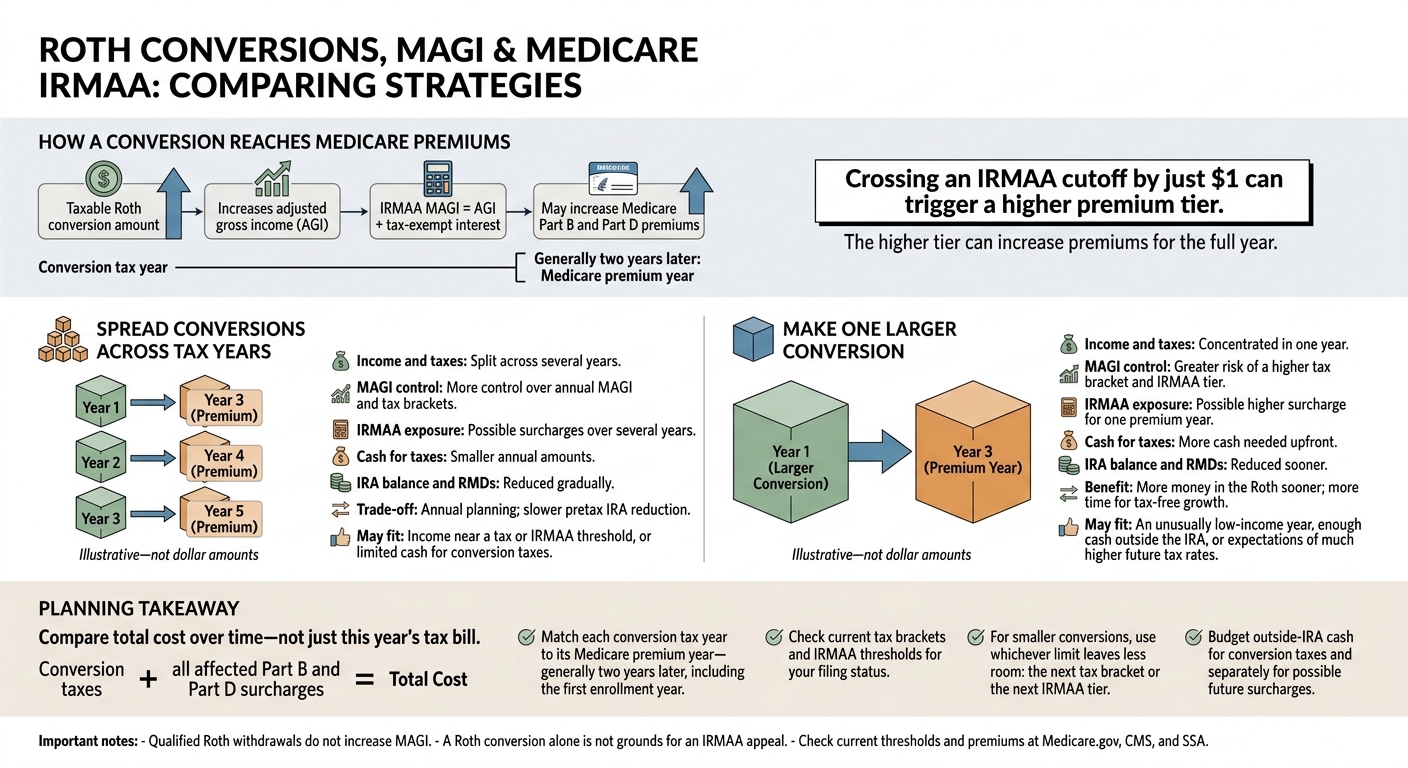
A Roth conversion can increase Medicare premiums two years later. The taxable amount increases adjusted gross income (AGI); Medicare adds tax-exempt interest to calculate MAGI for IRMAA. Before converting, compare the added tax and future Part B and Part D surcharges - not just this year’s tax bill.
The choice comes down to two approaches:
- Spread conversions across tax years: More control over annual MAGI, tax brackets, and cash needs, but slower reductions in pretax IRA balances and required minimum distributions (RMDs).
- Make one larger conversion: More money in the Roth sooner and lower future RMDs, but a larger upfront tax bill and possible Medicare surcharges.
Quick Comparison
| Factor | Spread conversions | One larger conversion |
|---|---|---|
| Income and taxes | Split across several years | Concentrated in one year |
| IRMAA exposure | Possible surcharges over several years | Possible higher surcharge for one premium year |
| Cash for taxes | Smaller annual amounts | More cash needed upfront |
| IRA balance and RMDs | Reduced gradually | Reduced sooner |
Crossing an IRMAA cutoff by just $1 can trigger a higher premium tier. Match each conversion year to its Medicare premium year - generally two years later - and compare total costs across all affected years. Qualified Roth withdrawals do not increase MAGI, and a conversion alone is not grounds for an IRMAA appeal.
Roth Conversions and Medicare IRMAA: Timing and Trade-Offs
Roth Conversions + IRMAA: How To Plan Correctly
sbb-itb-a729c26
1. Spread Roth Conversions Across Tax Years
Spreading Roth conversions across tax years gives you more control over annual income and Medicare brackets. The focus is control now, not speed later.
Taxable Income and MAGI
Estimate your total annual income, including both spouses’ income if you file jointly. Then size the conversion to stay below both your next tax bracket and the next IRMAA tier. Use whichever limit leaves less room.
IRMAA Exposure
Smaller conversions can help you avoid moving into a higher IRMAA tier. Check the thresholds each year rather than converting the same amount automatically.
Tax-Payment Timing
Spreading conversions also spreads the tax payments across tax years. Before setting each year’s conversion amount, budget for the added tax and any Medicare surcharge that may follow later.
Future IRA Balances and RMDs
Each conversion lowers future pretax IRA balances and RMDs, but more slowly than a single larger conversion. Adjust your annual conversion amount as retirement income and planned withdrawals change.
That slower balance reduction is the tradeoff - and where a larger conversion may have an edge.
2. Make One Larger Roth Conversion
One larger conversion gives you less control over annual taxable income in exchange for reducing your IRA balance sooner.
Taxable Income and MAGI
A large conversion concentrates more taxable income in a single year. That can push you into a higher tax bracket and increase your modified adjusted gross income (MAGI). For IRMAA, MAGI generally equals your adjusted gross income (AGI) plus tax-exempt interest.
Medicare Surcharge Exposure
Higher MAGI can mean higher Part B and Part D premiums two years later. A Roth conversion usually doesn’t qualify as a life-changing event for an IRMAA appeal.
Tax-Payment Timing
A larger conversion means a larger tax bill for that year. Pay the tax with money outside the IRA so the full converted amount stays in the Roth. Budget separately for the Medicare surcharge that may follow two years later.
Future IRA Balances and RMDs
Moving more assets earlier gives them more time for tax-free growth in the Roth. It also reduces future traditional IRA balances and required minimum distributions (RMDs). Weigh those benefits against both the upfront tax and the delayed IRMAA costs - not just this year’s tax bill.
Pros and Cons of Each Approach
Taxable conversion income increases MAGI and can trigger Medicare surcharges later. The comparison below shows the trade-offs between control and speed.
| Strategy | Principal advantages | Principal disadvantages | Circumstances that may favor it |
|---|---|---|---|
| Spread conversions across tax years | More control over annual MAGI and taxes; staggered tax payments; room to adjust as income changes. | Planning each year; possible IRMAA surcharges over several years; slower IRA reduction. | Income is near a tax or IRMAA threshold, or cash to pay conversion taxes is limited. |
| Make one larger conversion | Faster Roth funding and RMD reduction; fewer transactions. | Income concentrated in one year; risk of a higher tax bracket; more cash needed; higher IRMAA two years later. | An unusually low-income year, enough cash outside the IRA, or expectations of much higher future tax rates. |
Focus on total cost over time, not just one year’s premium. Compare total taxes plus all Part B and Part D surcharges across the affected years.
Test conversion amounts near each IRMAA threshold. Going just $1 over a cutoff can increase premiums for the full year.
Plan Around Your Tax and Medicare Calendar
Plan around the tax year Medicare will use - not your birthday. Medicare bases premiums on income from two years earlier. That means a Roth conversion can affect premiums two years later, including your first year of enrollment.
Match each conversion year to the year it could affect your premiums:
| Factor | Spread conversions | One larger conversion | Planning takeaway |
|---|---|---|---|
| Years until Medicare | Several conversion years may affect premiums after enrollment. | A conversion before the lookback window may avoid affecting initial premiums. | Match each conversion year to the premium year two years later. |
| Income and filing status | Adjust amounts as household income changes. | Requires a more detailed forecast of that year’s income. | Use the thresholds for your expected filing status. |
| Outside cash | Needs smaller annual tax reserves. | Needs more cash upfront. | Identify funds for taxes before converting. |
A Roth conversion alone does not qualify for an IRMAA appeal.
Before converting, check current thresholds and premiums on Medicare.gov, CMS, and SSA. Align your tax projections with your retirement-income projections, then compare conversion schedules using these calendar checks to find the approach with the lower total cost.
Conclusion
Your choice depends on timing, taxes, and Medicare costs. The taxable portion of a Roth conversion increases MAGI for IRMAA purposes, which can mean higher Part B and Part D premiums two years later. Smaller annual conversions give you more control. One larger conversion gets more money into the Roth sooner and can reduce future RMDs sooner, too.
Compare several conversion amounts, match each tax year to its Medicare premium year, and add up taxes plus surcharges across all affected years. Use those totals to choose the lowest-cost schedule that also fits your long-term retirement goals.
FAQs
How can I estimate my maximum conversion without triggering IRMAA?
Estimate your adjusted gross income (AGI) before the Roth conversion. Then add tax-exempt interest to calculate your Medicare MAGI. Subtract that amount from the applicable IRMAA threshold to estimate how much taxable Roth conversion income you can add before reaching the threshold. Use the thresholds for the Medicare premium year - two years after the conversion.
A Roth conversion is not a qualifying life-changing event, so it cannot serve as the basis for a Form SSA-44 appeal of the resulting surcharge.
Will my Roth conversion raise my spouse’s Medicare premiums too?
Yes - if you file a joint tax return. Taxable income from a Roth conversion increases your joint modified adjusted gross income (MAGI), which Medicare uses to calculate IRMAA surcharges.
If the conversion moves your joint MAGI into a higher tier, both you and your spouse will pay higher Medicare Part B and Part D surcharges two years later. Medicare bills each enrolled spouse separately.
When could one larger conversion cost less than smaller annual conversions?
One larger conversion may cost less than several smaller annual conversions if those smaller conversions push your modified adjusted gross income (MAGI) into an IRMAA surcharge bracket year after year. A single larger conversion could limit the surcharge to one premium year.
Medicare uses a two-year look-back, so a one-time income spike affects surcharges two years later. Spreading conversions across multiple years could mean higher premiums in consecutive years, depending on your income and the IRMAA thresholds that apply.
Related Blog Posts
- 7 Tips for Managing Medicare Premium Taxes in Retirement
- How to Claim Medigap Premiums on Taxes
- IRS Guidelines for Medicare Premium Deductions
- Medicare Look-Back: How MAGI Drives IRMAA
Recent Comments