

Your small business may qualify for a health insurance tax credit of up to 50% of eligible premiums - or 35% for an eligible tax-exempt employer. I’d start by checking these four requirements for 2026:
- Fewer than 25 full-time equivalent employees (FTEs), calculated from annual hours - not headcount.
- Average annual wages below $69,000 per FTE.
- Employer payments covering at least 50% of employee-only premiums, generally at a uniform rate.
- SHOP coverage, unless an IRS exception applies.
The maximum credit isn’t automatic. It shrinks above 10 FTEs or $34,000 in average annual wages and generally lasts for only two consecutive tax years. SHOP eligibility alone doesn’t establish tax-credit eligibility.
Before choosing coverage, I’d check payroll, owner and family exclusions, seasonal-worker rules, and premium records. <u>Use estimates for planning, not filing.</u> Illinois Health Agents can help with plans and enrollment; a tax adviser can check the final calculation on Form 8941. Eligible tax-exempt employers submit it with Form 990-T.
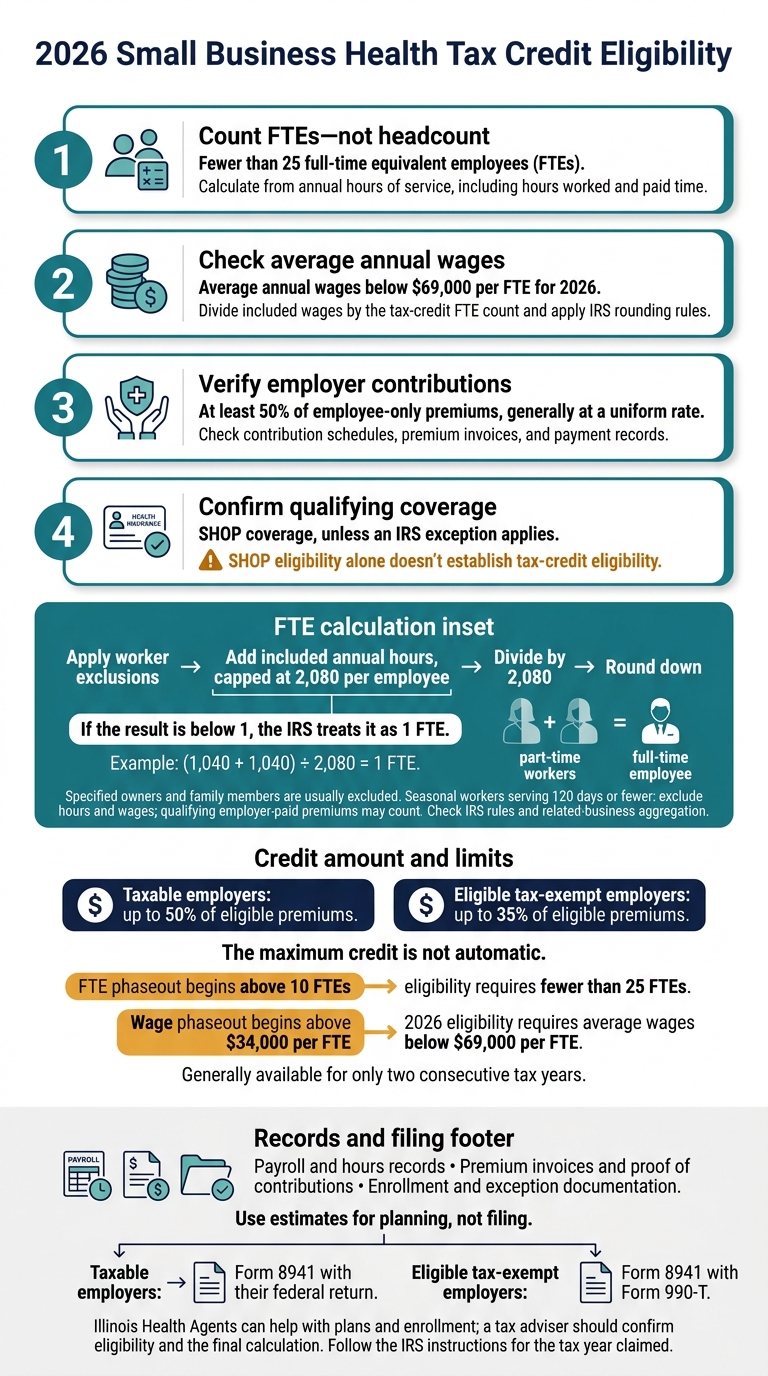
2026 Small Business Health Tax Credit Eligibility
IRS Form 8941 walkthrough (Credit for Small Employer Health Insurance Premiums)
Compare group health plans for your Illinois business. Our local, licensed agents shop the top carriers and send you side by side quotes at no cost.
Get Group Quotes
Which Employers Can Claim the Credit?
Taxable and eligible tax-exempt employers can qualify if they meet the federal tests.
The table below shows the four tests and the records to check for each. Use full-year payroll records to verify employee counts and wages.
| What is measured | General threshold | Documentation to review |
|---|---|---|
| FTEs | Fewer than 25 | Payroll registers, time records, hours-of-service reports, and employee classifications |
| Wages | Below the tax-year ceiling | Payroll journals, Forms W-2, and records identifying excluded owner compensation |
| Contributions | At least 50% of employee-only premiums | Billing and payment records, contribution policy, and payroll deductions |
| Coverage | SHOP coverage or an IRS exception | Enrollment confirmations, employee-offer records, waivers, and exception documentation |
How Do Tax-Credit and SHOP Eligibility Differ?
Qualifying for SHOP doesn’t mean you qualify for the tax credit. SHOP has broader rules. It generally requires employers to offer coverage to all full-time employees - usually those averaging at least 30 hours per week - but not to dependents or employees working fewer hours.
| Requirement | Tax-credit eligibility | SHOP eligibility |
|---|---|---|
| Employer size | Fewer than 25 FTEs | Generally 1-50 FTEs |
| Average wages | Below the tax-year ceiling | No comparable wage ceiling |
| Employer contribution | Generally at least 50% of employee-only premiums | No general federal minimum contribution to enroll |
| Coverage offer | SHOP coverage or an IRS exception | Offer coverage to all full-time employees |
What Wage and Premium Limits Apply?
To calculate average annual wages, divide included wages by the tax-credit FTE count and apply IRS rounding rules. For tax year 2026, average wages must be less than $69,000 per FTE. The credit begins phasing out above $34,000 per FTE.
The credit also decreases above 10 FTEs. Employer contributions generally must be a uniform 50% of employee-only premiums. Only employee-only premiums count toward this minimum, so check contribution schedules against invoices before relying on the credit.
What Can Make an Employer Ineligible?
An employer loses eligibility if it reaches 25 FTEs, reaches the wage ceiling, contributes too little, or uses non-SHOP coverage without an exception. Not offering coverage to all required full-time employees can also prevent SHOP enrollment.
Sole proprietorships, partnerships, S corporations, and nonprofits aren’t automatically excluded. However, owners and related individuals are usually excluded from the FTE, wage, and premium calculations. Separate their records before calculating eligibility.
If the employee count is close to the limit, use the FTE calculation to determine whether the employer qualifies.
How Is the Tax-Credit FTE Count Calculated?
After checking the wage and premium rules, calculate your FTE count.
Tax-credit FTEs depend on annual hours of service - hours worked and paid time - not headcount. Follow the IRS Form 8941 instructions for the tax year you’re claiming to check whether you fall below the 25-FTE limit. This count can determine whether you qualify for the credit.
How Are Hours Counted?
Add each included employee’s annual hours of service, counting no more than 2,080 hours per employee. Divide the total by 2,080, then round down. Include hours worked and paid time for vacation, holidays, illness, leave, jury duty, and military duty.
If the result is below 1, the IRS treats it as 1 FTE. You can also use consistent equivalency methods, such as 8 hours per qualifying day or 40 hours per qualifying week.
Hypothetical calculation: Two included employees with 1,040 hours of service each during the tax year contribute 2,080 combined hours. Their FTE count is (1,040 + 1,040) ÷ 2,080 = 1.
Which Workers Are Included or Excluded?
| Worker category | Hours and wages included | Employer-paid premiums included |
|---|---|---|
| Full-time employees, unless excluded | Yes; hours capped at 2,080 per employee | Yes |
| Part-time employees, unless excluded | Yes; hours count toward the FTE total | Yes |
| Seasonal workers serving 120 days or fewer | No; exclude wages and enter zero hours | Yes |
| Independent contractors | No, if correctly classified | No |
| Specified owners or family members | Excluded under IRS ownership and family rules | No |
Included premiums must meet the credit’s requirements. Qualifying seasonal-worker premiums may count even when those workers’ hours and wages don’t.
For seasonal workers, record employment dates, days worked, the seasonal nature of the job, and premiums paid. Use Form 8941 to verify contractor classifications and ownership and family exclusions. Check aggregation rules, too: related businesses may need to combine employees, wages, and credit amounts.
With your worker list set, check your records before enrollment.
How Can Illinois Employers Check Eligibility Before Enrollment?
Once Illinois employers confirm FTEs, wages, and contribution levels, they should check the plan’s enrollment path before coverage starts.
What Records Are Needed?
Gather payroll records, premium invoices, proof of employer contributions, carrier enrollment confirmations, and employee offer and enrollment records for the tax year being claimed. Keep projections separate from actual tax-year records.
Use these records to check whether the plan qualifies before enrollment.
How Is Eligibility Verified and the Credit Claimed?
Confirm the plan’s SHOP enrollment path, participation rules, and coverage effective date. Keep the carrier’s confirmation and enrollment documents.
The HealthCare.gov SHOP Tax Credit Estimator is for planning only. Final eligibility depends on tax-year records and the Form 8941 instructions.
Taxable employers claim the credit on Form 8941 with their federal return. Eligible tax-exempt employers file Form 8941 with Form 990-T.
How Can Illinois Health Agents Help?
Illinois Health Agents can review group plan options, explain SHOP enrollment requirements, and organize enrollment documents. A tax professional must confirm credit eligibility and the final Form 8941 calculation.
Conclusion: Check Eligibility Before Choosing Coverage
Before you enroll, check every eligibility requirement for the tax year: FTEs, wages, contributions, and SHOP coverage or a valid exception. Use FTEs - not headcount - in your calculations. SHOP enrollment alone doesn’t qualify you for the credit.
With your records in hand, review the phaseouts and two-year credit limit before counting on the credit. Follow the rules for the tax year you’re filing, document your calculations, and keep supporting records.
Use Illinois Health Agents for help selecting a plan and enrolling. Then have a tax adviser confirm your eligibility and Form 8941. File only after your adviser confirms the credit.
FAQs
How do midyear hires affect my FTE count?
Midyear hires increase your full-time equivalent (FTE) count by adding employee hours during the tax year. Track hours for every employee, including anyone hired partway through the year.
For part-time staff, add their monthly hours together and divide the total by 120. Each full-time employee who works at least 30 hours per week or 130 hours per month counts as one FTE. Average these monthly figures over the year to determine tax credit eligibility.
Can I pause the two-year credit period?
No. The Small Business Health Care Tax Credit is available for a maximum of two consecutive tax years. You can’t skip a year or pause that period and resume it later.
To get the most from the credit, keep accurate records and meet all eligibility requirements in both years. These include having fewer than 25 full-time equivalent employees and paying at least 50% of employee premiums.
How can I verify eligibility before enrolling?
Before enrolling, check your eligibility for the Small Business Health Care Tax Credit. To calculate full-time equivalents (FTEs), divide your part-time employees’ total weekly hours by 40, then add your full-time staff. Next, divide total annual payroll by your FTE count to find average annual wages.
Confirm that you pay at least 50% of employees’ self-only premiums and purchase your plan through the SHOP Marketplace. Illinois Health Agents can help you assess eligibility.
Recent Comments